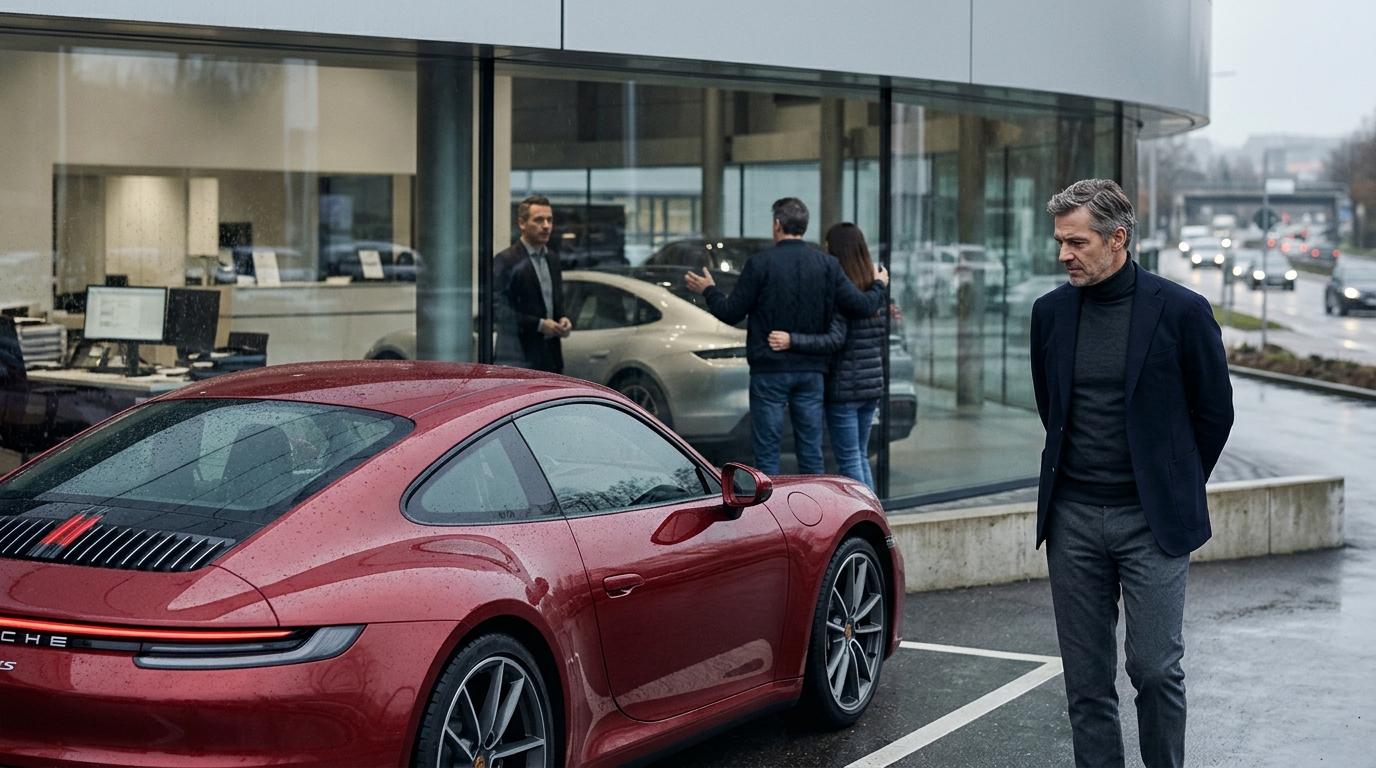
Hey there, bargain hunter. Porsche just handed you the first clean quarterly read on CEO Michael Leiters’ turnaround plan, and the number that matters most is not the one in the headline.
Scoreboard
Through nine months of 2026, Porsche posted revenue of €25.28 billion and operating profit of €1.74 billion, on an operating return on sales of 6.9%. Deliveries came in at 178,532 vehicles, versus 212,509 a year earlier. That is 33,977 fewer cars. Restructuring costs were roughly €500 million, down from €2.7 billion in the same period last year, which is the main reason profit looks so much better year-over-year. The company kept its full-year forecast for group sales revenue of €35 to €36 billion, an operating return on sales of 5.5% to 7.5%, and an automotive net cash flow margin of 5.5% to 7.5%.
What Actually Happened
Group revenue declined 5.9% year-over-year to €25.28 billion, but operating profit surged from €40 million to €1.74 billion, with return on sales expanding to 6.9% from 0.2%. That looks dramatic until you remember 0.2% was a restructuring-scarred disaster. The real comparison is against Porsche’s own history, when margins routinely sat above 15%. Against that standard, 6.9% is not a recovery. It is a work in progress.
Automotive revenue per vehicle rose to about €126,000, roughly €6,000 more than a year earlier, which is the strategy’s entire thesis in one line: sell less, charge more. The 911 was the standout, with deliveries up 12% to 42,217 units. That part is working. China is not.
The China Problem Is Not Temporary
Deliveries in China fell to about 21,500 cars in the first nine months of 2026, down roughly a third year-over-year. Porsche has said it is cutting its China dealer network toward about 80 locations by the end of 2026, from more than 100 in 2025. From nearly 100,000 cars at the start of the decade to a smaller niche: that is not a retreat, it is a reclassification of the market entirely.
The China retreat is not unique to Porsche. Jaguar Land Rover’s simultaneous restructuring shows how broadly European luxury brands are repricing their volume assumptions.
Is It Cheap?
This is where the bargain-hunter question gets sharp. Porsche at 6.9% operating margins is a very different asset from the 15%-plus machine that justified its 2022 IPO premium. The company targets an operating margin of 10% to 15% in the medium term. Getting there requires volume recovery or sustained price increases, and management has flagged 2027 as a trough year with lower volumes and weaker fixed-cost absorption. Ferrari, the brand Porsche most wants to emulate, runs margins north of 25%. The gap is vast.
Bull / Base / Bear
- Bull: Leiters re-engineers cost structure fast enough that margins reach 12%+ by 2028, the all-electric Cayenne gains traction in North America, and the 911 halo keeps average transaction values rising.
- Base: Margins hover in the 7% to 9% range through 2027, revenue stays flat as volume losses offset pricing gains, and P911 trades at a discount to historical multiples until a clearer earnings recovery is visible.
- Bear: Whether customers will accept higher prices is the strategy’s exposed flank. If US demand softens or tariffs bite further, prior-year tariff-related headwinds stop looking like a one-off and start looking like a recurring tax on margins.
Cheap Investor Checklist
- Operating return on sales: currently 6.9%; watch for progression toward the 10% lower bound of medium-term guidance
- Automotive revenue per vehicle: about €126,000 today; needs to keep climbing to justify volume losses
- China deliveries: watch whether the decline stabilizes as Porsche shrinks its dealer footprint toward ~80 locations by end-2026
- 911 delivery trend: up 12% through nine months; the one model line carrying margin quality
- Restructuring costs: down to ~€500 million from €2.7 billion; any reversal is a red flag
- 2027 outlook: management flagged a trough year; quantification of how deep matters more than the warning itself
- Automotive net cash flow margin: watch full-year progress versus the 5.5% to 7.5% forecast that Porsche raised after closing the Bugatti Rimac and Rimac Group stake sale in September 2026
Bottom Line
If Leiters can push operating margins back above 12% while holding average selling prices near €126,000, P911 becomes genuinely interesting at current levels. If 2027 proves as difficult as management signaled and China keeps shrinking, you are holding a luxury brand running mass-market margins with a premium valuation attached. The nine-month figures are better than last year, but last year was a wreck. The harder question is whether they are good enough for the price you are paying today.