October 21, 2026
Bonus Content: Gulf Keystone Is Buying 323 Million Barrels for Less Than $2 a Barrel
Companies worldwide are on track to spend $308 billion on cybersecurity this year. But very few small cybersecurity firms get the chance to secure the most coveted contracts with the federal government. They require a stack of credentials that takes years and real money to assemble.
CYBR, a private-stage cybersecurity company, already has them. With a HUBZone certification, CMMC certification, and federal contracts with the Department of Homeland Security, Department of Defense, and many more, this AI security company has access to rooms most of its peers cannot enter. And you can own a piece of it.
Their revolutionary CYBRscan platform finds the “threat needle in the cyber haystack” that catches malware nobody has seen before. While most traditional platforms can only identify previously logged threats, CYBR’s is one of the few platforms capable of detecting never-before-seen threats.
They’ve even reserved their Nasdaq ticker CYBI, preparing for potential growth. Become an early-stage CYBR shareholder today at $1/share and get up to 20% bonus shares if you invest before the 10/23 deadline.
Gulf Keystone Is Buying 323 Million Barrels for Less Than $2 a Barrel
Hey there, bargain hunter. Two Iraqi Kurdistan oil producers just agreed to merge, and the headline number is striking enough that it deserves a proper look: $601 million for 323 million barrels of proved and probable reserves. Do the arithmetic and you get roughly $1.86 per barrel of 2P reserves acquired. In a world where global M&A comps for producing barrels regularly run $8 to $15 per barrel, that is a discount that would make any value investor sit up.
The question, as always with Kurdistan, is whether cheap means opportunity or whether it means the market is correctly pricing something you cannot hedge away.
Scoreboard
Gulf Keystone Petroleum announced on Tuesday, October 20, 2026 that it would merge with Norway’s ShaMaran Petroleum in an all-share, roughly 50-50 deal, valuing ShaMaran’s equity at about $601 million.
The exchange ratio delivers a 22.9% premium over ShaMaran’s closing price on October 19, 2026, rising to 28.6% and 32.2% against the stock’s 30-day and 90-day volume-weighted average prices, respectively. Gulf Keystone’s current shareholders are also in line for a $50 million special dividend on completion.
The merged company is expected to have a market capitalisation exceeding $1 billion, with estimated working-interest production of 53,000 barrels per day and proved and probable reserves of 323 million barrels.
Both companies’ boards have unanimously endorsed the merger, with shareholder meetings scheduled on or around December 22, 2026 and completion expected mid-2027.
What the Business Actually Is
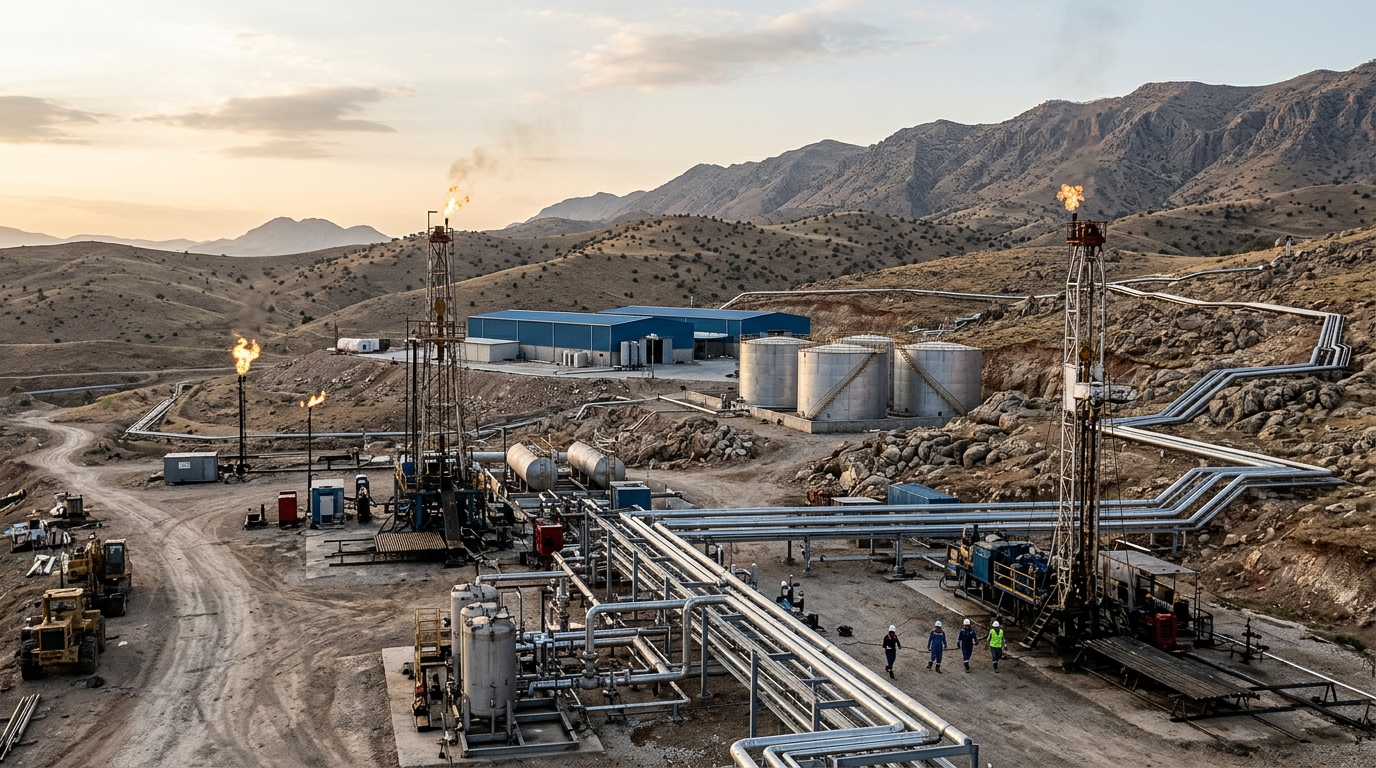
The merger combines Gulf Keystone’s Shaikan field with ShaMaran’s interests in the Atrush and Sarsang fields, alongside its planned investment in the Hamrin field in federal Iraq.
Gulf Keystone’s core asset is the Shaikan field in Duhok, one of the KRI’s largest producing fields, where output recently returned to around 40,000 barrels per day. The field holds estimated gross proved and probable reserves of 416 million barrels.
The merged company will integrate Gulf Keystone’s operated 61.5% working interest in Shaikan with ShaMaran’s non-operated stakes in the Atrush field (50% working interest) and Sarsang field (18% working interest), both located in Kurdistan. ShaMaran also disclosed a new investment in a 25% holding in HKN Hamrin, adding further reserve and resource potential.
The combined group has the potential to reach 100,000 barrels of oil per day through development of the Shaikan and Hamrin fields. That would make this a genuine growth vehicle, not just a consolidation play.
The Real Reason Kurdistan Always Looks Cheap
The $1.86-per-barrel implied acquisition cost is not an accident. Kurdistan assets have traded at persistent discounts to global peers because getting paid is genuinely hard.
The Kurdistan Regional Government has said it has received only a fraction of the federal transfers it believes it is entitled to under Iraq’s budget law, and multiple outlets and regional research publications have put outstanding payments owed to international oil companies operating in the region at around $1 billion.
The pattern is consistent: Baghdad uses legal ambiguity and fiscal pressure to reassert control over Kurdistan’s oil revenues; Erbil insists on predictable transfers to meet its payroll and other obligations; and the absence of a fully functioning export route leaves the KRG with limited leverage.
This is the discount engine. Not geology. Not production risk. Payment risk.
Is It Cheap?
- $601m for ShaMaran’s equity, combined market cap over $1bn post-merger
- 323 million 2P barrels at working-interest level across four fields
- Implied acquisition cost: ~$1.86/barrel on 2P reserves
- 53,000 bopd pro-forma production; $1bn market cap implies roughly $18,900 per flowing barrel
- Oslo relisting targets a Nordic investor base more comfortable with Kurdistan names like DNO
On pure reserve math, these barrels are priced for payment disruption. The Oslo move is not cosmetic. Gulf Keystone says it plans to move its primary listing to Euronext Oslo Børs‘ main market and, in due course, discontinue its London listing. DNO, the Norwegian major with deep Kurdistan exposure, trades at a structurally tighter discount than its London-listed peers. Management is betting Oslo’s market re-rates the combined entity closer to Nordic comps.
The Lundin family, which holds about 25.6% of ShaMaran, and Lansdowne Partners, managing about 13% of Gulf Keystone, have indicated they intend to vote in favour. With the two largest shareholders already on board, this deal closes unless something fundamental breaks.
Bull / Base / Bear
Bull: Baghdad-Erbil payments normalise, the Iraq-Turkey pipeline runs near capacity, and the Oslo listing compresses the reserve discount toward $4 to $5 per barrel. At that rate, these barrels are worth multiples of today’s price.
Base: Payment delays persist but stay manageable. The combined 53,000 bopd generates enough cash to sustain distributions, and the scale of the merged entity attracts institutional capital previously locked out by liquidity constraints.
Bear: Baghdad shortfalls deepen, the ITP runs below capacity again, and the merged group carries the same discount it inherited from its two predecessors. Scale does not cure a sovereign payment problem.
The bull case here is inseparable from where Brent trades over the next two years. At Brent above $100, the front-month backwardation signals real supply tightness, which is the environment that makes discounted producing barrels worth owning rather than avoiding.
Action Plan
This is not a trade for someone who needs predictable quarterly cash flow. It is a position for a bargain hunter willing to hold through political noise for a payoff that is mathematically large if Kurdistan’s export and payment situation continues its gradual improvement.
If you want exposure: scale in slowly before the late-December 2026 shareholder votes. The Oslo relisting is your re-rating catalyst. Watch Baghdad’s monthly transfers to Erbil as your primary risk indicator. If those stabilise above 50% of owed amounts, the discount narrows. If they slip back toward the roughly 41% level the KRG has cited for 2023-2025 entitlements, the discount widens further.
Trim or avoid if you cannot stomach a complete halt to exports, which has happened before and could happen again.
Cheap Investor Checklist
- Combined 2P reserves: 323 million barrels confirmed
- Pro-forma production: 53,000 bopd at merger close
- Implied reserve cost: ~$1.86/barrel (watch for re-rating post-Oslo)
- ShaMaran premium at announcement: 22.9% to prior close
- GKP special dividend: $50 million payable on completion
- Shareholder vote date: on or around December 22, 2026
- Expected close: mid-2027
- Key risk gauge: Baghdad monthly budget transfers to KRG
- Re-rating catalyst: Euronext Oslo primary listing completed
- Growth target: 100,000 bopd long-term via Shaikan and Hamrin development
Bottom Line
If Kurdistan’s payment environment holds and the Oslo listing attracts a new investor class, GKP’s combined barrels are being acquired at a discount that looks absurd in hindsight. If Baghdad-Erbil relations deteriorate again, the discount is a warning label, not an opportunity. The math is compelling. The geopolitics are the job.