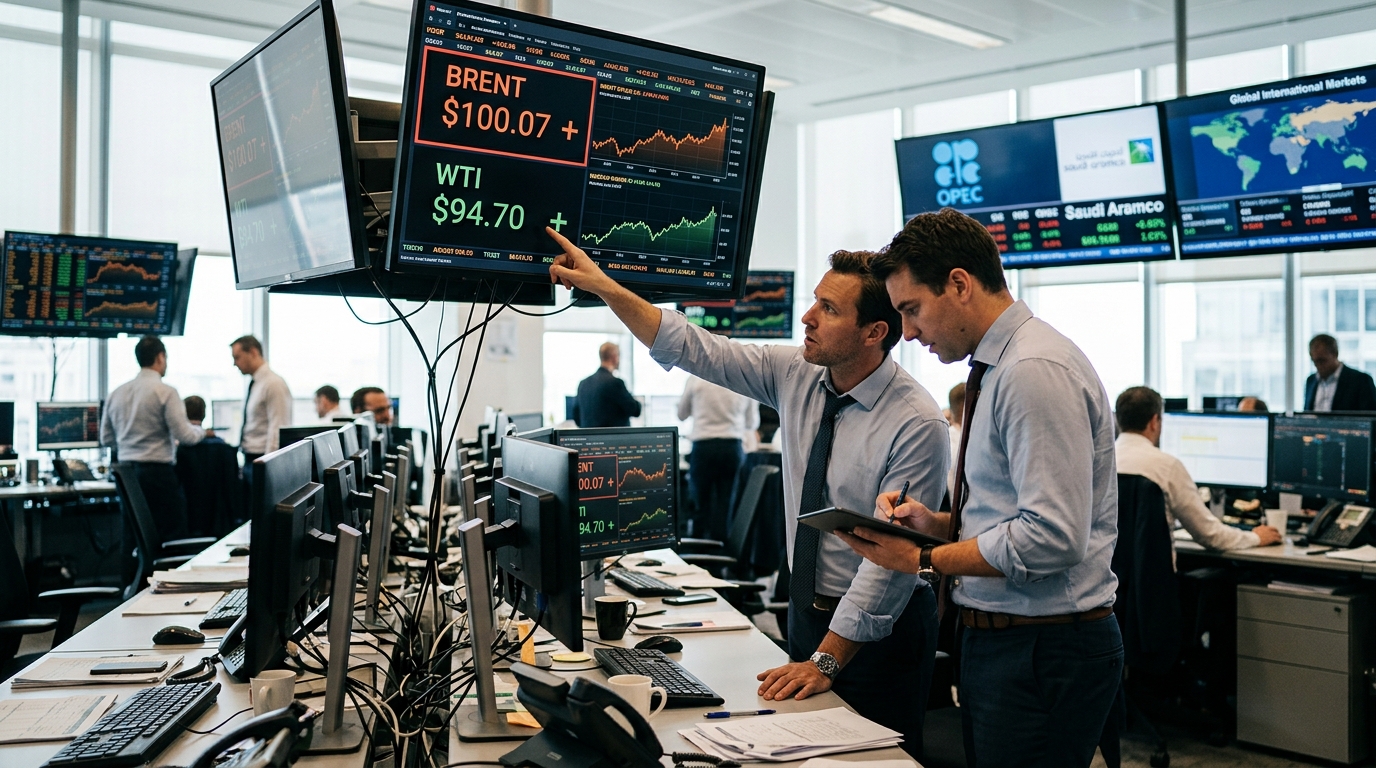
Brent crossed $100 a barrel in overnight trading Wednesday for the first time since July 24, touching roughly $100.07. Oil prices surged after attacks on Saudi energy facilities compounded fears of escalating hostilities. WTI followed, adding more than 3% to trade near $94.70. This is Brent’s fourth consecutive up session and a roughly 25% rally off August lows.
The Houthis claimed responsibility for targeting energy facilities in Saudi Arabia’s southern region, including the 400,000-barrel-a-day Jazan refinery and other sites serving the domestic market. Saudi Arabia’s Energy Ministry said the attacks caused fires and temporarily halted some operations, with field teams working to contain the blazes and assess damage. That detail separates Tuesday’s barrage from last week’s U.S.-Iran tanker exchange near Hormuz. The target is now fixed Gulf production and refining infrastructure, and a second front has reopened in Yemen.
Why the Curve Matters More Than the Headline
WTI and Brent futures have pushed front-month crude into backwardation. The curve is telling you the market believes supply tightness is real and immediate. Deferred contracts pricing toward the low $60s by the early 2030s say the market also believes it eventually resolves. Trade the front, not the back.
Where Capital Is Moving
The U.S. energy sector has outperformed in 2026, driven primarily by geopolitical-related supply fears and elevated oil prices. XLE traded between $64.31 and $65.24 on Tuesday, with volume of about 28 million shares running above its recent average. That is institutional participation, not retail momentum chasing.
The more interesting distinction is inside the energy complex. Refiners including Valero (VLO) and Phillips 66 (PSX) have been major winners as U.S. crack spreads surged. On September 1, Wells Fargo raised its price target on VLO to $389 and on PSX to $335, reaffirming Overweight ratings on both, signaling the bank sees the current refining upcycle lasting longer. The Jazan disruption tightens refined product supply globally, which is precisely the environment where VLO and PSX capture margin on both the crude input and the product output side.
Upstream producers tell a cleaner story. Chevron reported Q2 2026 adjusted EPS of $6.06 on revenue of $67.20 billion. OXY in particular carries operational leverage to crude that XOM and CVX, with their integrated structures, partially offset. When Middle East risk premiums returned, CVX and XOM lifted at the open. OXY tends to move harder.
The Trade and the Risk
The highest-conviction position right now is long XOP as a clean expression of rising crude, paired with individual exposure to VLO or PSX where crack spreads are extending the move. XLE works as a broader hedge but its top two weights, XOM and CVX, dilute the upside. If you want the energy trade, own the parts of the value chain actually capturing the supply disruption.
Key levels: Brent holding above $98 on any intraday pullback confirms institutional support. A failure back below $96 would suggest the $100 break was a spike rather than a floor.
The primary risk is not modest. Goldman Sachs warned in recent research that Brent could exceed $120 if Gulf output remains materially below prewar levels, though that is not the bank’s base case. A credible deal announced over any given weekend could trigger a $5 to $8 intraday drop in Brent before physical supply data catches up. A ceasefire in the Gulf that holds would push crack spreads sharply lower and take the refiners with it. Position size accordingly. The thesis is strong; the reversal, if it comes, would be fast.
Watch for any Saudi damage assessment on Jazan capacity. That data point will determine whether $100 is a ceiling or a base camp.