
September 9, 2026
A supply problem in one small segment crushed the stock. Here is how to decide whether the sale is real.
Editor’s Note: In 2016, our friend Louis Navellier recommended Nvidia at $2.51 – split-adjusted. It went up 44,000%. He also called Apple before a 36,000% rise and Microsoft before a 60,800% climb. Now he says a new AI infrastructure project coming online in Tennessee is the setup for the most significant call of his career. He’s agreed to reveal the stock at the center of it — down to the ticker — at no charge.
Dear Reader,
In 2016, I sent my readers a simple recommendation.
Buy Nvidia… at $2.51, split-adjusted.
What happened next is now well-documented market history.
Nvidia went up 44,000%.
Investors who acted were well-positioned for what followed.
Those who didn’t have been watching from the sidelines ever since.
I’m writing today because I believe the structural conditions are setting up to rhyme.
Right now, behind a secured perimeter in the mountains of Tennessee…
At the same federal research facility that developed the Manhattan Project in 1945…
American scientists are completing work on a new AI computing system called “Golden Dawn.”
Golden Dawn is projected at 283 trillion times the processing capacity of today’s leading data centers.
Its infrastructure footprint will span more than 700 miles — larger than the state of Texas.
And its design targets an acceleration of AI development timelines by a factor the project team describes as compressing five years into five days.
At launch, it would leapfrog the current generation of AI models — ChatGPT, Gemini, Grok — in a single step.
And it stands to trigger what I’m calling a $100 trillion reallocation across AI-exposed markets.
I’ve identified one company — still largely under-covered, much as Nvidia was in 2016 — that I believe is best positioned for what’s coming.
I’m revealing it, down to the ticker, in a new presentation available at no charge.
This is the most consequential call of my 40-year career.
Watch the full presentation here, at no charge.
Regards,
Louis Navellier
Senior Quantitative Investment Analyst, InvestorPlace
P.S. Readers who entered Nvidia at $2.51 — split-adjusted — didn’t need another move. They were set. I believe “Golden Dawn” presents a comparable structural setup: a largely under-covered company, a significant technological inflection, and a narrow window before broader market awareness builds. Go here for the full details, including the ticker.
Stryker Lost 8% on a Factory Glitch. The Core Business Is Fine.
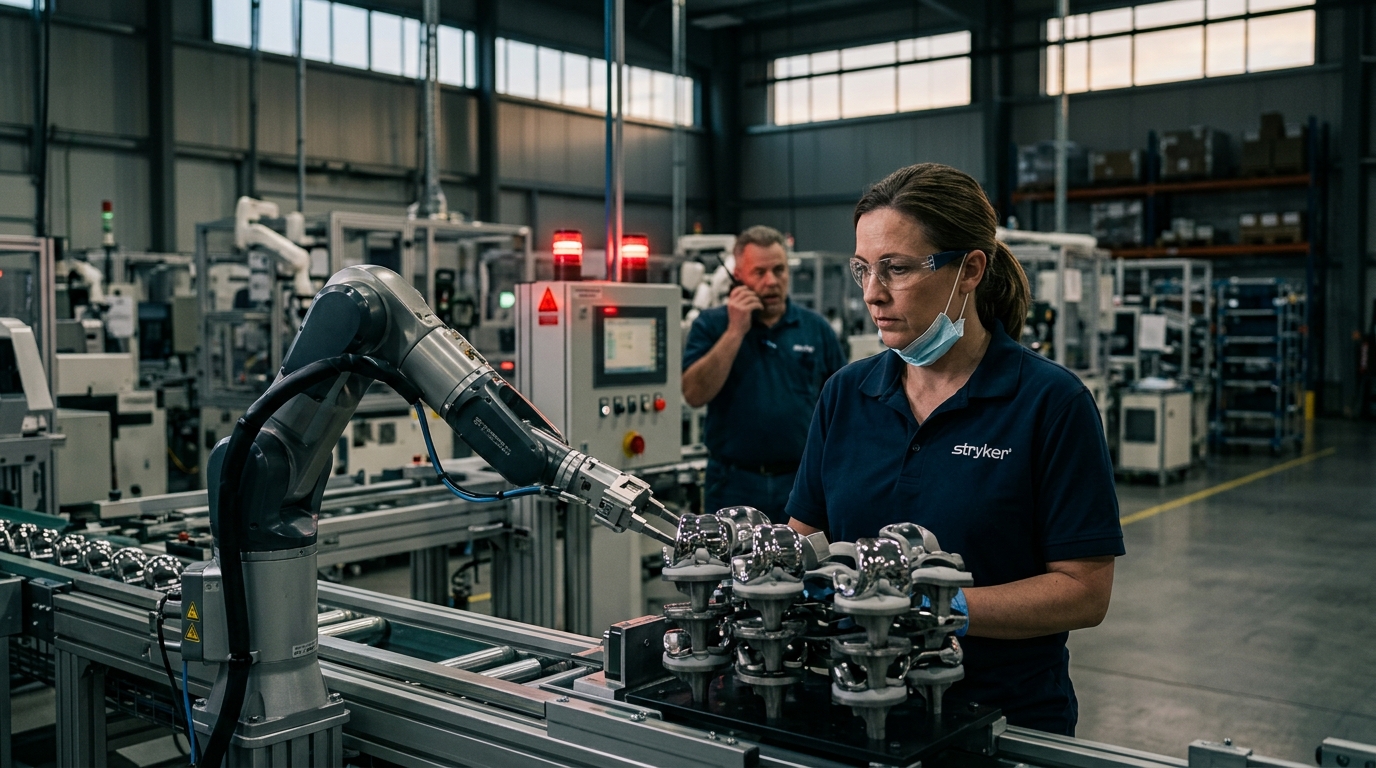
Hey there, bargain hunter. Stryker just handed you a 52-week low and an 8% single-day drop on a Tuesday in September. The question worth asking is not whether the news is bad. It is. The question is whether the factory problem the market is pricing in tells you anything new about the business you would own for the next decade.
Pilots Use One. Smart Traders Should Too.
A pilot never takes off without running a checklist. Not because they don’t know how to fly – because they know that the moment something feels routine is the moment a step gets skipped.
Options trading punishes skipped steps faster than almost anything else. So, I put the 7 that matter most on one page.
It’s called the Smart Trade Options Checklist. Normally $29.97. Free today.
Run it before any options trade. Takes about 30 seconds. You’ll catch the bad ones before they cost you.
Scoreboard
Stryker shares fell as much as about 8.8% on September 8, 2026, hitting a 52-week low near $275.10 intraday. The stock is now down roughly 21% year to date. Zimmer Biomet, a direct orthopedic peer, also dropped in sympathy in the same session despite no company-specific news of its own.
What Actually Happened
CFO Preston Wells appeared at the Wells Fargo 21st Annual Healthcare Conference and said manufacturing constraints in the peripheral vascular business are still preventing the company from reaching full inventory supply at customer accounts. The company had originally expected the issue to clear in Q3. Wells told the conference it now extends into Q4. He also flagged that joint replacement trends, particularly in hips and in Europe, had been softer than seasonal expectations, though he said the company was anticipating a better September.
The supply drag in peripheral vascular is quantified: 70 to 80 basis points of headwind to organic growth in Q2, with a similar impact expected in Q3, and Q4 still under review. That is not a rounding error, but it is also not the whole company. Capital equipment and trauma and extremities are performing well and are actively offsetting the weakness.
An under-covered ticker Larry Benedict says is positioned for the next market move.
It doesn’t appear on any top-100 watchlist.
Search volume is minimal, and most institutional coverage has passed it by.
But when one specific sector begins to reprice, this under-covered ticker tends to draw significant interest from active traders.
Larry Benedict believes a White House policy shift could soon act as a catalyst for that sector, opening a series of potential entry points.
He’s now sharing the ticker at the center of his analysis, at no cost.
The Business, in Plain English
Stryker makes three kinds of things: orthopedic implants (hips, knees, the Mako robotic surgical system), medical and surgical equipment (beds, cameras, stretchers), and neurotechnology and spine devices. Peripheral vascular, the troubled unit, sits within the MedSurg and Neurotechnology segment. Alongside its customers around the world, Stryker says it impacts more than 150 million patients annually, and Mako procedures have topped 2.5 million across 47 countries.
Revenue for Q2 2026 was $6.6 billion, up 10.2% year over year. Organic sales grew 9.0%. Adjusted EPS of $3.69 was up 17.9%. Adjusted gross margin came in at 66.0%, up 60 basis points. The Mako robotic platform posted its best-ever Q2 for installations globally, and Stryker has now surpassed 2.5 million Mako procedures worldwide. The company held $3.5 billion in cash and marketable securities at quarter-end, with an elevated backlog and no reported order cancellations.
Is It Cheap?
At the current price near $277, the forward multiple on the company’s full-year adjusted EPS guidance of $14.95 to $15.10 works out to roughly 18 to 19 times forward earnings. A stock that has historically carried a premium multiple now trades at a meaningful discount to its recent levels, on a supply problem confined to one sub-segment while the core robotics and capital equipment franchises are still growing.
Zimmer Biomet’s peer contagion drop is worth noting for a different reason: ZBH was already carrying its own baggage, including cautious full-year guidance earlier this year. This move looks like the market extrapolating Stryker’s factory problem across the whole orthopedic sector, which is a cleaner buying opportunity in SYK than it is a new fundamental concern in ZBH.
When a U.S. ally tried to tax ONE American energy company…
Trump didn’t hesitate to issue a direct warning.
Now this same company is generating over $3 billion in operating income…
And partnering with the hottest AI stock on Wall Street.
Out of 23,281 publicly traded stocks, this is the ONLY one that meets all the “unicorn” criteria.
Bull / Base / Bear
- Bull: Supply resolves by Q1 2027, Mako RPS gains traction in ambulatory surgery centers, capital equipment backlog converts cleanly. The stock re-rates toward its historical premium multiple on $15-plus EPS, implying a price well above $500 over a two-year horizon.
- Base: Peripheral vascular supply drags through early 2027, joint replacement stays sluggish in Europe. Organic growth comes in at the low end of guidance around 8.3%. The stock recovers to the mid-$300s as the discount narrows.
- Bear: Manufacturing issues prove harder to fix than disclosed, cybersecurity remediation costs exceed estimates, and a second operational disclosure forces guidance down again. The stock retests or breaks below $270.
Action Plan
This is a quality compounder with a factory problem, not a demand problem. Patients still need hip and knee replacements. Hospitals are still ordering Mako systems. The peripheral vascular drag is roughly 70 to 80 basis points on a business growing at 9%. If you have conviction in the long-term robotics and implant thesis, the current price is a scaled entry point, not a binary bet. Consider a first tranche near current levels, with a second tranche reserved if the stock tests $260 to $265 on any further negative conference commentary this fall. Avoid sizing aggressively into Q3 earnings, which will likely confirm the vascular headwind before showing any recovery evidence.
Cheap Investor Checklist
- Peripheral vascular supply: does CFO signal resolution at Q3 earnings (October)?
- Joint replacement trends in September: management said it is anticipating seasonal improvement this month.
- Mako RPS commercial launch uptake in ambulatory surgery centers through year-end.
- Capital equipment backlog conversion rate in H2 2026.
- Full-year adjusted EPS landing above $14.95 without further guidance cuts.
- Cybersecurity remediation costs: watch for any additional disclosure beyond Q2 figures.
- ZBH and BSX price action as sector sentiment indicators into Q3 earnings season.
- Insider buying: monitor Form 4 activity for any reversal from net selling.
Bottom Line
If the supply issue clears and Mako momentum holds, SYK at $277 will look like an obvious entry in hindsight. If the factory problems are deeper than Wells disclosed at the conference, there is more downside from here. The business itself, strip out one constrained sub-segment, is growing at 9% organically with record robotics installations and a clean balance sheet. That is not a broken company. Scale in carefully, keep a cash reserve for Q3 earnings, and watch the vascular commentary like a hawk.