Dear Reader,
Elon Musk just made a shocking prediction.
He said 99% of compute long-term will be for a new kind of AI.
And one tiny company holds 150 patents on the tech that makes it possible.
OpenAI, Microsoft, IBM, AMD, and Amazon have all signed multi-billion-dollar deals with the little-known company.
And I believe this company is in a similar position to Nvidia…
When I recommended it in early 2016…
Before it soared 37,800%…
And gave my readers the chance to turn $5,000 into $1,895,000.
If this stock goes the same way, which I believe it will…
It could be the only stock you need to retire.
Click here to see all the details
Jeff Brown
Founder & CEO, Brownstone Research
P.S. Don’t delay, I believe this company is about to announce its biggest deal ever on November 11. Click to get all the details before it’s too late.
Pepsi Just Lost KFC. Is the Stock Cheap Enough to Care?
Hey there, bargain hunter. Pepsi just got dunked on. Again.
Scoreboard
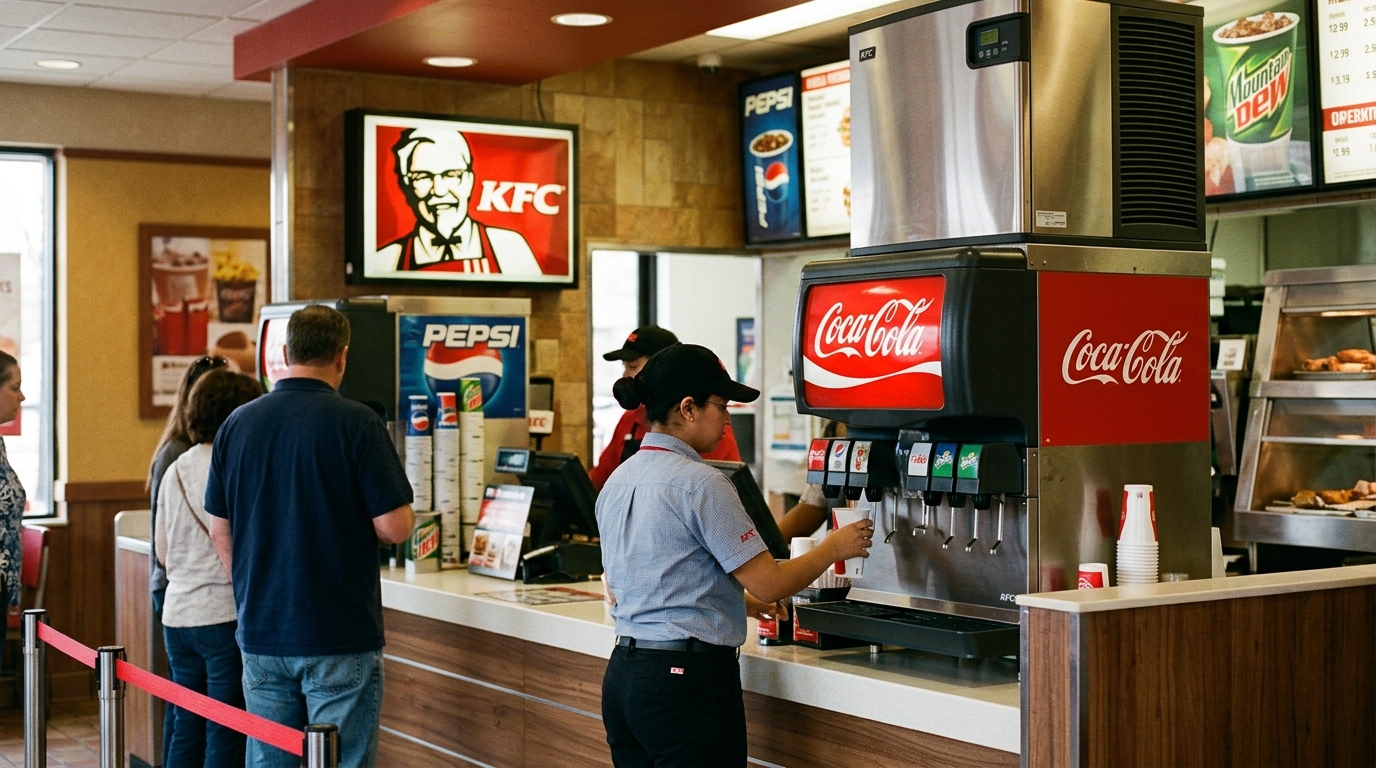
KFC U.S. is making the switch from Pepsi to Coke after a nearly 40-year exclusive partnership. Beginning in January 2027, KFC will transition its U.S. beverage partnership, with Coca-Cola products expected to be served in all restaurants by spring 2027. That covers 3,718 U.S. locations.
What Actually Happened
The move ends a nearly 40-year relationship that began when PepsiCo acquired KFC in 1986. PepsiCo separated its restaurant businesses from the company in 1997 but continued supplying beverages to KFC under its parent company, Yum Brands. KFC is framing this as a comeback play: the chain described the Coca-Cola deal as part of its “Kentucky Fried Comeback” plan, working to regain American customers it has lost to competitors like Chick-fil-A and Popeyes.
PepsiCo is not walking away empty-handed. Reuters reported that a PepsiCo spokesperson confirmed that Yum Brands and PepsiCo have renewed agreements covering Taco Bell and KFC International stores, with the Taco Bell agreement running 10 years. But the U.S. KFC account is gone, and it is the third high-profile loss in a short run.
Yum Brands is the counterparty in every contract renewal PepsiCo is counting on. Yum’s own stock has faced pressure from a separate food-safety investigation that hit Taco Bell directly, which matters for anyone modeling how durable that 10-year Taco Bell agreement actually is.
The Pattern
This is not a one-off. Marriott International has confirmed that it is replacing PepsiCo with The Coca-Cola Company as its exclusive global beverage provider, ending a partnership in place since 1992. Pepsi also lost Costco’s food court after about a decade. Arby’s moved from Pepsi to Coke in 2018. Culver’s followed in 2023. Costco moved its food courts back to Coke.
Evercore ISI’s Robert Ottenstein estimated PepsiCo’s lost KFC revenue at about $50 million a year, implying the chain sells roughly $350 million to $400 million of drinks at retail. That is not catastrophic on a roughly $92 billion revenue base. But he argued the loss matters more than its size, because fast-food chains lean on beverages to drive traffic in a way hotels do not.
Is PEP Actually Cheap?
Here is where it gets interesting for bargain hunters. Coca-Cola stock is up about 30% year-to-date, outperforming PepsiCo’s roughly 23% decline. That performance gap has carved out a valuation spread you rarely see between two Dividend Kings.
- KO trades at roughly 27x forward earnings versus PEP around 15x.
- Coca-Cola’s operating margin is in the mid-30% range lately, roughly double PepsiCo’s mid-teens level.
- Forward dividend yields sit around the mid-2% range for KO and roughly the low-4% range for PEP.
- PepsiCo also faces weakness in its snacks business and pressure from an activist investor.
Bull / Base / Bear
Bull: PEP at 15x forward earnings prices in a lot of bad news. Taco Bell, Subway, and international KFC stay in the fold. Frito-Lay still dominates salty snacks, and a reset year clears the deck for an earnings recovery in 2027.
Base: Coca-Cola has the bigger share of the U.S. carbonated soft drink market, and that gap keeps widening slowly. PEP grinds sideways as snack volumes recover and beverage losses are absorbed. Dividend grows, stock does not.
Bear: The account losses are a signal about brand equity, and the signal compounds. More chains follow KFC. The activist pushes for a snacks spinoff that destroys value. The 4%-plus yield becomes a trap, not a floor.
The fast-food competitive landscape is shifting faster than beverage contracts alone can explain. Wendy’s losing its number-two ranking while cutting its dividend shows how quickly brand equity erosion translates into financial deterioration, the same mechanism the bear case assigns to PepsiCo.
Cheap Investor Scorecard
- Forward P/E (PEP): 15x vs. KO around the high-20s. Discount is real.
- Dividend yield (PEP): 4.2%+. Covered by free cash flow.
- Revenue base: roughly $92B. KFC loss is less than 0.1% of that.
- Taco Bell contract renewed for 10 years. Anchors away-from-home volume.
- Snacks: Frito-Lay still the dominant U.S. salty snack brand. Watch volume trends each quarter.
- Activist pressure: monitor for portfolio restructuring announcements.
- Account losses: if Subway or Taco Bell wobble, the thesis breaks.
Bottom Line
If you believe the account losses are noise around a structurally sound snacks-and-beverages business, PEP at 15x forward earnings is a legitimate value with a 4%-plus dividend while you wait. If you believe the losses signal a brand in secular decline, that multiple still has room to compress. Watch Taco Bell. Watch snack volumes in Q3. The discount to Coke is real. Whether it is compensation or a warning depends on which account goes next.