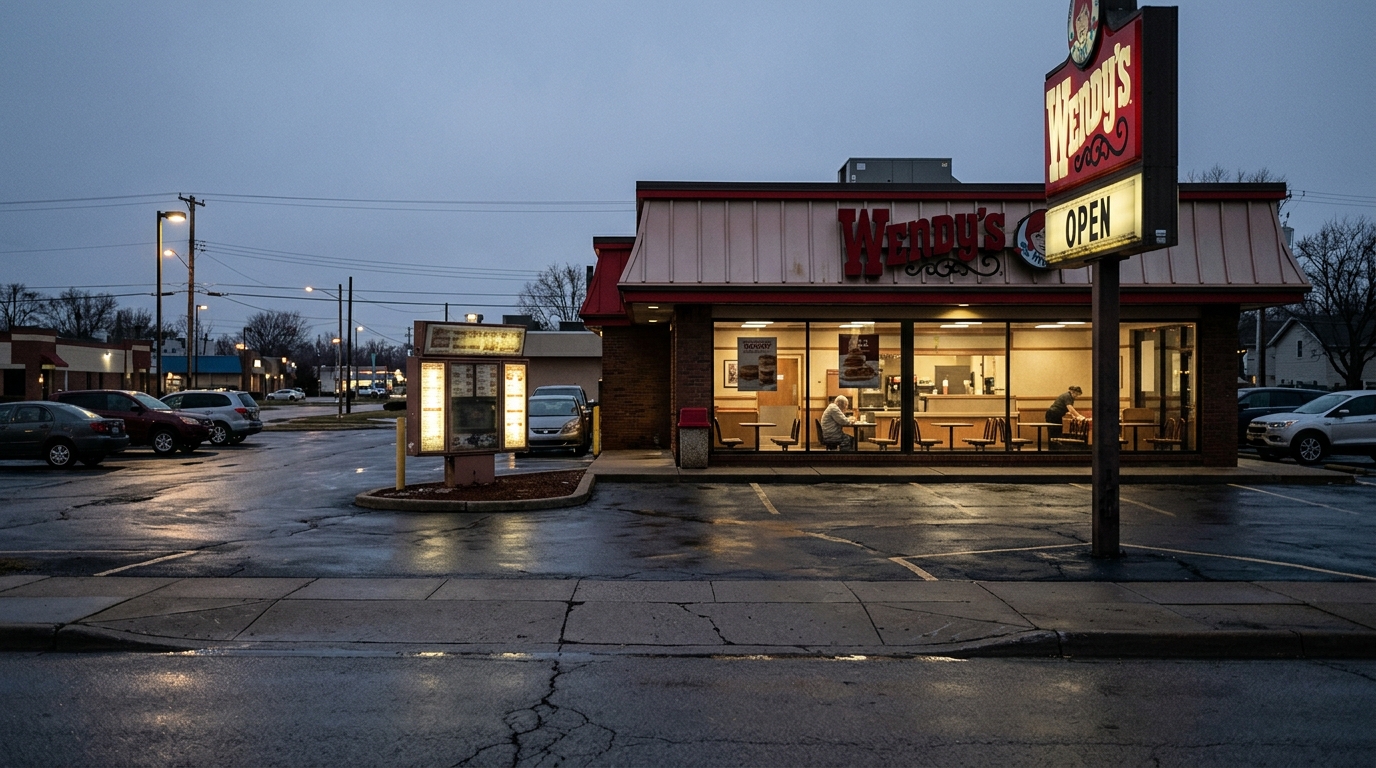
This is not a story about restaurant closures. It is a story about what happens when a brand loses the thread entirely, and the closures are the symptom, not the disease.
On August 7, Wendy’s reported Q2 2026 results that management characterized as a beat versus lowered expectations on revenue and earnings per share. The stock fell anyway. New CEO Bob Wright halved the quarterly dividend from $0.14 to $0.07 per share, withdrew the company’s full-year financial guidance, and opened his first earnings call by telling analysts: “Today we are clearly not performing at our potential.” That sentence, unvarnished and direct, is both the most honest thing Wendy’s has said in two years and the clearest sign of how deep the hole is.
The same week, Burger King reported strong U.S. same-store sales growth for Q2. Wendy’s reported a U.S. same-store sales decline and extended its streak of contraction. The competitive ordering is shifting. Whether that means Wendy’s has definitively ceded the No. 2 slot depends on the dataset, but the direction is clear: Wendy’s is losing ground in its core category while a direct rival is gaining it.
The numbers, the leadership reset, and the system pullback are all happening simultaneously. For traders, that convergence creates a defined set of scenarios. None of them are simple.
The Q2 Numbers: What the Beat Hides
On the surface, Q2 2026 looked survivable. Wendy’s reported revenue of roughly $571 million, and adjusted EPS that came in ahead of consensus by a few cents. Adjusted EBITDA was also modestly above expectations. Those are clean beats on the headline metrics, all above what a demoralized sell-side had modeled.
Below those lines, the destruction is systematic. Wendy’s reported a 7.0% U.S. same-store sales decline. Global systemwide sales also declined on a constant-currency basis. Profitability and margins were weaker year over year, and restaurant-level pressure remained visible. The overarching pattern did not change: the model is absorbing volume losses while trying to defend the income statement through costs.
The traffic number is the one that demands attention. Wendy’s reported a double-digit decline in U.S. customer visits in the quarter. That is not a pricing problem. That is not a commodity problem. A double-digit traffic decline means fewer Americans are choosing Wendy’s, and that choice is being made actively, not by accident. Management flagged continued pressure among lower-income consumers, but the breadth of the traffic loss suggests the problem extends beyond one demographic.
For the first half of 2026, free cash flow improved versus the prior-year period. The dividend cut and the pause on share repurchases contributed to that improvement. It is preserved liquidity for a turnaround, not evidence of an underlying business inflecting upward.
Strategic Interpretation: What the Market Priced, What It Got
Coming into Q2, the Street had already capitulated on expectations. Consensus models assumed roughly flat year-over-year revenue and materially lower EPS versus the prior year. Same-store sales expectations for the global system were already negative. The actual U.S. decline was worse than what many models had embedded.
What the market got was a beat on the income statement paired with a continued deterioration in underlying traffic. That combination, beats-on-margins plus a worsening top-line, is the most dangerous quarterly read for a consumer-facing franchise model. Royalty revenues depend on franchisee sales volumes. When those volumes keep shrinking, no amount of G&A discipline saves the income statement permanently.
The guidance withdrawal tells you everything about what management itself believes. Wendy’s previously provided a 2026 outlook that included roughly flat global systemwide sales and adjusted EBITDA and EPS ranges. All of that is now off the table. Wright needs time to evaluate the business, as the company put it, which is a way of acknowledging that the prior plan was built on assumptions that no longer hold.
Compare this to Wendy’s Q4 2025 results, when interim CEO Ken Cook disclosed an 11.3% U.S. same-store sales decline. That number helped trigger the more aggressive closure and optimization messaging. Q2’s 7.0% decline is an improvement over Q4 in percentage terms, but the cumulative damage to franchise economics has now run multiple quarters deep.
The Closure Math: 600 Restaurants Gone in Two Years
The restaurant closure program is the most misunderstood part of this story. Management frames it as “system optimization,” which is accurate as far as it goes. The company is closing underperforming units, concentrating resources on higher-traffic locations, and giving franchisees the ability to invest more in their remaining restaurants. That logic is sound.
The scale is the problem. Wendy’s disclosed that 28 U.S. restaurants closed in Q4 2025 and that it ended 2025 with 5,969 U.S. locations. It also said it expected approximately 5% to 6% of U.S. restaurants to close in the first half of 2026, including those 28 Q4 closures, implying roughly 298 to 358 closures in total under that expectation. By the end of Q1 2026, Wendy’s reported 5,805 U.S. restaurants, consistent with a net decline versus late 2025. Add in the roughly 240 U.S. closures the company referenced from 2024, and the two-year figure is plausibly in the “hundreds”. But the exact “roughly 600” total depends on how you define the program window and whether you net openings against closures.
Every closure takes revenue off the top line. It removes royalty income, reduces advertising fund contributions, and shrinks the system leverage that makes QSR brands work. Closures can lift average unit volumes at surviving locations, as customers migrate to nearby stores. That effect is real, and Wendy’s is counting on it. But the aggregate footprint reduction also compresses the brand’s visibility, reduces marketing reach, and increases the risk that franchisees in thinly covered markets exit entirely.
U.S. franchisee profitability is thin, and cost pressures in beef and labor have not disappeared. When franchisee-level margins are already under strain, a further traffic decline, a commodity spike, or a capex requirement for remodeling can push marginal operators into losses. That is the scenario Project Fresh is trying to prevent, not just describe.
Sector Implications: The Burger Wars Have a New Pecking Order
Wendy’s market share position tells the competitive story more concisely than any earnings slide. Six quarters of negative U.S. comparable sales at Wendy’s, running simultaneously with a multi-quarter recovery at Burger King, have narrowed whatever cushion Wendy’s had. The market does not need perfection from Burger King. It only needs Wendy’s to keep slipping.
Burger King’s recovery has not been passive. Restaurant Brands International executed a multiyear remodel program, sustained marketing investment, and leaned into product messaging. The result is a brand that absorbed the same macroeconomic headwinds facing Wendy’s and grew anyway.
McDonald’s remains the category anchor, with outside estimates often putting its U.S. burger share far ahead of peers. But the race for second place is now a live fight, and the gap can widen before it closes, given that Wendy’s recovery, even in management’s most optimistic framing, is a multi-quarter rebuilding effort, not a near-term event.
The broader QSR sector context matters here. Chains that have prioritized value perception, McDonald’s with McValue, Taco Bell with its loyalty ecosystem, have been better positioned for a value-sensitive consumer. Wendy’s breakfast rollback, with management acknowledging breakfast does not work everywhere in its system, is a reversal of prior ambition. That admission closes one avenue for traffic recovery while opening the question of what replaces it.
Options Market Analysis
WEN is a small-cap stock. Recent market cap has been around the mid-$1 billion range, with shares outstanding around 190 million. The 52-week range has recently been cited as roughly $6 to $11. Options liquidity is limited relative to large-cap QSR names, which shapes the available strategies.
Put/Call ratio readings around the August 7 earnings window looked roughly balanced. That near-neutral posture suggests the options market was not heavily positioned for a directional move in either direction heading into the release. Given the guidance withdrawal and dividend cut, the balance of subsequent flow can tilt toward puts as income-focused holders reassess their positions.
Implied volatility on WEN options has historically run elevated relative to large-cap peers, reflecting the stock’s binary-outcome quality during this turnaround period. Shares have also shown sharp, sentiment-driven moves during 2026, including at least one episode widely described by market observers as a retail-driven surge that produced a roughly mid-20% one-day gain before retracing. That episode is a caution: thin sentiment, high short interest, and a heavily watched ticker can produce violent moves disconnected from fundamentals in either direction.
The withdrawn guidance means there is no management-provided earnings anchor for the back half of 2026, which elevates uncertainty and, structurally, can support elevated implied volatility across the term structure. Management has indicated that near-term sales trends remain pressured. That is the closest thing to forward framing on offer, and it implies more quarters of weak comps before any recovery is visible.
Structured Trade Framework
Bull Case
For traders who believe Wright’s turnaround credentials are real and the brand’s underlying equity is intact, a defined-risk long structure can make sense at current levels. The thesis: at a market cap in the mid-$1 billions, WEN trades at a low multiple of trailing revenue. The franchise model generates real cash, and free cash flow improved in the first half of 2026. The China expansion deal for up to 1,000 restaurants represents a growth option the current stock price may assign limited near-term value. A long call spread, buying the $8 call and selling the $10 call in the January 2027 expiry, limits risk to the premium paid while capturing a meaningful percentage move if comparable sales trough and management delivers even modestly improved language later in 2026. If you believe Wright’s track record at Potbelly translates to Wendy’s, and that the brand has more equity than the traffic numbers reflect, this structure defines the maximum loss at entry.
Bear Case
The bear thesis is simpler and better supported by current data. Multiple consecutive quarters of U.S. same-store sales declines. A double-digit traffic drop in Q2. Franchisee economics under pressure with commodity and labor costs still elevated. A dividend cut that can remove income-focused holders from the shareholder base. Some analysts have price targets below the current trading range, implying material downside. A put spread, buying the $7 put and selling the $5 put in the October expiry, is a defined-risk structure that profits if the stock tests the lower end of its 52-week band as investors digest the absence of guidance and the continued traffic deterioration. For traders expecting another mid-single-digit to high-single-digit comp decline in Q3 with no visible floor, that structure captures the move without unlimited exposure to the squeeze volatility that has characterized WEN this year.
Neutral Case
A defined-range outcome also has analytical support. The stock has spent much of 2026 trading in a tight band around the high-$6s to low-$8s. Retail interest has appeared to create a recurring bid at times. The beat-and-cut dynamic in Q2 shows that the income statement can be managed even as the business deteriorates. A short premium structure, such as an iron condor rather than naked short options, can express the view that the stock stays range-bound while Wright develops his turnaround plan and the market waits for a Q3 data point. The risk is the same: a retail-driven surge to the upside, or a fundamental break lower through support. Defined risk is the primary control.
Risk Analysis
The risks in WEN are asymmetric in an unusual way. To the downside, the structural risks compound: franchisees exit, the system shrinks further, royalty income declines, and a vicious cycle takes hold. At a market cap below $2 billion, the company is not too large for an activist or a strategic buyer to approach, but the franchise liability structure and the current cash requirements for the turnaround make an acquisition complicated. Leverage is meaningful; the balance sheet has long reflected the capital structure typical of a franchised model, but it limits financial flexibility if EBITDA continues to compress.
To the upside, the risks are event-driven. A credible Q3 comparable sales print that shows the decline rate narrowing, a new marketing campaign that resonates with the core demographic, or a surprise strategic announcement could all produce violent short-covering moves in a stock with elevated short interest. The retail community demonstrated in mid-2026 that it can move WEN sharply in a single session on momentum alone. That reality does not change the fundamental analysis; it changes the risk management math.
Commodity exposure is a direct risk in both directions. Beef inflation hurts restaurant margins and franchisee economics. A reversal in cattle prices would flow to the bottom line. Wendy’s is more beef-intensive than competitors that have shifted toward chicken, which means the commodity exposure is concentrated and difficult to hedge operationally.
Forward Outlook
Wright has publicly identified five priorities: rebuilding the menu at compelling value, demand-driving marketing, operational excellence, digital capabilities, and restaurant investment. That list is correct in its diagnosis. The question is execution speed. Bob Wright previously served as executive vice president and COO at Wendy’s before leading Potbelly’s turnaround, and the company appointed Steve Cirulis as CFO and Chief Strategy Officer in late June, bringing in an executive who worked alongside Wright at Potbelly. The leadership team is assembled. The plan is being built.
The international business has held up better than the U.S. business in recent quarters, even as U.S. traffic has weakened. The China franchise deal, targeting up to 1,000 restaurants over the next decade, is a real growth option. Wendy’s has also highlighted ongoing digital initiatives and rising digital mix in recent reporting periods. These are legitimate structural improvements.
None of them fix a double-digit traffic decline in the core market. Traffic is the only number that matters right now, and management’s own framing suggests second-half trends will remain pressured. That is a multi-quarter decline running into another quarter. At some point the closures end, the surviving system stabilizes, and the per-unit economics of a smaller Wendy’s improve. That may be the 2027 story. It is not the 2026 story that traders need to price.
The analyst community reflects this uncertainty. Roughly two dozen analysts cover WEN, and the consensus has leaned Hold. Average 12-month price targets cluster around the high-$7s, depending on the dataset. Citi has carried a Neutral rating with a target around the low-to-mid $7s. The Street is not constructive and is not capitulating. It is waiting for a comp trend reversal that has not yet arrived.
Action Checklist
- Monitor the Q3 same-store sales print. Management framed second-half trends as similar to Q2’s 7.0% decline. A print materially worse than that, around 8% or more, is a signal the traffic problem is accelerating beyond the closure drag. A print closer to 4% to 5% would suggest the first signs of stabilization.
- Track franchisee economics. Franchisee-level margins are under pressure. Sustained beef inflation with no traffic recovery likely pushes a cohort of marginal operators toward exit. Watch for any formal franchisee disclosures in the Q3 earnings materials.
- Watch the dividend signal. The annualized payout is now $0.28, down from $0.56 at the prior run-rate. If the company cuts further, it signals the turnaround investment is costlier than disclosed. If it holds, it can become a floor for income-focused re-entry.
- Size options positions for squeeze risk. WEN demonstrated a sharp single-session move driven by retail and short-interest mechanics in 2026. Any defined-risk structure should account for the possibility of this repeating regardless of fundamental merit. Short naked positions are ill-advised given the float characteristics.
- Watch the Wright timeline. The guidance withdrawal was explicitly framed as time needed to evaluate the business and build a detailed plan. The Q3 earnings call, likely in early November, should include a new framework. If it does not, the market will treat continued absence of guidance as an admission that no credible path has been identified.
- China expansion is a long-dated option. A 1,000-restaurant development deal for China is a 10-year story. It has no near-term earnings impact. Do not use it as a reason to pay a premium for WEN stock today; file it as a call option embedded in the equity at current prices.
- Competitive gap is widening. A quarter in which Burger King posted strong positive comps while Wendy’s posted a 7.0% decline is a large divergence in a single quarter. That gap does not close quickly. Any bull thesis on WEN requires a view on why the competitive situation stabilizes before it deteriorates further.