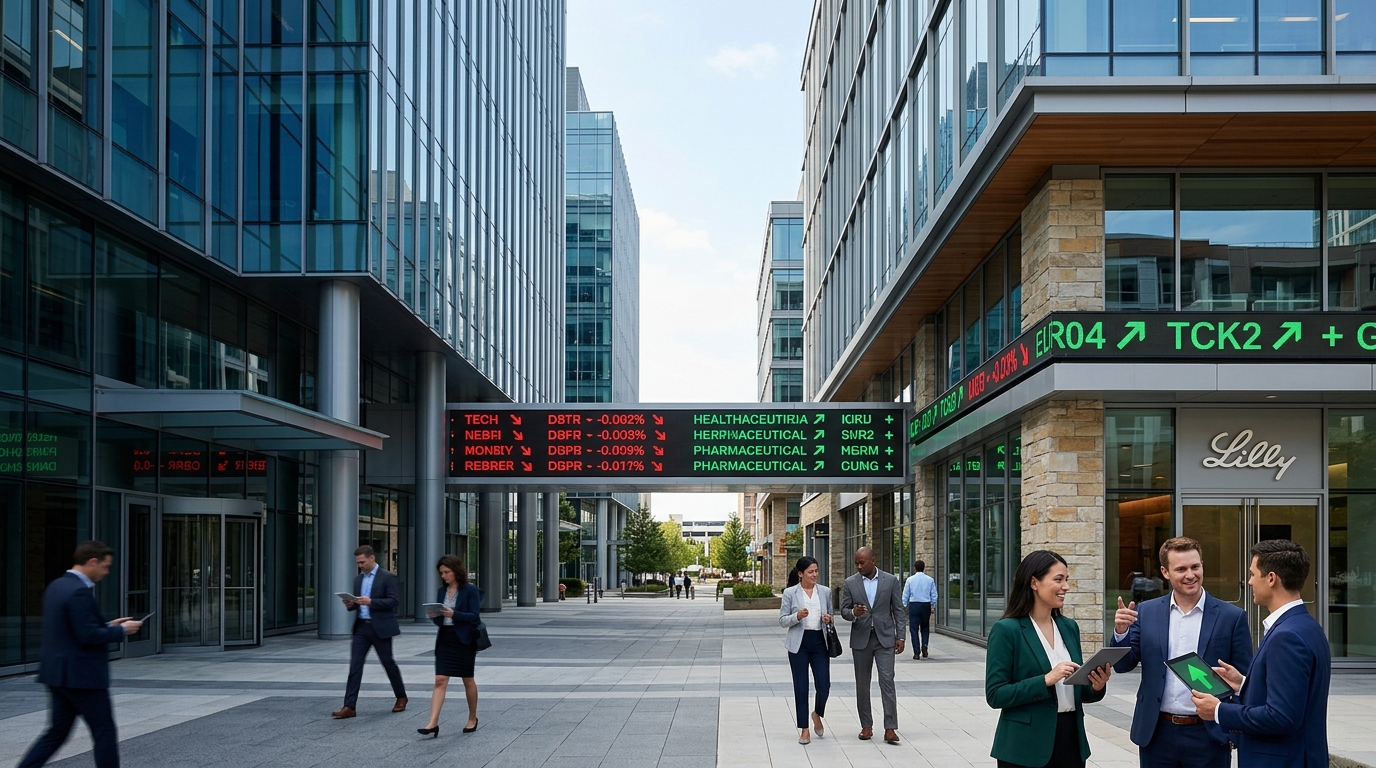
Wednesday’s session split the market in two. Technology fell about 3%, the worst sector in the S&P 500, while healthcare and consumer staples led gainers, both up over 2%. The S&P 500 dropped 1.1%. The money that left the AI trade went somewhere. The question is whether it stays there.
The catalyst was straightforward. September’s Consumer Price Index rose 3.7% year over year versus the 3.6% economists expected. Excluding food and energy, core CPI rose 0.3% month on month versus an expected 0.2%, and the core year-over-year rate rose to 2.6% from 2.4%. That core surprise is the one that matters. It forces rate expectations higher, compresses the long-duration multiples that AI infrastructure stocks depend on, and makes cash-generating defensives look relatively better by the hour.
Healthcare heavyweights swept the leaderboard. Broad defensive buying, yes. But the candidate that deserves the most scrutiny heading into next week is Lilly.
Why Lilly, and Why Now
The rotation gave every pharma name a lift. Only Lilly arrives at this moment with an earnings report two weeks out and a revenue trajectory that has no peer in the sector. Revenue in Q2 2026 increased 48% to $23.0 billion, driven primarily by Mounjaro and Zepbound volume. Full-year 2026 revenue guidance was raised to the range of $85 billion to $87 billion. Both numbers were well above what analysts had modeled coming into the summer.
Lilly is expected to report Q3 2026 earnings on October 29, before the market opens, though the company has not confirmed the date. The company has topped analysts’ EPS expectations in each of the past four quarters. The Street’s consensus EPS estimate for Q3 varies by data source and is best treated as a range rather than a single figure. Lilly stock rose in morning trading as pre-earnings positioning drove buyers into shares ahead of the October 29 earnings call. That is a pre-earnings bid layered on top of a defensive rotation. Two distinct buyers are showing up at the same time.
Recent analyst action is almost uniformly constructive: Cantor Fitzgerald raised its target to $1,440 on October 8, and RBC Capital reiterated Outperform with a $1,500 target days later. Analyst counts and rating breakdowns vary by provider, so treat any single tally as directional rather than definitive.
The Earnings Case Is Also the Risk
The central debate heading into October 29 narrows to a single question: how much has Medicare GLP-1 Bridge pricing affected Zepbound net revenue in the quarter. The Q3 Zepbound net revenue figure and any revision to the $85 billion to $87 billion full-year guidance will settle that argument one way or the other.
That risk is real. A guidance cut on October 29 would reverse most of Wednesday’s defensive premium. Lilly trades at a price-to-earnings ratio around 40, which provides little cushion if the Zepbound number disappoints. And if inflation data cools over the next two weeks, the rotation that lifted the whole sector could partially unwind before earnings even arrive.
The Bottom Line
Wednesday’s session was a clear example of capital leaving the AI trade rotating into an identifiable sector rather than simply parking in cash. Healthcare has historically served as a defensive destination when money flows out of technology. What sets Lilly apart from AbbVie and Merck right now is not the defensiveness of the business, it is the proximity and weight of its October 29 earnings report. Analysts’ consensus for full-year 2026 EPS is about $34.79, with 2027 EPS forecast around $46.82, though estimates move and vary by source. That growth rate belongs to no other large-cap pharma name. If Wednesday’s rotation reflects genuine conviction rather than a single-session hedge, Lilly is the stock most likely to hold the gains.