October 17, 2026
Bonus Content: Steel’s Big Quarter Is Built on Borrowed Time
Dear Friend,
The biggest energy deadline in American history is 12 days away.
And it just aimed its full firepower at ONE company.
See, on July 4th, the One Big Beautiful Bill Act killed the federal tax credits that powered alternative energy for years.
But here’s what almost nobody knows:
When the White House killed credits for solar, wind, EVs, and every other renewable energy source in America…
They left one untouched.
Not only that, they reclassified it alongside oil and nuclear…
And gave it eight years of credits.
Because in June 2025, a drilling crew working near the Grand Canyon…
Unearthed a well of clean energy producing almost 8 times the output of the largest oil well in Saudi Arabia…
Capable of powering civilization for two million years.
Right here on American soil.
Google signed a 15-year contract.
Bill Gates wrote a $100 million check.
And now the clock’s running.
On October 20th, Washington puts 83 parcels of federal land on the auction block.
Whoever wins them could lock up this energy for decades.
One company already owns the entire chain.
Once the gavel drops, this stops being a secret.
Get the Grand Canyon ticker before October 20th here >>
The Buck Stops Here,
Kelly Maguire
Behind the Markets
P.S. The auction opens October 20th. After that, everyone will know who’s behind this discovery.
Steel’s Big Quarter Is Built on Borrowed Time
Hey there, bargain hunter. Two of America’s biggest steelmakers are about to tell you how much money they made while a war in the Middle East and a wall of tariffs did most of the heavy lifting. The question worth answering before those reports land Monday morning: what do these businesses actually earn when the scaffolding comes down?
Scoreboard
Steel Dynamics reports Q3 2026 earnings on October 19, with Wall Street expecting about $5.47 per share on roughly $6.43 billion in revenue. That compares to company guidance issued in September of $5.34 to $5.38 per diluted share, and to sequential Q2 earnings of $3.69 and prior-year Q3 earnings of $2.74. The year-over-year jump is real. So is the gap between where consensus sits and where management guided.
Cleveland-Cliffs (CLF) reports the same morning. Analysts are forecasting about $0.24 per share on roughly $5.72 billion in revenue, a return to profitability after an ugly stretch. In Q3 2025, Cliffs posted an adjusted loss of $0.45 per share on $4.7 billion in revenue. That turnaround looks dramatic. It is, largely, because the world changed around them.
The Real Reason
Two forces crushed foreign competition and sent domestic steel prices to levels not seen in years. Hot-rolled coil prices climbed to about $1,255 per short ton, the highest since May 2022, according to Bloomberg’s Oct. 16 review of Fastmarkets data. Finished-steel imports fell about 13.5% to roughly 13.0 million net tons in the first nine months of 2026, with import market share estimated at 16% year-to-date, the American Iron and Steel Institute said in October.
Tariffs did the structural work. Section 232 steel tariffs are running at 50%.
What the Business Actually Is
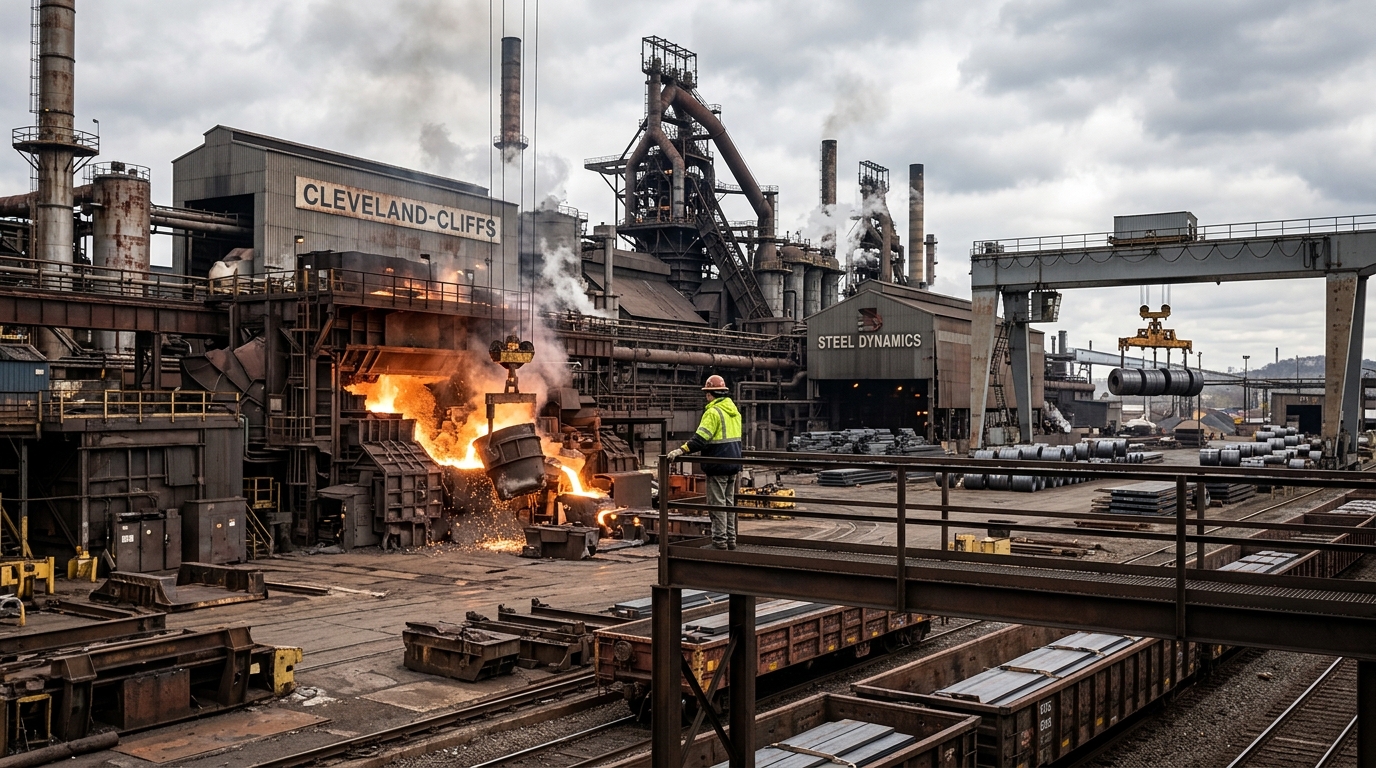
Cleveland-Cliffs has transformed from an iron ore miner into North America’s largest producer of flat-rolled steel, with a vertically integrated footprint and a heavy focus on automotive. It carries a heavy fixed-cost structure, blast furnace operations, and meaningful leverage. Any rollback of the 50% Section 232 tariff or a broader economic slowdown could disproportionately impact Cliffs due to its elevated fixed-cost base.
Steel Dynamics runs a different machine. Its electric arc furnace model uses scrap metal rather than iron ore, making it structurally more flexible on costs. In its September guidance, the company said third-quarter steel profitability was expected to be meaningfully higher than Q2, helped by metal margin expansion and record shipments, with realized selling values rising while scrap costs fell. When prices drop, STLD’s cost base can follow. Cliffs’ cannot, nearly as fast.
Is It Cheap?
CLF’s price-to-sales ratio stands at about 0.35, significantly below its historical median of roughly 0.63. That looks like a bargain until you remember Cliffs has no P/E to point to, still carries meaningful debt, and its CFO sold shares in 2026. The Wells Fargo bull case centers on a projected $2.65 billion in 2027 EBITDA, a figure that analyst Timna Tanners argues materially exceeds FactSet consensus even if HRC prices pull back from current levels.
Steel Dynamics trades at about a 10-11x forward P/E. JPMorgan recently maintained a Neutral rating while lowering its price target to $260 from $272. At around $245 with a roughly 10x forward multiple, STLD is reasonably priced if earnings power holds. If HRC retraces from $1,255 back toward $900, the multiple expands fast.
Bull / Base / Bear
- Bull: The Iran conflict drags on, freight stays elevated, tariffs hold at 50%, and domestic mills retain pricing power well into 2027. Cliffs hits the Wells Fargo $2.65 billion EBITDA target. Both stocks re-rate higher.
- Base: HRC softens toward $1,000 per ton as freight normalizes, imports creep back. STLD earns through the cycle better than CLF due to cost flexibility. Modest upside for STLD, range-bound for CLF near current prices.
- Bear: A tariff deal or ceasefire removes the import price shield and the freight premium simultaneously. Cliffs, with its blast furnace overhead and leverage, takes the hardest hit. STLD holds up better but still moves lower.
Action Plan
STLD is the cleaner position. Its EAF model gives it a cost floor CLF cannot match, and it enters earnings with guided EPS essentially in line with consensus. For bargain hunters comfortable with cyclical exposure, a starter position ahead of the report makes sense, with a second tranche contingent on management commentary about Q4 order books and scrap costs.
CLF is the higher-conviction trade only if you believe the $575 million Q3 EBITDA guidance holds and management articulates a credible bridge to 2027. Wells Fargo raised its CLF target to $14 from $12 on October 6. That is meaningful upside from current prices, but it is a 2027 story, and 2027 assumes 50% tariffs stay in place.
Cheap Investor Checklist
- CLF Q3 adjusted EBITDA: does it hit the guided $575 million?
- STLD Q3 EPS: does it clear the company’s own guidance of $5.34 to $5.38?
- HRC price trend: is $1,255 per ton holding or rolling over post-earnings?
- Management commentary on Q4 order books and customer inventory levels
- Any signal on tariff durability from either management team
- CLF debt reduction progress: total liquidity as of June 30 was $3.1 billion
- STLD scrap cost trajectory into Q4
- Import market share: does 16% hold or creep back as freight normalizes?
Bottom Line
If the Iran war and 50% tariffs stay in place through 2027, both CLF and STLD are underpriced on a forward basis and Monday’s results will confirm the earnings inflection. If either tailwind softens, the numbers get much harder. STLD is the one to own through the uncertainty. CLF is the one to trade around a catalyst. Know which game you are playing before the open Monday.