September 22, 2026
Rising memory costs are squeezing Personal Systems margins
Hey there, bargain hunter. A stock that drops 4% in a day on fresh bad news has a way of looking cheap. Sometimes it is. Sometimes the dip is the appetizer and the real losses come with the entree. HP right now deserves very careful attention before you reach for the fork.
J.P. Morgan Is Building on This Under-$1 Crypto
While fear hits levels not seen since 2022, major institutions aren’t backing off – they’re building. One little-known crypto is being used for real infrastructure tied to moving traditional assets on-chain. With supply tightening and activity expected to rise, this setup is getting harder to ignore.
Get the full breakdown on this under-$1 crypto before attention grows
Scoreboard
HPQ shares dropped roughly 3% to 4% in Monday’s premarket session after HP cautioned in a fresh SEC filing that it expects global PC unit volumes to shrink by a mid-single-digit percentage in calendar 2027 compared to 2026. HP noted that it remains in its planning period for fiscal 2027 and is not providing financial guidance, and had already told investors on its August 26, 2026 earnings call that it was premature to give specifics. The stock closed the prior Friday at $34.40.
What Actually Happened
The filing itself is not guidance. The company stressed that the projection is a market assumption rather than formal financial guidance for its next fiscal year. But the market read the silence on fiscal 2027 targets as its own answer. When a company with a maturing PC business declines to tell you what next year looks like and simultaneously tells the SEC volumes are going down, you are left to fill in the blanks yourself.
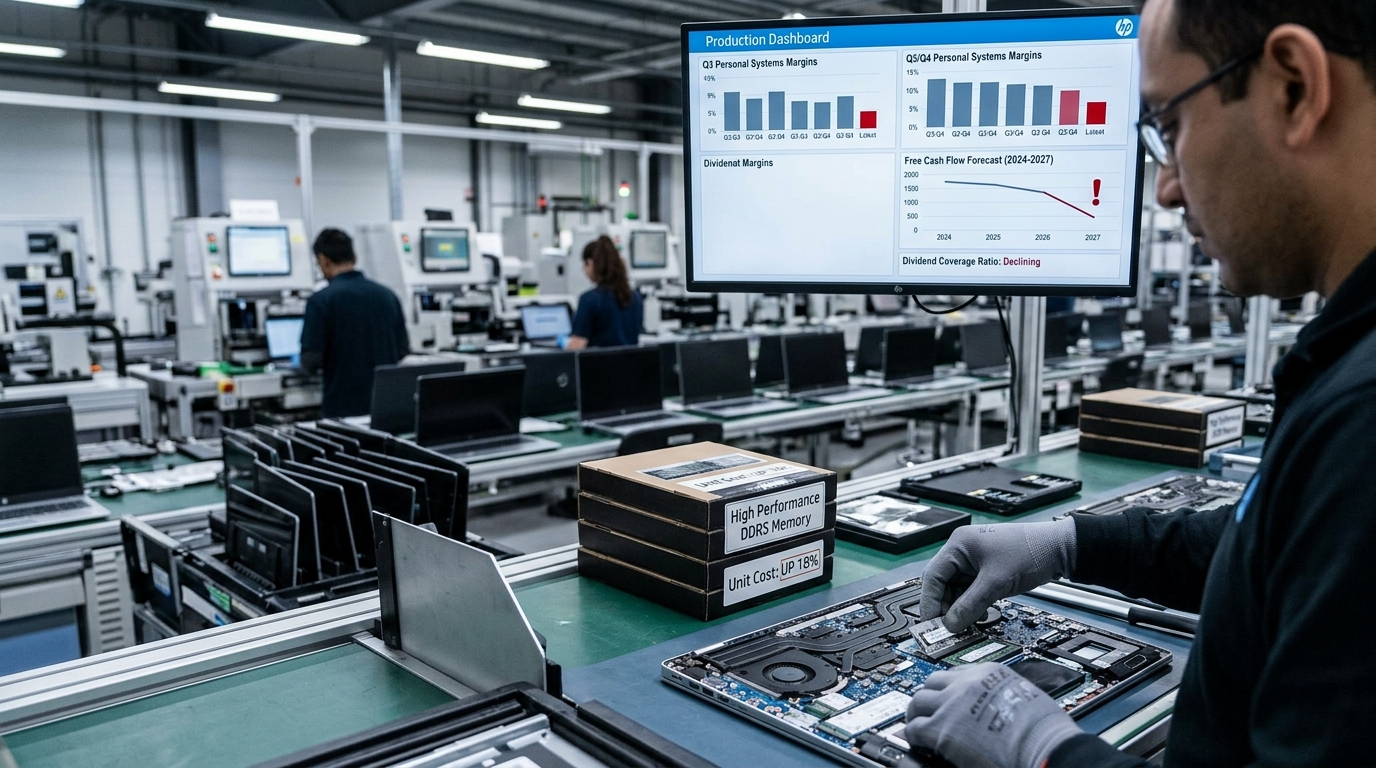
The blanks are not flattering. Personal Systems operating margin in Q3 fiscal 2026 came in at 4.6%, below the long-term range, pressured by higher commodity costs. Management also flagged rising memory and storage costs as a near-term margin headwind, with pressure expected to continue into Q4 fiscal 2026 and improvement anticipated in fiscal 2027.
The Memory Problem Is Structural, Not Cyclical
This is where the real danger lives. According to TrendForce, conventional DRAM contract prices were projected to jump about 90% to 95% in Q1 2026, another 58% to 63% in Q2, and to rise a further 13% to 18% in Q3. Unlike the 2020 to 2023 chip shortage, which stemmed largely from pandemic-era supply chain disruptions, this squeeze has been tied to suppliers reallocating capacity toward higher-margin products serving AI infrastructure, tightening availability for more conventional markets.
Calls, Puts, and Why It’s Simpler Than It Sounds
Two basic building blocks. That’s really where it starts.
Once you see how calls and puts actually work — without the textbook fog — the whole thing clicks.
This free guide gets you there, with examples you can copy into your own account.
Normally $29.97. Free today.
Memory suppliers SK hynix, Samsung, and Micron continue to prioritize AI-related demand because margins remain substantially higher than in consumer electronics. Micron (MU) and Sandisk (SNDK) are capturing that pricing power. HP is absorbing it.
The Numbers That Matter
- Personal Systems net revenue: $11.8 billion in HP’s fiscal Q3 2026, up 18% year over year, but operating margin of just 4.6%.
- Free cash flow: roughly $1.6 billion in fiscal Q3 2026.
- Raised fiscal 2026 free cash flow outlook to $3.0 to $3.2 billion.
- Dividend yield around 3.5%, with a payout ratio around 35% and a 3-year dividend growth rate around 5%.
- Quarterly dividend: $0.30 per share, costing roughly $277 million per quarter in cash based on HP’s fiscal Q1 2026 disclosure.
At $3.0 billion in full-year free cash flow, the dividend consumes roughly $1.1 billion annually. That leaves around $1.9 billion for buybacks and balance sheet management. Comfortable today. Less comfortable if Personal Systems margin keeps compressing into a mid-single-digit revenue decline.
Is It Cheap?
GF Value suggests HPQ is 5.7% overvalued at $34.40, though the company holds a GF Score of 78 out of 100, reflecting strong profitability and momentum despite moderate growth rankings. The roughly 3.5% dividend yield is real and the payout ratio is conservative, but valuation based on trailing cash flow gets complicated fast when forward volume assumptions move south. Dell (DELL) faces the same memory cost headwind. Logitech (LOGI), more dependent on peripherals than raw PC units, has somewhat more insulation from unit volume compression, though not from weak consumer spending.
Bull / Base / Bear
Bull: Memory costs peak in Q4 fiscal 2026, HP’s cost-mitigation actions from product redesign kick in during fiscal 2027 as management has suggested, and the AI PC refresh cycle drives average selling prices high enough to offset unit declines. Free cash flow holds near $3 billion and the dividend is never in question.
5 Nasdaq Stocks Under $5 That Aren’t What You Think
Most stocks under $5 come with a reputation. These don’t.
Each company on this list is tied to major trends like AI, cybersecurity, and next-gen infrastructure.
They may not have the spotlight yet, but they are building real businesses in real markets. That combination is not always easy to find at this price level.
Base: PC units fall mid-single digits in 2027 as filed. Personal Systems margin stays below the long-term range through mid-2027. Free cash flow dips toward $2.5 billion. Dividend is safe; buybacks slow. Stock drifts sideways to down another 10%.
Bear: HP has previously cited industry forecasts for a double-digit decline in PC unit TAM in calendar 2026, with pressure expected to be heavier in the back half of the year. If memory costs stay elevated longer than expected and Personal Systems margin falls toward 3%, free cash flow could weaken enough that buybacks stop entirely. The multiple contracts further.
Action Plan
Do not chase this on the dip alone. Wait for Q4 fiscal 2026 earnings, when management has said it will share more on its fiscal 2027 outlook. That is your real signal. If management shows a credible path back to 5%+ Personal Systems margins and reaffirms the free cash flow range, a starter position at current levels becomes defensible. If they guide free cash flow below $2.8 billion, the dividend math stays fine but the stock deserves to be cheaper still. Scale in thirds: one-third now if you have conviction on the AI PC cycle, one-third after Q4 results, one-third only if the 2027 volume assumption proves conservative.
Cheap Investor Scorecard
- Personal Systems operating margin: watch for recovery above 5% in fiscal Q1 2027
- Free cash flow full-year 2026: confirm $3.0 to $3.2 billion guidance at Q4 results
- Dividend payout ratio: around 35%; alert above 50%
- Memory cost trajectory: monitor TrendForce DRAM contract price data quarterly
- PC unit volume: watch IDC and Gartner quarterly shipment data for 2027 confirmation
- MU and SNDK pricing power: rising further means HP’s costs stay elevated
- Buyback pace: any quarter below $100 million signals cash flow stress
- 2027 formal guidance: absent at Q4, flag as a negative surprise risk
Bottom Line
If memory costs stabilize and HP’s cost-mitigation actions land on schedule, HPQ at these levels is a tolerable value with a well-covered dividend. If memory inflation runs another two quarters and PC volumes in the second half of 2026 disappoint at the double-digit rate management has referenced for calendar 2026, the stock is not cheap, it is a value trap with a roughly 3.5% consolation prize. The Q4 earnings call is the moment of truth. Until then, watch the margin line, not the yield.