
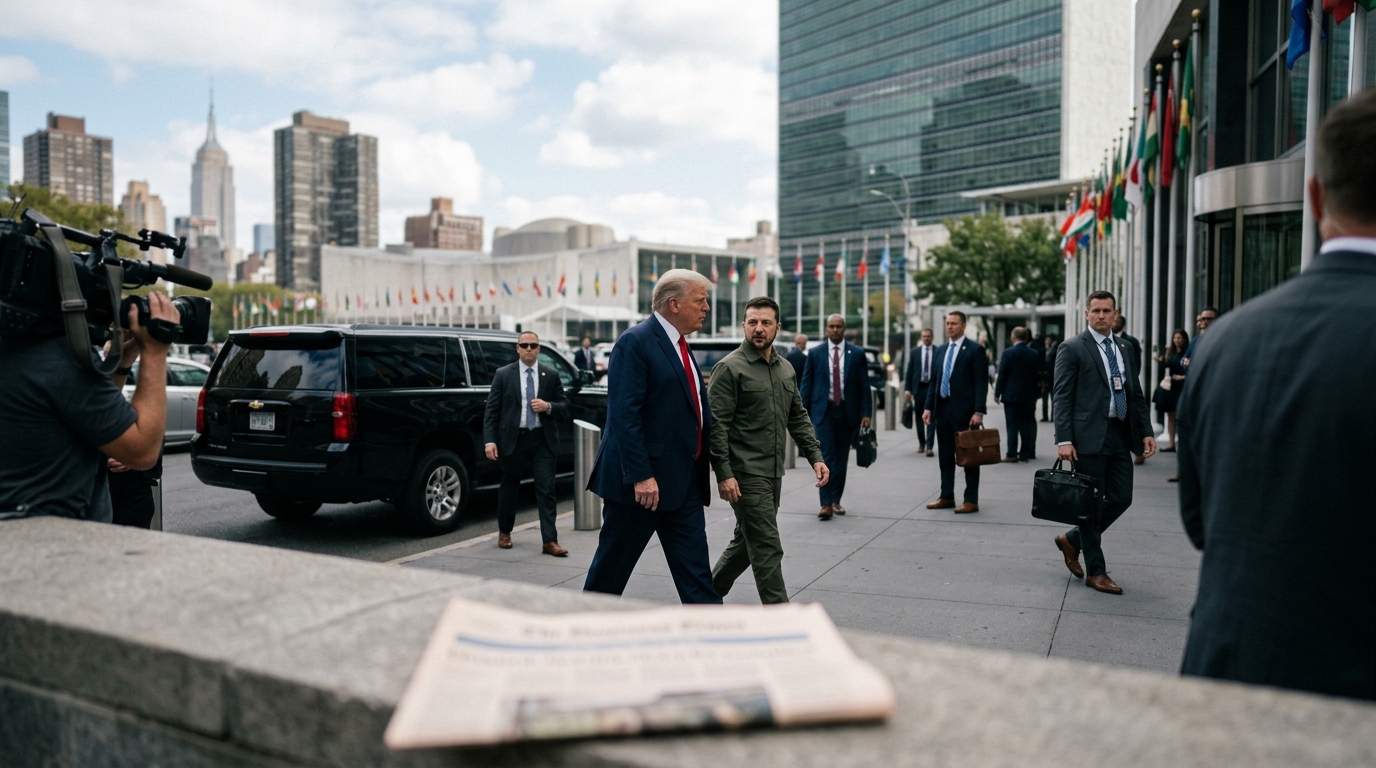
Two pieces of news are converging on the same trading session, and both run directly through the energy market.
Market Snapshot
Brent traded near $100 on September 21 after a sharp selloff, pulled lower by diplomatic signals out of the Middle East. That softness could reverse quickly if today’s New York meeting produces a hawkish read or, alternatively, extend if the session ends with a credible de-escalation framework. Watch that $100 level closely: it is both round-number support and a politically charged threshold in the current environment.
Stocks in Focus
RTX, LMT, Rheinmetall (RHM.DE). Defense names are the clearest read-through from any ceasefire signal, and the two-way risk is unusually wide today. Rheinmetall has already pulled back sharply this year, so the stock is not priced for an indefinite war premium. Any language from Trump or Zelensky suggesting a near-term energy truce, let alone a broader ceasefire framework, could accelerate selling in RTX and LMT, which have run hard since 2022. Rheinmetall’s structural position is different: it carries a record order backlog of about €80.5 billion and multi-year contracts that support cash flow visibility from European rearmament, making it less binary than its U.S. peers on a single diplomatic headline.
Sector Watch: Energy
The fuel supply picture tightened materially over the weekend. Ukrainian forces fired more than 1,000 drones at Russia overnight on September 20, including hundreds launched toward Moscow, with Russia’s Defense Ministry saying it intercepted 1,110 drones. The primary industrial casualty was Gazprom Neft’s refinery in Moscow’s Kapotnya district. Russia’s Moscow Oil Refinery halted crude processing after the drone strike damaged key production units, with both primary crude-processing units catching fire; repairs could take several weeks, Reuters reported.
The refinery processed 11.6 million tonnes of crude oil in 2024, equivalent to roughly 230,000 barrels per day, and produced 2.9 million tonnes of petrol and 3.2 million tonnes of diesel fuel. Fuel produced by the refinery was no longer being offered for sale on the St. Petersburg International Mercantile Exchange as of Monday, September 21.
This lands on top of an existing supply constraint. Russia has maintained fuel export restrictions aimed at stabilizing the domestic market, with the latest measures running through January 31, 2027, while some diesel exports are allowed under exceptions. Diesel crack spreads are the specific price to watch intraday: any diplomatic breakthrough that implies an end to refinery strikes would pressure cracks lower; further escalation or a breakdown in talks does the opposite.
Catalyst Calendar
- Today: Trump-Zelensky bilateral meeting on the sidelines of the UN General Assembly in New York. Zelensky has said there are ideas on the table for de-escalation covering energy security, food security, and the protection of human life, and that Ukraine is ready to take “really serious steps.”
- Energy ceasefire status: Trump has claimed Moscow and Kyiv agreed not to target each other’s energy infrastructure, but no deal has been confirmed and strikes have continued. Any post-meeting statement that formalizes or collapses that framework is a direct fuel-price catalyst.
Risk Radar
Over the past few days, Trump has argued that Ukraine’s strikes on Russian oil refineries are contributing to higher diesel prices, while others point to broader trade disruptions from the Iran conflict as a more important driver. That framing matters for the meeting’s tone: pressure on Zelensky to halt refinery strikes is a real negotiating variable, and any commitment in that direction would compress diesel cracks even if broader peace talks stall.
Ukraine’s long-range drone campaign has disrupted Russia’s refining system and forced the government to lean harder on domestic-market protections. Whether Trump extracts a concrete energy commitment today is the question the market does not yet have an answer to.
The Cheat Sheet
- Top Theme: Geopolitics is the fuel trade today. The Moscow refinery shutdown tightened diesel supply; the meeting determines whether that tightening persists or begins to ease.
- Stock to Watch: Rheinmetall. Structurally supported by a record backlog, but the most direct read on whether any ceasefire language out of New York has teeth.
- Sector to Watch: Energy. Brent sitting near $100 with a halted 230,000 bpd refinery and Russian export restrictions in force is not a quiet backdrop.
- Biggest Risk: A vague or inconclusive meeting outcome that leaves traders unable to price either escalation or de-escalation, maximum intraday whipsaw conditions for crude and defense names alike.
- One Thing to Remember: The Moscow refinery outage is a supply fact; what happens today is the variable. Size positions accordingly before the meeting.