Hey there, bargain hunter. Ryanair reported first-half results this morning, and the headline number is a 15% drop in profit. That stings, but it is not the part that matters for your portfolio. What matters is April 2027, when the hedge book that has been shielding this airline from a fuel shock starts to roll off.
Scoreboard
First-half FY27 profit after tax fell 15% to €2.15 billion, down from €2.54 billion a year earlier, as higher fuel costs and lower fares reduced earnings despite passenger growth. Average fares dropped 4% and operating costs climbed 10%. Ryanair carried 125.8 million passengers in the first half, a 6% increase, with an average load factor of 95%. Revenue, passengers, load factor: all fine. The problem is entirely on the cost line.
The Real Reason
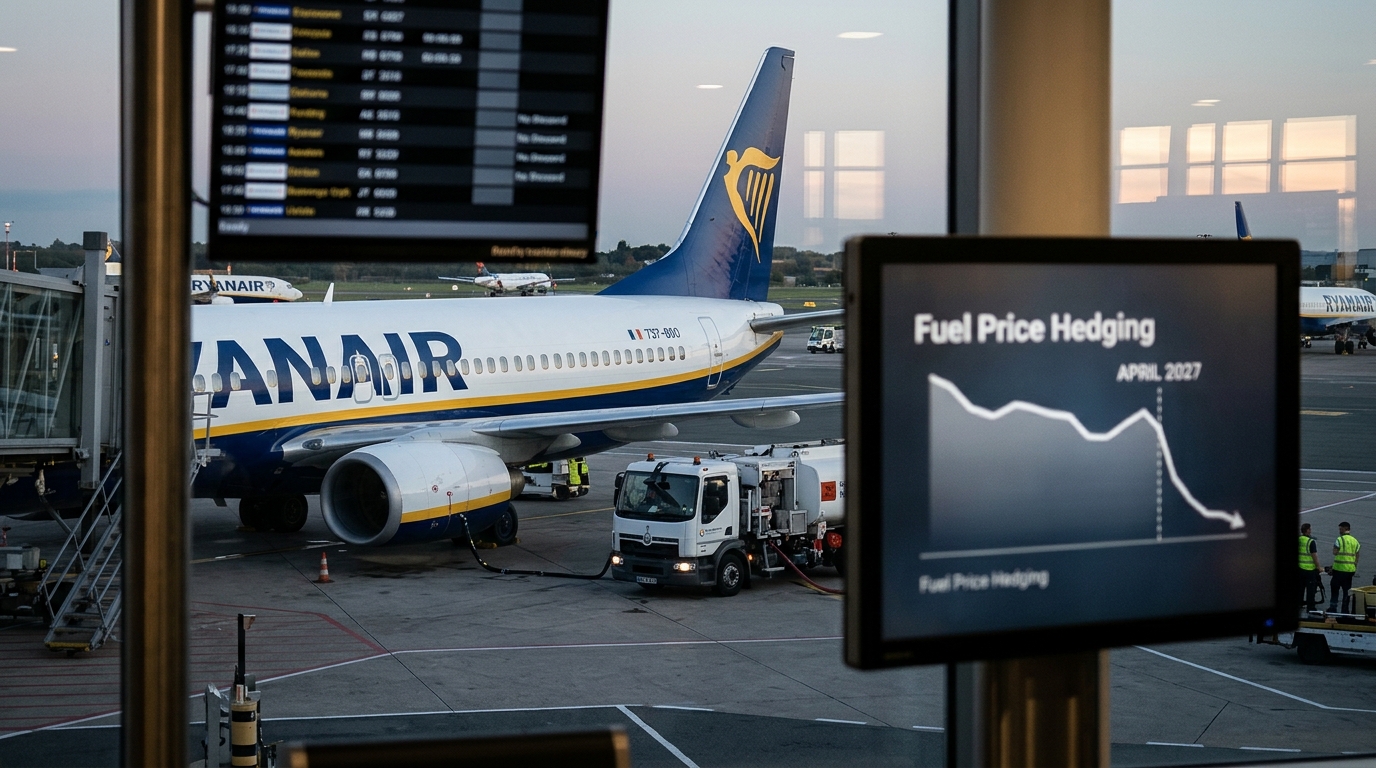
For FY27, the airline has said it is about 80% hedged on jet fuel at roughly $67 per barrel through March 2027. That hedge has been a competitive fortress while spot prices spiked. In H1, Ryanair said its unhedged jet fuel doubled to around $130 per barrel. The 80% lock-in is precisely why H1 results look tolerable rather than catastrophic. It is also precisely why the roll-off is the story.
Ryanair has said its fuel bill could rise by about €2 billion in FY28 (the year ending March 2028) as the low-cost hedges expire after April 2027, and it has floated pay freezes and leaner crewing as part of the response. The company has also said the estimate is based on current forward prices, with about 25% of fuel for FY28 hedged at around $95 per barrel. So in FY28, Ryanair goes from being heavily covered at ~$67 to being mostly exposed to whatever the market gives it.
What Ryanair Actually Is
Strip away the noise and this is Europe’s lowest unit-cost airline. It flies point-to-point, keeps its fleet almost entirely standardized on Boeing 737s, and uses secondary airports to hold ground costs low. Fuel and staff are the two levers management controls. Management has argued that Ryanair’s structural advantages, lowest costs, lowest fares, and strongest balance sheet, position it to emerge stronger as weaker competitors struggle with higher fuel prices. That argument is worth something. It is not worth €2 billion.
The fuel shock is not a Ryanair-specific problem — it is a market-wide repricing driven by a conflict that has already moved benchmarks sharply. The Strait of Hormuz remains the single chokepoint that determines whether the FY28 fuel bill shrinks or stays punishing.
Data
- Fuel and oil costs rose 15% to €3.40 billion as the price of the Group’s unhedged jet fuel spiked.
- Total costs surged 10% to €7.69 billion.
- H1 revenue was about €10.08 billion, up 3% year-over-year.
- Ryanair declared an interim dividend of €0.273 per share, payable in late February 2027, alongside an €800 million share buyback starting in February 2027.
- The company said it has “zero Q4 visibility” and that it is too early to give a profit forecast for the year to March 2027.
Is It Cheap?
RYAAY has recently traded around the mid-$50s, with a 52-week low of $51.68 and a recent close around $53.72. That can look attractive until you price in FY28. Management has flagged an estimated €2 billion increase in the fuel bill for FY28, and has warned that even double-digit fare increases may not fully offset that rise. Ryanair’s FY28 hedge cover is better than zero, but 25% at roughly $95 per barrel still leaves most of the bill floating.
Bull / Base / Bear
Bull: A de-escalation in the Middle East pulls crude and jet fuel down materially, the FY28 fuel bill shrinks, and Ryanair’s cost lead drives market share gains as rivals cut capacity. The buyback at these prices is accretive. Ryanair has also said it expects competitor capacity cuts, which would support higher prices.
Base: European airfares rise by the mid-teens to around 20% into 2027 as fuel hedges expire across the industry. Ryanair passes through most of the cost increase but absorbs a meaningful earnings dip in FY28. EPS recovers in FY29 as the fleet’s newer Gamechanger aircraft deliver fuel burn savings.
Bear: Jet fuel prices remain elevated well into 2027 without a swift resolution of the Middle East conflict. The €2 billion fuel shock is only partially offset by fare increases and cost actions like pay restraint. Margins compress hard for two consecutive years, and guidance withdrawals keep institutional buyers on the sidelines.
The bear case hinges on how long elevated crude persists, and that depends on whether the geopolitical premium in Brent is structural or temporary. Brent’s forward curve already separates the near-term supply shock from the long-run resolution the market expects.
Action Plan
At roughly 13x trailing earnings with a buyback underway, RYAAY is not expensive for what it normally earns. The problem is that FY28 earnings are not normal. This is a story in two acts: the hedge cliff arrives in April 2027, and the fare recovery plays out through calendar 2027 and into 2028. Scale in slowly. A first position at current levels makes sense if you believe management’s cost discipline holds. Hold the second tranche until there is visibility on how much of the €2 billion fuel bill fares actually absorb, likely by the H1 FY28 report next November.
Cheap Investor Checklist
- FY28 hedge coverage: about 25% at ~$95/bbl. Track quarterly updates for increases.
- Fare trajectory: management has implied very large fare increases would be needed to fully cover the fuel jump. Watch monthly traffic stats.
- Competitor capacity cuts: Lufthansa has said it planned to cut 20,000 flights in 2026 amid the fuel shock. More cuts support Ryanair fares.
- Buyback execution: €800 million starting February 2027 is real capital return at a depressed share price.
- Unhedged spot price: if jet fuel retreats below $100, the FY28 bill shrinks and the bear case weakens fast.
- Pay freeze outcome: staff cost control is the secondary lever. Watch for union pushback.
- Boeing MAX-10 deliveries: Ryanair has said it expects its first 15 MAX-10s around spring 2027, adding lower fuel-burn capacity at the worst possible time for costs.
- Q4 FY27 guidance: management currently has zero visibility. Any update in February is a catalyst.
Bottom Line
If the Middle East conflict cools and jet fuel retreats, Ryanair at around 13x trailing earnings can be a genuine bargain: best cost structure in Europe, loyal passenger base, and a buyback to support the share price through the pain. If fuel stays elevated, the higher FY28 bill hits as hedges thin after April 2027 and earnings get hit again before fares fully catch up. This is not a stock to avoid, but it is a stock to buy in stages. The hedge cliff is real. Size accordingly.