
October 29, 2026
Bonus Content: D.R. Horton Closes FY2026 With Mortgage Rates at 7.4%

Multiple institutional funds back RAD Intel.
30,000+ investors back it, among them early investors, including operators from Meta, YouTube, and Amazon. Selected by the Adobe Design Fund.
Every brand needs intelligence. RAD Intel’s AI turns what brands already know into decisions they can act on, before the money goes out.
A who’s-who of Fortune 1000 clients across gaming, entertainment, fashion and healthcare already uses it.
Current allocations remain limited.
RAD Intel’s Regulation CF round is now open to all investors.
P.S. Limited allocations remain in the current investment round. The offering page lays out the details, risks included. Learn more to invest →
Regulation CF · now open to investors
This is a paid advertisement for RAD Intel made pursuant to Regulation CF offering and involves risk, including the possible loss of principal. Brand references reflect factual platform use, not endorsement. Investor references reflect factual individual or institutional participation and do not imply endorsement or sponsorship by the referenced companies. Please read the offering statement and related risks at invest.RADIntel.ai.
D.R. Horton Closes FY2026 With Mortgage Rates at 7.4%
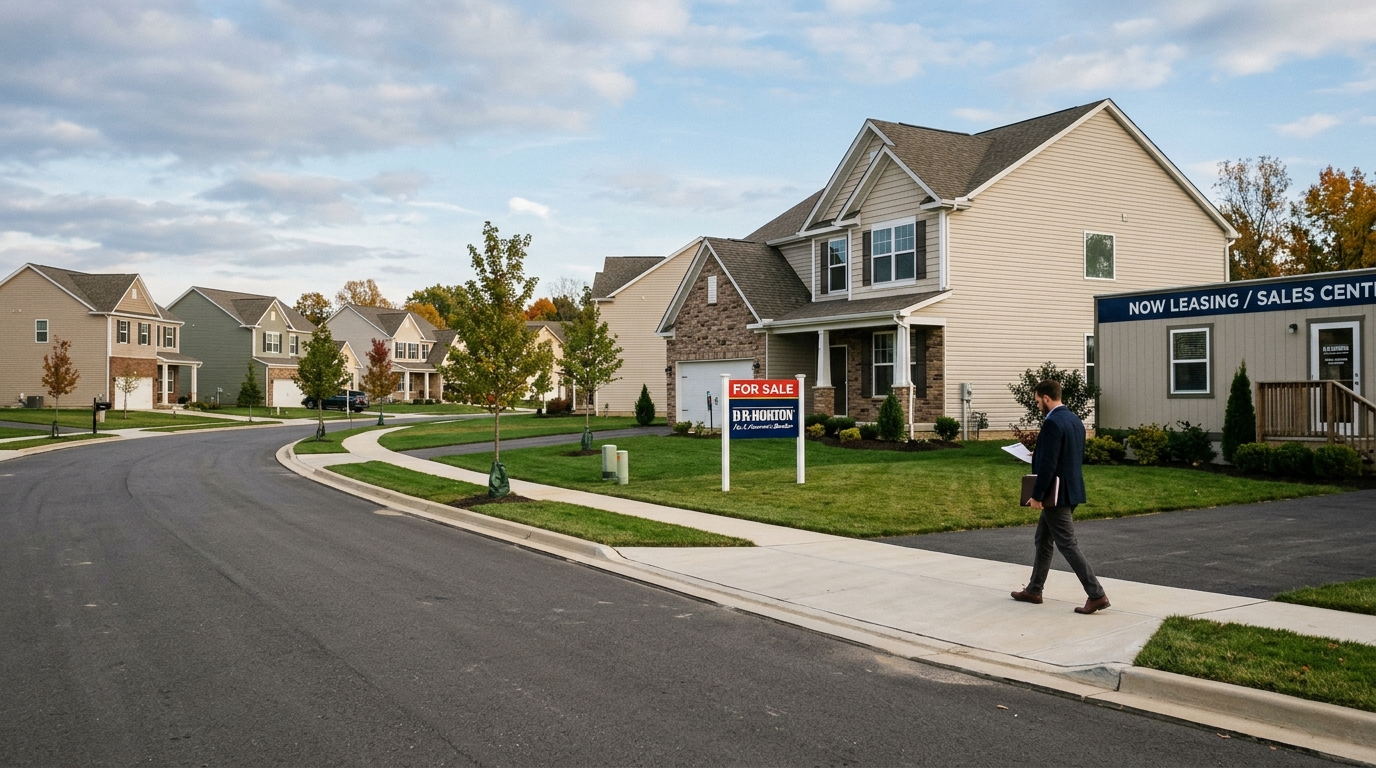
Hey there, bargain hunter. D.R. Horton dropped its fiscal full-year results this morning, and the timing is almost comically brutal. Pending home sales hit a record low in September, falling 7.3% to an index reading of 66.0, the weakest since the gauge began in 2001. The 30-year fixed mortgage averaged 7.4% earlier this month. Builder sentiment hit a 14-year low. DHI just closed its fiscal year inside all of that.
Scoreboard
Consensus going into today had Q4 revenue at roughly $9.07 billion, against $9.68 billion a year ago, a 6.3% year-over-year decline. EPS expectations sat at $3.01, essentially flat with last year’s $3.04. Through the first nine months of fiscal 2026, DHI earned $7.45 per diluted share on $23.7 billion in revenue, down 13% and 4% respectively from the prior year. The company cut its full-year revenue guide in Q3 from $33.5–$34.5 billion down to $32.5–$33.0 billion. That midpoint landed below what analysts had modeled at the time.
The Real Reason Revenue Is Falling
This is not a volume story. It is a margin and incentive story. In Q2, home sales gross margin compressed to 20.1%, from 21.8% in the prior year quarter, as DHI leaned harder on mortgage rate buydowns and price concessions to keep buyers moving. By Q3, gross margin recovered slightly to 20.7%, but management was explicit: incentives running at roughly 10% of revenue, with 90% of buyers using mortgage rate buydowns through DHI’s own financing arm. The company guided Q4 home sales gross margin to 20.5%–21.0%, signaling stable but structurally lower profitability than fiscal 2025.
The math is simple. Every buydown DHI funds to get a buyer across the finish line at 7.4% rates is profit DHI gives up. When construction costs don’t fall to offset that, the income statement absorbs the difference.
That arithmetic does not improve in 2027 without a meaningful rate move. Fannie Mae’s October forecast projects the 30-year fixed averaging 7.5% across all four quarters of 2027, a sharp upward revision from its September outlook.
What the Business Actually Is
DHI is America’s largest homebuilder by volume, operating in 126 markets across 36 states, with prices ranging from roughly $200,000 to over $1,000,000. In the twelve months ended June 2026, it closed 84,655 homes in its homebuilding operations, plus 3,129 single-family rentals and 2,370 multi-family rental units. It also runs mortgage financing, title services, and insurance. The financial services segment is not a side hustle: it is the engine that helps fund buydowns and captures fees, which is exactly why monitoring that revenue line matters today.
Key Numbers Heading Into Today
- Nine-month revenue: $23.7 billion, down 4% year-over-year
- Nine-month diluted EPS: $7.45, down 13%
- Q3 home sales gross margin: 20.7% vs. 21.8% prior year
- Pre-tax profit margin (nine months): 12.2%
- Total liquidity (end of Q3): $6.1 billion
- Debt-to-total-capital ratio: 23.0%
- Full-year EPS consensus: $10.44, down 9.8% from fiscal 2025’s $11.57
- Full-year revenue guide midpoint: $32.75 billion
Is DHI Cheap?
On trailing earnings, DHI trades around 13–14x. DHI’s price-to-book sits around 1.65x. The sector is priced for continued pain, and that is visible: average 2026 EPS estimates for homebuilders fell meaningfully since January. On fiscal 2027 estimates, DHI is expected to earn $11.42 per share, implying roughly 9% growth from this year’s depressed base. At today’s price, that puts the stock at close to 12x next year’s numbers.
Bull / Base / Bear
Bull: Rates drop meaningfully in early 2027, buydown costs normalize, and margins rebound toward 22%. DHI’s scale and liquidity let it take share from smaller, weaker builders who can’t absorb the same incentive costs.
Base: Rates stay sticky above 7% through at least the first half of 2027. Gross margin holds near 20.5%–21%. Closings stabilize around 83,000–84,000 homes per year. DHI earns $11 in fiscal 2027, trading at 12–13x, roughly flat from here.
Bear: Rates push higher, cancellation rates rise above 20% from 16% in the prior quarter, and management is forced to cut guidance again. A reset to 19% gross margins would take another 80–100 basis points out of earnings.
Action Plan
DHI is not a fire-and-forget buy here. It is a rate-conditional position. If you want exposure to the eventual rate relief trade, DHI gives you the most liquid, lowest-multiple entry in the sector. Watch today’s Q4 results for three things: whether gross margin came in at the top or bottom of the 20.5%–21% guidance band, what management says about Q1 fiscal 2027 closings, and whether incentive costs as a percentage of revenue are moving up or holding flat.
Scale in on weakness below $140, target a full position only if management holds margin guidance on the call. Trim toward $170 if rates fall sharply before earnings power actually improves.
Cheap Investor Checklist
- Q4 home sales gross margin: did it land inside 20.5%–21.0%, or disappoint?
- Full-year closings: did DHI hit the 83,800–84,300 guidance range?
- Incentives as % of revenue: holding at 10% or climbing?
- Q1 fiscal 2027 closing guidance: above or below 21,000 homes?
- Cancellation rate: staying near 20%, or rising further?
- Total liquidity: still above $6 billion at fiscal year-end?
- Debt-to-capital: moving higher or holding under 23%?
- Financial services revenue: is buydown cost visible in the segment margin?
- Share count: did buybacks continue through Q4?
- Fiscal 2027 EPS trajectory: is $11.42 still a credible consensus, or moving lower?
Bottom Line
If today’s margins hold and management guides fiscal 2027 closings with any confidence, DHI at roughly 12x forward earnings is a reasonable entry for a rate-sensitive recovery. If gross margin slips below 20.5% and the company signals more incentive escalation, the stock needs another leg lower before the risk-reward works. Watch the margin line first. Everything else follows from there.