October 29, 2026
Bonus Content: Apple Has $146 Billion. The One Deal That Fixes Its AI Gap.
Former tech executive Jeff Brown, the man who picked Nvidia in 2016, before it jumped as high as 37,800%, just got inside a Cybercab, Elon Musk’s new car that has no steering wheel or pedals… and what happens will shock everyone. Click here to see the details or read more below.
Dear Reader,
Warning…
If you’re an Elon Musk hater…
You’ll probably cry yourself to sleep after you click here and watch this footage of his latest technology.
He’s proving everyone wrong again.
Just a few years ago…
They laughed at him…
And said that what he was planning to do was impossible.
In 2018, the New York Post even called Elon “a total fraud”…
But I just caught his new technology on camera (click here to see it)…
And it proves the media was 100% wrong about Elon.
This is pure genius…
And it’s about to take America by storm.
We have so much to look forward to,
Jeff Brown
Founder & CEO, Brownstone Research
Apple Has $146 Billion. The One Deal That Fixes Its AI Gap.
Hey there, bargain hunter. Apple has a spending problem, and it is the opposite of the one you usually hear about.
Scoreboard
Apple held $39.5 billion in cash and cash equivalents as of June 27, 2026, plus about $107.0 billion in marketable securities, roughly $146.5 billion combined. That is not a war chest sitting idle. CFO Kevan Parekh told analysts the company would no longer provide net cash neutral as a formal target, a posture it had held for years. Translation: the wallet is now open.
The Real Problem
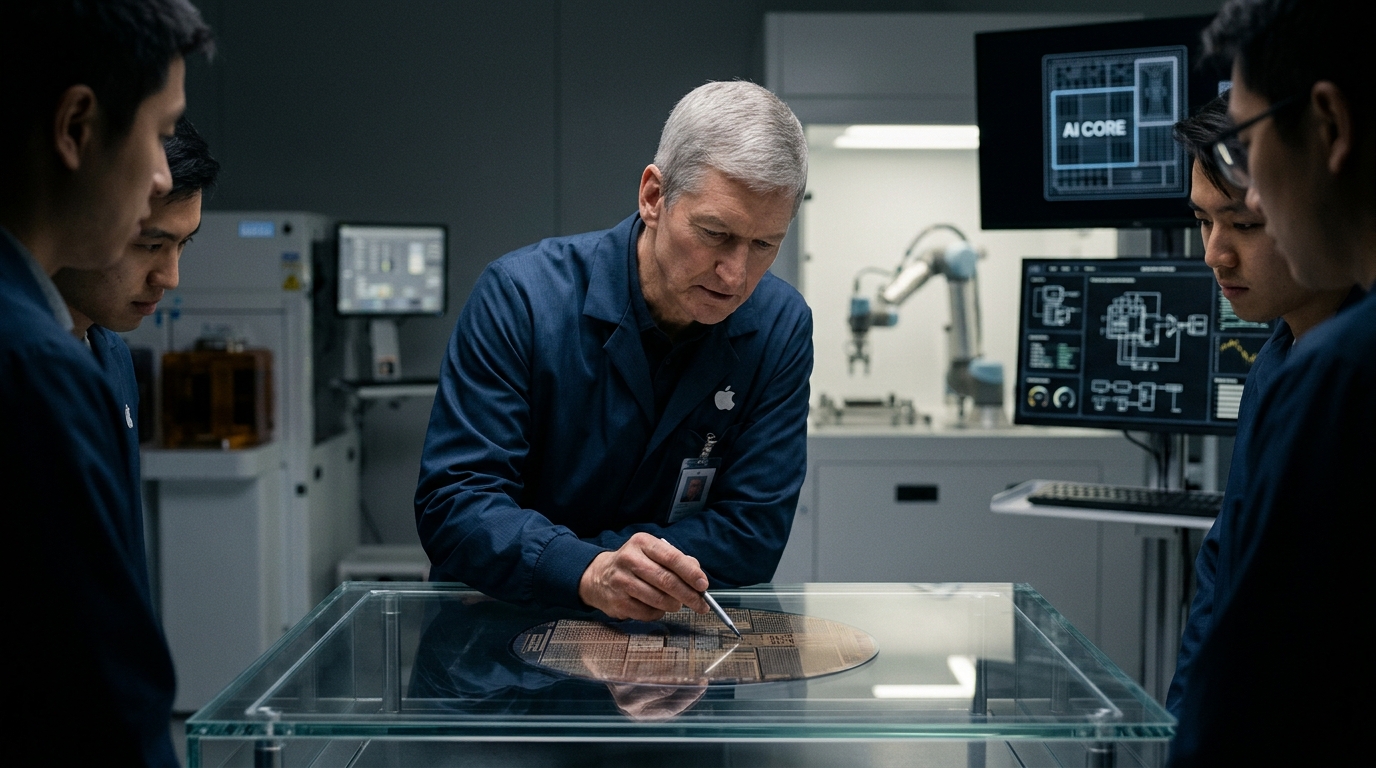
Apple’s AI servers have been built around Apple silicon, with reports pointing to M2 Ultra-class chips in its data center effort. And for its Gemini-powered Siri, reporting has said the “Cloud Pro” model runs on Google-owned Nvidia hardware. That is a structural dependency that costs margin and strategic autonomy every quarter it persists.
Apple’s own server chip, codenamed Baltra, was expected to arrive sooner but has slipped. Reporting in 2026 said a server chip based on an M7 Ultra-class design was unlikely to be ready before 2029. Three years is a long time to rent compute from a partner whose roadmap Apple does not control.
What Ternus Has to Buy
Apple has already announced that John Ternus will succeed Tim Cook as CEO effective September 1, 2026. In the same transition window, Johny Srouji was given a broader role as Apple’s chief hardware officer overseeing Hardware Engineering. A more hardware-driven leadership bench could be more willing to take risks to bolster Apple’s technology by making bigger acquisition plays.
Apple is already looking at smaller, targeted discussions such as meetings with PrismML to run larger AI models on-device. On-device compression is useful. It is not the problem. The problem is the server side, and that requires a different target entirely.
Apple could be interested in companies developing complete AI processors, but a transaction would not necessarily involve buying a direct Nvidia competitor. Potential areas include high-bandwidth chip-to-chip interconnects, advanced packaging, memory controllers, optical communications, inference accelerators, or specialized processor architectures.
The smartest deal here is not chasing a headline. It is buying the piece Baltra cannot be retooled to supply: interconnect and inference acceleration expertise that makes Apple’s own silicon more competitive three years sooner than organic R&D allows.
Is the Price Right?
Apple has historically limited its acquisitions to deals in the hundreds of millions of dollars and avoided large purchases, but that approach appears to be shifting. In January 2026, Apple completed its acquisition of Q.ai, an Israeli AI startup tied to interpreting speech and facial micromovements, in a deal that Reuters reported was valued at about $1.6 billion. That would still rank among Apple’s biggest deals, after Beats.
A $5 to $10 billion chip acquisition would barely register against $146 billion in combined cash and securities.
Bull / Base / Bear
- Bull: Ternus closes a deal for an inference accelerator or interconnect specialist by mid-2027. Baltra ships on a compressed timeline using acquired IP. Apple exits its Google-hosted Nvidia dependency before the M8 cycle.
- Base: Apple buys one or two smaller chip startups for under $3 billion combined. Mac-class Ultra chips temporarily bridge the infrastructure gap while Baltra finishes. Siri’s backend remains partly on Google’s infrastructure through 2028.
- Bear: Acquisitions stall in antitrust review or integration fails. Apple’s AI future continues to hinge on Google’s and Nvidia’s roadmaps rather than its own R&D. Margin compression follows as cloud costs scale with usage.
Cheap Investor Checklist
- Does any deal target server-side AI capability, not just on-device efficiency?
- Does acquired IP accelerate Baltra’s timeline or render part of it redundant?
- Does Apple disclose capex guidance indicating genuine infrastructure investment?
- Does Private Cloud Compute shift off Google-hosted Nvidia hardware by end of 2027?
- Does Siri’s benchmark performance close measurably on Gemini within four quarters of any deal closing?
Bottom Line
If Ternus writes a chip check in the $5 to $8 billion range and lands the right interconnect or inference team, Apple buys itself out of a structurally weak position while its competitors are still spending hundreds of billions on data centers. If he waits for Baltra, he pays years of Nvidia rent and hands rivals more time to own the assistant layer on his own devices. The war chest is there. The gap is real. This is the one deal that actually moves the needle.