July 23, 2026
Tesla’s Big Quarter Has a Catch
Featured: Tesla’s Big Quarter Has a Catch
A 2,240% Gold Giant with a Neighbor Already Drilling
In mining, property lines matter to lawyers.
They matter less to geology.
One gold producer in Papua New Guinea has already turned this regional corridor into a multi-billion-dollar success story. It produces tens of thousands of gold-equivalent ounces per quarter and has become one of the top names in the world.
Now a smaller explorer is drilling nearby.
Not in a random patch of jungle.
In the same structural corridor, where surface work has already pointed to gold, copper, and silver mineralization.
The timing is interesting, too.
Across the developed mining world, many of the obvious deposits have already been drilled, mined, or picked apart. Ore grades are declining. Reserves are depleting. New discoveries are getting harder and more expensive to define.
In the South Pacific, it is different.
Rugged, remote, complicated. But still one of the few places where large undeveloped mineral systems remain on the map. Recently, the Oregon Group, a critical minerals intelligence firm, described this region as holding some of the largest undeveloped copper-rich deposits in the world.
No two projects are the same.
But the neighbor proved the district can produce.
Now the question is what sits next door.
See why this frontier location is getting attention again…
Hey there, bargain hunter.
Here is a question worth sitting with for a moment. What does it mean when a company grows revenue 26% year over year, delivers a record number of vehicles in a single quarter, and still watches its stock slide more than 6% in premarket trading the next morning?
It means the market was expecting something else entirely.
What Actually Happened
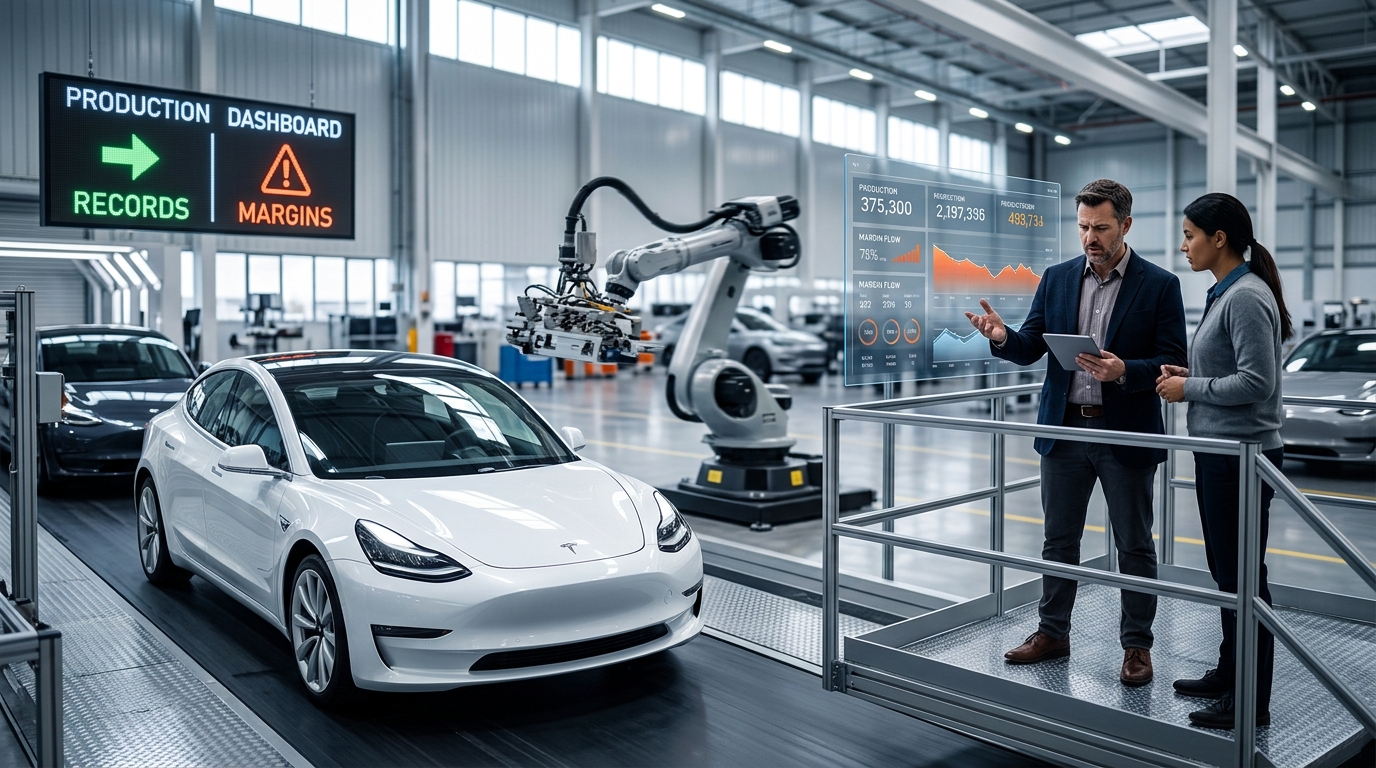
Tesla reported Q2 2026 results after the bell on Wednesday, July 22. The headline numbers were genuinely strong on the top line.
- Revenue: $28.24 billion vs. $26.32 billion expected (Bloomberg consensus) — up 26% year over year
- Adjusted EPS: $0.33 vs. $0.50 estimated — a meaningful miss
- Adjusted EBITDA: $3.27 billion vs. $4.0 billion expected
- Operating income: $398 million — down 57% year over year
- Operating margin: 1.4%
- Free cash flow: negative $1.09 billion (better than the negative $3.64 billion analysts feared)
- Vehicle deliveries: 480,126 — up 25% year over year, well above the 397,466 Bloomberg consensus estimate
- Energy storage deployments: 13.5 GWh — up 41% year over year and more than 50% above Q1’s 8.8 GWh
- Active FSD subscriptions: 1.48 million — up 56% year over year
- Trailing twelve-month revenue crossed $100 billion for the first time in company history
The stock closed regular trading at $374.01 before falling another 4% or more in after-hours and extended premarket action. That is the market’s answer to a question Tesla hasn’t fully resolved yet: where does the profit go?
“My system said ‘SELL’ right before this stock tanked. Today, I’m shouting ‘BUY NOW’ before it soars.”
In 2023, Marc Chaikin’s system flashed bearish on an automotive company no one had yet heard of. The stock crashed 35%. Today, his system rates this company “Very Bullish” and Marc calls it a screaming buy thanks to a new “groundbreaking partnership” with Nvidia that hands this company the keys to the self-driving kingdom on a silver platter.
Expectations vs. Reality
Wall Street wanted evidence that Tesla’s delivery surge would flow through to earnings. It did not. Not in a meaningful way.
The operating margin collapse from prior-year levels to just 1.4% is the number that stings. Lower average vehicle selling prices weighed on automotive gross margins, which slipped to 16.3% from 19.2% sequentially. Capital expenditures more than doubled sequentially, coming in at $5.79 billion — up 142% from the same quarter last year. That capex surge ate directly into cash generation.
Management didn’t hide from it. CFO Vaibhav Taneja confirmed on the earnings call that full-year capex will be “more than $25 billion” and that operating expenses, largely R&D-driven, are expected to keep growing in 2026 and beyond. Elon Musk called it a “massive capex year.” That is an understatement.
Slight tangent, but it matters: net income actually looked reasonable at $1.114 billion, largely because Tesla booked a $1 billion mark-to-market gain on its SpaceX stake. Strip that out alongside $300 million in FX losses and $100 million in Bitcoin losses, and the underlying operating picture is considerably less flattering than the headline net income figure suggests.
What Tesla Is Actually Building Right Now
This is where Tesla stops being a car company and starts being something harder to value.
The company is simultaneously funding Cybercab production, a Robotaxi network expansion, Optimus humanoid robot manufacturing lines, AI compute infrastructure, battery capacity, semiconductor fabrication, and new energy storage factories. All at once. Tesla more than doubled its onsite AI training compute capacity in Texas during the first half of 2026 alone.
The Robotaxi rollout now spans seven major metro areas. Tesla launched unsupervised rides in Miami, Orlando, and Tampa in July, on top of its Austin operations. Musk said on the call that the company expects “more than 10% growth in miles driven per week” from the Robotaxi service, though safety considerations will govern the pace.
On Optimus: production remains on track for later this year. The initial builds will be used internally for training data collection at what Tesla is calling the Optimus Academy. The company has not yet indicated a firm reveal date for the latest version. Services and Other revenue, meanwhile, grew 50% year over year to a record $4.58 billion, generating $648 million in profit at a 14% gross margin — the highest services margin Tesla has ever reported.
That services line is a real business. One worth watching closely.
Is It Cheap?
Let’s be direct. No. Not by conventional measures.
Tesla’s forward P/E sits in the range of 165 to 183 depending on the estimate source you use, against an automotive industry median P/E around 13. The EV/EBITDA multiple is approximately 124. Return on equity is around 4.9% and return on invested capital is near 6.3% — modest figures for any company trading at these multiples, let alone one in the middle of a historic capital buildout.
The valuation has never been about what Tesla earns today. It is entirely a bet on what Tesla monetizes in three to five years across Robotaxi, FSD licensing, Optimus, and energy storage. That bet may well prove correct. But it is a bet, not a discount.
Here is the honest tension: Tesla’s cash position of roughly $44.7 billion is substantial, and the company has lined up debt facilities to borrow up to an additional $30 billion if needed for the buildout. The balance sheet is not in distress. The problem is that the stock already prices in a substantial portion of the autonomy optionality. If any of the major bets — Robotaxi at scale, Optimus mass production, FSD monetization — slip by even a year or two, the math at current prices becomes very difficult.
The A-Z breakdown of this “battle-tested” income strategy – FREE (ticker included)
Most traders who struggle with options aren’t bad at trading – they’re just drowning in noise. New charts, tools, alerts, algorithms, and opinions crop up daily… and simply figuring out where to start can become overwhelming. Dave Aquino’s 11-Hour Options for Beginners guide cuts through that noise with a clear plan and shows you real results. Inside, you’ll get the A-Z breakdown of his 11-hour options income strategy in plain English, complete with the “battle-tested” ticker he’s used nearly 900 times with a 95.3% success rate. And today, it’s yours – FREE.
Cheap Investor Scorecard: TSLA
| Factor | Score | Notes |
|---|---|---|
| Business Quality | 8/10 | Strong brand, multi-platform optionality, growing services |
| Financial Strength | 6/10 | $44.7B cash, but free cash flow is now negative |
| Valuation | 2/10 | Forward P/E near 165+, EV/EBITDA around 124 — priced for perfection |
| Competitive Position | 8/10 | FSD lead, Supercharger network, energy moat building |
| Cash Flow | 4/10 | Operating cash flow strong at $4.7B; capex doubled, FCF negative |
| Management Execution | 6/10 | Delivery beat was real; EPS misses are now recurring |
| Catalyst Strength | 8/10 | Robotaxi expansion, Optimus, FSD monetization all near-term |
| Margin of Safety | 1/10 | Almost none at current prices for traditional value investors |
| Long-Term Potential | 9/10 | If autonomy scales, the upside case is genuinely large |
| Cheap Test | FAIL | Quality company. Not a bargain at current levels. |
Bull, Base, and Bear
Bull case: Robotaxi scales across dozens of U.S. cities by 2027. FSD subscriptions push well past 2 million paying users. Optimus achieves even modest commercial sales volumes. Energy storage, now growing at 41% year over year, becomes a billion-dollar profit center in its own right. If even two of those three bets deliver on time and at scale, today’s price may look reasonable in hindsight.
Base case: Execution is lumpy. Timelines slip by 12 to 18 months across multiple product lines, as has happened before. The core auto business holds up, services keep growing, and FSD adds subscribers steadily. The stock grinds sideways or drifts lower as the capex cycle pressures margins through 2027.
Bear case: Regulatory friction slows Robotaxi expansion significantly. Optimus production hits technical or supply chain obstacles. Auto margins compress further as global EV price competition intensifies. With operating income already down 57% year over year on a 26% revenue increase, the bear case does not require imagination — it just requires more of what already happened this quarter.
The Mispricing Question
Here is where The Cheap Investor has to be honest with you.
Tesla is not mispriced in the traditional sense. There is no obvious gap between perception and reality where the market is being irrationally fearful. The market knows what Tesla is building. It has assigned that vision a $1.4 trillion market cap. The stock isn’t cheap because the future it’s pricing is extraordinary — and extraordinary outcomes require extraordinary execution over an extended period.
What the Q2 report actually revealed is that Tesla is in the middle of its most aggressive investment cycle ever. Capex more than doubled sequentially to $5.79 billion. Full-year capex will exceed $25 billion. That spending is real and it is necessary — Robotaxi infrastructure, Optimus assembly lines, AI compute clusters, the Terafab chip project, solar manufacturing. The company is not wasting money. It is making very large, very long-duration bets.
The question is not whether those bets are good ones. It is whether the stock prices them in already at a forward P/E of 165 to 183 and a trailing P/E that has ballooned well above 300.
For patient value investors, the honest answer is: watch and wait. A pullback that brings the forward multiple closer to 80 to 100 — still generous by any historical standard for an automaker, but defensible for a technology platform with genuine autonomy momentum — would create a more interesting entry point. The business quality is not in question. The price is.
If you already own it and bought lower, the case for holding through the investment cycle is reasonable. If you are looking to start a position today, the margin of safety is thin.
The Cheap Investor