July 23, 2026
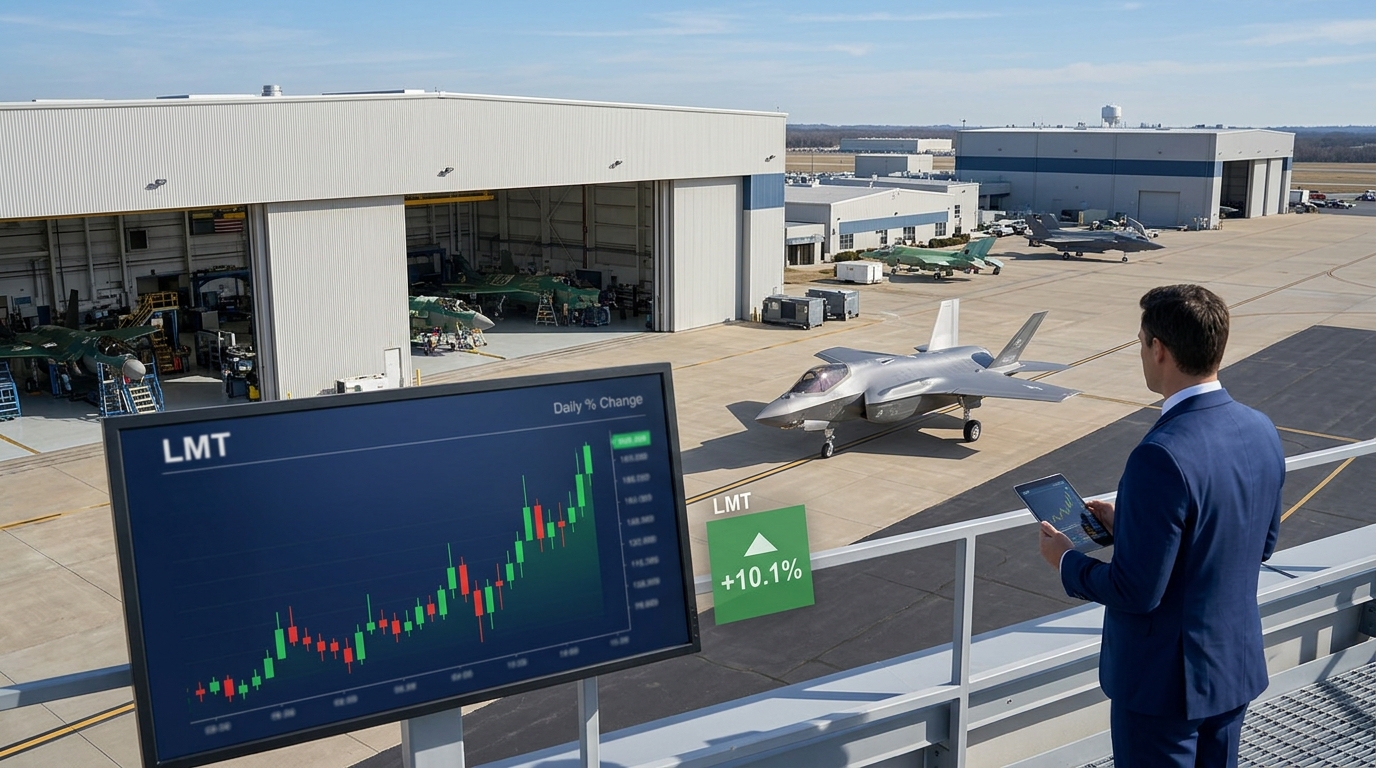
LMT Just Surged 10%
Is it still cheap after one of its biggest single-day moves in years?
Hey there, bargain hunter.
There’s a question worth sitting with today: when a great business you’ve been watching suddenly surges 10% in a single session, does that make it less interesting? Or does it mean the market is finally catching up to something that was hiding in plain sight?
That’s the Lockheed Martin situation right now.
What Happened This Morning
Lockheed Martin (NYSE: LMT) reported Q2 2026 earnings before the open on Thursday, July 23, and the numbers were not close to what Wall Street expected. They were better. A lot better.
- Revenue: $20.1 billion, up 11% year over year (consensus was $19.4 billion)
- EPS: $7.94 per share (consensus was $7.22 per share)
- Free cash flow: $2.9 billion (vs. negative $150 million in Q2 2025)
- Cash from operations: $3.2 billion (vs. $201 million a year ago)
- New orders: $65 billion in a single quarter
- Backlog: $230.4 billion, a new all-time record
The stock opened the day near $545, ripped through $575 intraday, and was trading around $568 as of early afternoon. Volume was running nearly three times the daily average.
For context, the prior-year quarter was a mess. Q2 2025 included $1.6 billion in program losses and $169 million in other charges, which dragged net earnings down to just $342 million, or $1.46 per share. That made today’s year-over-year comparison look like a completely different company. In a sense, it is.
Iran War TRUTH: What Was Revealed Behind Closed Doors
There’s a strategy behind the Iran war.
I know because I heard it directly in a closed-door meeting with a source whose connections run deep into global power networks.
He walked me through the real purpose and the massive deal tied to it.
The Real Story Behind the Beat
Here’s where it gets interesting.
The earnings surge looks dramatic in part because it’s measured against a quarter that was artificially depressed by one-time charges. Strip that noise out, and what you’re left with is a business that is genuinely accelerating across all four segments.
- Missiles and Fire Control: Sales up 19% to $4.1 billion, driven by production ramps in PAC-3, THAAD, and Precision Strike Missile programs
- Aeronautics: Sales of $8.1 billion, up 9%, led by higher F-35 production volume
- Rotary and Mission Systems: Sales rose 9% to $4.4 billion
- Space: Sales increased 6% to $3.5 billion
The part people will skip over, but shouldn’t: a $35 billion multi-year contract with the Missile Defense Agency for THAAD interceptors was signed during the quarter. That single contract nearly doubled the Missiles and Fire Control backlog to $87.9 billion. One contract. One quarter.
And then there’s the book-to-bill. Lockheed booked $65 billion in new orders on $20 billion in sales. That is a book-to-bill ratio of 3.2. For every dollar of revenue it recognized, it brought in more than three dollars of new business. That does not describe a company running out of runway.
What Management Said
CEO Jim Taiclet raised the full-year 2026 revenue outlook to $79.75 billion to $81.75 billion, up from the prior range of $77.5 billion to $80.0 billion. Full-year EPS guidance was also raised, now expected to land between $29.95 and $30.65 per share. Free cash flow for the full year is now projected to exceed $7 billion.
Slight tangent, but it matters: Lockheed had a rough Q1 2026. Net earnings fell to $1.5 billion from $1.7 billion a year earlier, weighed down by $125 million in unfavorable profit adjustments on the F-16 program and $55 million in delivery delays on C-130s. Management kept guidance intact at that time but did not raise it. The Q2 acceleration is not just optics. It is a real-world reversal.
Why the Market Got This Wrong (For a While)
Look at the 52-week range: LMT traded between $412 and $692 over the past year. It touched its all-time closing high of $672 in early March 2026, then pulled back hard. As recently as a few weeks ago, the stock was trading in the low $500s, sitting roughly 25% below its peak.
What caused the pullback? A combination of things. The Q2 2025 program charges spooked investors who worried about execution risk. The Q1 2026 profit adjustments on F-16 and C-130 programs added fuel to that concern. And in a market that tends to extrapolate recent weakness into permanent impairment, Lockheed got treated as a problem company rather than a great company with some temporary friction.
That is exactly the kind of perception-versus-reality gap The Cheap Investor exists to find.
The underlying business never stopped generating orders. The F-35 program remains the largest defense procurement program in history, with revenue visibility extending into the 2060s. PAC-3 and THAAD demand was not slowing down. It was accelerating, driven by elevated global defense spending that shows no signs of reversing.
Get YOUR Pre-IPO Exposure to ChatGPT’s Trillion Dollar IPO!
No Accreditation… No Qualifications…
Is It Still Cheap After a 10% Day?
This is the honest question. And the honest answer is: it depends on your framework.
At around $568 per share and with full-year EPS guidance of $29.95 to $30.65, LMT is trading at roughly 18.5x to 19x forward earnings. The Aerospace and Defense industry median forward P/E sits closer to 30x. LMT’s forward multiple is approximately 40% below that peer median.
On a trailing basis, LMT’s P/E is around 27x. Its 10-year historical average is closer to 21x. So on a trailing basis, the stock is not cheap by its own history. But the trailing earnings number was distorted by over $1.7 billion in charges during the prior four quarters. Strip those out, and the normalized earnings picture looks considerably different.
Forward free cash flow of more than $7 billion on a market cap of roughly $132 billion puts the price-to-free-cash-flow ratio around 19x. For a business with a $230 billion backlog, 11% revenue growth, and multi-decade contracts with the U.S. government, that is not an obvious bargain. But it is also not outrageous.
The stock’s 52-week high is $692. Today’s close near $568 is still about 18% below that level. A return to the prior high would represent meaningful upside from here.
The Cheap Investor Scorecard
- Business Quality: Strong. F-35, THAAD, PAC-3, and a decades-long moat in defense contracting.
- Financial Strength: Q2 free cash flow of $2.9 billion. Full-year guidance above $7 billion. Solid.
- Competitive Position: Near-irreplaceable in stealth aircraft and missile defense. Extremely high barriers to entry.
- Balance Sheet: Manageable debt. Returned $1.3 billion to shareholders in Q2 2025 alone through dividends and buybacks. Quarterly dividend of $3.45 per share authorized for Q3 2026.
- Backlog Quality: $230.4 billion is a record. The $35 billion THAAD contract alone represents 1.75 years of Missiles and Fire Control revenue at current run rates.
- Management Execution: Guidance raised, not just held. After two quarters of bumpy execution, that matters.
- Valuation vs. Peers: Forward P/E approximately 40% below the industry median. That gap is unusual for a company of this quality.
- Long-Term Visibility: F-35 production and sustainment runs into the 2060s. That is not a short-term trade.
- Catalyst Strength: Record backlog, guidance raise, and a $10.5 billion SOCOM logistics deal extending through 2038 all in the same week.
- Risk: Program charges have been a recurring issue. F-16 and helicopter programs are not fully resolved. International geopolitical shifts could affect foreign military sales.
The Next $435B Energy Empire
John D. Rockefeller would be worth $435b today. But “oil money” is old news. Next up? A $2.1 trillion opportunity in “clean” coal. It’s a “Rockefeller” moment for Frontieras, the company reforming coal into hydrogen and other valuable commodities. Their NASDAQ ticker ‘FASF’ is reserved.
Final weeks to join 12K+ people as an early-stage shareholder.
Invest in Frontieras at $9.01/share by 8/6.
Disclosure: This is a paid advertisement for Frontieras’s Regulation A offering. Please read the offering circular at invest.frontieras.com
Bull, Base, and Bear
- Bull case: The $230 billion backlog converts to revenue at an accelerating pace. Global defense budgets continue rising. F-35 production ramps. Free cash flow exceeds $8 billion within two years. The stock recovers toward its prior high and beyond.
- Base case: Revenue grows in the 8-11% range through 2027. Free cash flow stays above $7 billion. Valuation stays in the 18-20x forward range. Dividend grows. Shareholders collect a reasonable total return.
- Bear case: Additional program charges emerge from the classified Aeronautics program or international helicopter contracts. Budget reconciliation in Washington produces defense spending cuts. Foreign military sales face geopolitical disruption. The stock revisits the low $400s.
Here’s where I’m at on this.
Lockheed Martin is not the deep-discount bargain it was when it was trading near $412. That window has partially closed. But the perception that it was a broken company with execution problems has now been contradicted by the numbers in a fairly emphatic way.
A business with a $230 billion backlog, a book-to-bill above 3, and $7 billion-plus in projected free cash flow trading at roughly 19x forward earnings is not obviously expensive relative to what it is. Compared to the broader Aerospace and Defense universe, it remains meaningfully cheaper than most peers.
The question worth watching: can management continue to clean up the program charges and deliver on the raised guidance? If the answer is yes over the next two quarters, the market will likely continue to narrow the gap between where this stock has been and where the fundamentals suggest it could go.
That is not a prediction. It is a condition. Patient investors know the difference.