May 12, 2026
NVDA May 20: Good Enough Won’t Be Good Enough
The bar has moved. Here’s what it actually takes to surprise this market on May 20th.
NVDA May 20: Good Enough Won’t Be Good Enough
One of the most closely watched earnings reports of the year is coming up. Nvidia closes the books on fiscal Q1 2027 after the bell on May 20th and if the external data building around it is any guide, the company has not slowed down.
What happened in fiscal 2026 is worth stating plainly: $215.9 billion in total revenue, up 65% year over year. Data center alone hit $197.3 billion — more than double the $115.2 billion it posted the year prior. Q4 FY2026 came in at $68.1 billion, clearing the $66.2 billion Wall Street estimate, with GAAP gross margins at 75%. Management then guided Q1 FY2027 at $78 billion, a number that itself arrived above what analysts had penciled in. That’s the baseline.
The harder question isn’t whether Nvidia is executing. It clearly is. The harder question is whether May 20 delivers anything the market doesn’t already know.
A Quick Company Snapshot
Nvidia holds over 90% market share in data center GPUs. That number gets cited constantly, but the more durable moat is CUDA — the software platform Nvidia introduced in 2006 that became the default language of AI development. Over 4 million developers build on CUDA. Every major AI framework, including PyTorch and TensorFlow, runs on it. You don’t walk away from two decades of tooling investment just because a competitor ships a faster chip.
Revenue now breaks across four segments: Data Center at over 91% of total sales, Gaming, Professional Visualization, and Automotive. Gaming still matters at the margin. Data center is the whole business.
The SpaceX IPO Could Move More Than Just Stocks
When major IPOs hit Wall Street, money doesn’t just flow into new shares.
Funds rebalance. Institutions reposition. Retirement accounts often move with them whether investors realize it or not.
A new free 2026 Gold Guide explains how some Americans are moving part of their retirement savings into physical gold tax-free and penalty-free.
The Numbers Wall Street Is Watching
Consensus sits at approximately $78.8 billion in revenue and $1.78 EPS for Q1 FY2027. A few estimates have quietly drifted higher — ChartMill’s aggregated consensus is now at $80.1 billion in revenue and $1.79 EPS. That divergence matters. If the effective bar heading into May 20 is closer to $79–80 billion, hitting the company’s own $78 billion guidance target may not generate much of a reaction in either direction.
The specific metrics worth tracking:
- Data center revenue: Q4 FY2026 was $62.3 billion, up 75% year over year. Q1 FY2026 data center was $39.1 billion — the year-over-year comparison is favorable and the trajectory is expected to hold
- Gross margin: Management guided GAAP gross margins of ~74.9% and non-GAAP at ~75.0% for Q1. Full-year FY2026 came in at 71.1% GAAP and 71.3% non-GAAP — the sequential improvement is the story here
- EPS: Consensus range is $1.74–$1.79. Full-year FY2026 non-GAAP EPS was $4.77; FY2027 consensus is $8.34, which would represent a near-doubling in a single year
- Q2 FY2027 guidance: Consensus is around $86.6 billion, representing roughly 85% year-over-year growth. This number — not the Q1 result — will drive the post-earnings reaction
- Free cash flow and balance sheet: Nvidia generated $97 billion in free cash flow in fiscal 2026, returned $41 billion to shareholders, and enters Q1 with $51.1 billion in net cash
One accounting change to flag. Starting in Q1 FY2027, Nvidia will include stock-based compensation in its non-GAAP financial measures. That adds roughly $1.9 billion to non-GAAP operating expenses and compresses non-GAAP gross margin by approximately 0.1%. Year-over-year EPS comparisons will not be clean without adjusting for this shift.
What Analysts Are Actually Saying
- Goldman Sachs — Buy, $250 price target. Internal estimates run 14–34% above broader Wall Street consensus through FY2027
- Susquehanna (Christopher Rolland) — Buy, target raised to $275 from $250. Cites surging hyperscaler capex and combined Blackwell/Rubin revenue that could exceed $1 trillion through 2027
- 38+ firm consensus — Strong Buy. Median 12-month price target near $265–$267, implying roughly 20–24% upside from current levels near $220
- Price target range — Tigress Financial high at $360; consensus low at $210
Why Forward Estimates May Still Be Too Low
The hyperscaler capex figures that have been filed and reported over the last several months are, frankly, larger than most analysts were modeling at the start of 2026. Microsoft announced $190 billion in planned AI capex for the calendar year — well above the $154 billion Wall Street had been using. Meta raised its ceiling to $145 billion. Alphabet’s guidance reached up to $190 billion. Amazon committed $200 billion. Morgan Stanley’s latest forecast puts combined capex among the five largest hyperscalers at approximately $805 billion in 2026, representing nearly 80% growth year over year, followed by an additional 39% increase to $1.1 trillion in 2027.
You don’t build $800 billion worth of AI infrastructure without GPUs. And at this scale, there is no GPU supplier that can absorb that demand except Nvidia.
Slight tangent, but it matters: the valuation here is not as stretched as it looks on the surface. Nvidia’s non-GAAP EPS for FY2026 was $4.77, implying a forward P/E of approximately 40.5 on those earnings. On FY2027 consensus EPS of $8.34, the forward multiple drops to roughly 23.8x — actually the lowest next-twelve-month P/E among its closest peers. Broadcom trades at 31.3x. ASML at 36.1x. High-growth business, lower forward multiple. That’s the part people skip.
In at 9:35 AM. Out by 10.
I call it the “Opening Bell Breakout.” It’s the same setup I used to catch moves like 113% on GOOGL and 240% on META. I trade one simple 15-minute window each morning – and I’m usually done by 10 AM.
Blackwell Now. Rubin in H2 2026.
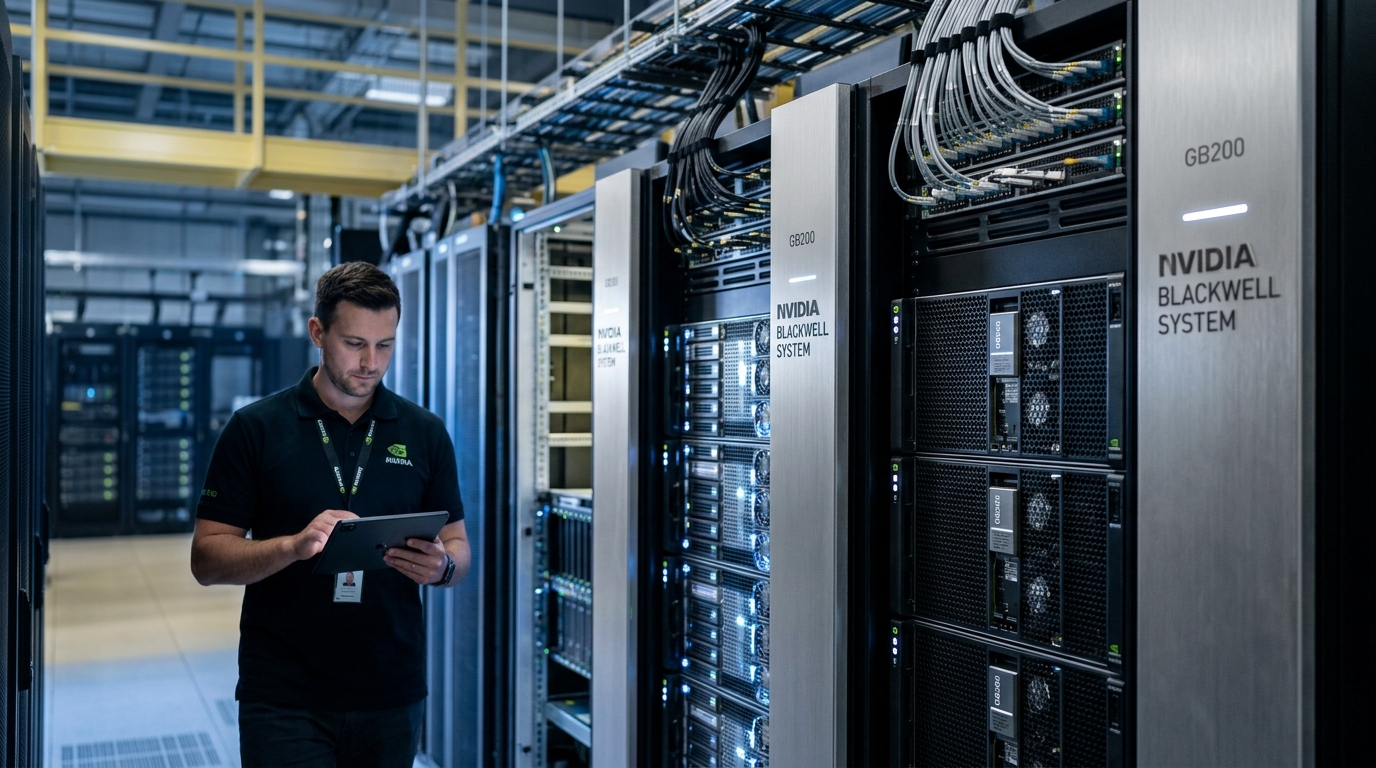
Blackwell Ultra is the dominant shipping architecture right now, with prior-generation Blackwell still seeing active demand. CFO Colette Kress confirmed on the Q4 call that Nvidia shipped first Vera Rubin samples to customers in late February 2026 and remains on track for full production in the second half of this year.
The Rubin platform is a meaningful performance step forward. Key numbers versus Blackwell:
- Up to 10x reduction in inference token cost
- 4x fewer GPUs required to train mixture-of-experts models
- Up to 18x faster rack assembly and servicing via modular, cable-free tray design
- First Nvidia platform to offer Confidential Computing at rack scale
- Spectrum-X Photonics switch systems delivering 5x improved power efficiency
Early adopters confirmed for H2 2026 deployment include AWS, Google Cloud, Microsoft Azure, and Oracle Cloud Infrastructure, alongside cloud partners CoreWeave, Lambda, Nebius, and Nscale. OpenAI, Anthropic, Meta, and xAI have all committed to Rubin for training larger models and running long-context multimodal systems.
One wrinkle: TrendForce estimates Rubin’s share of Nvidia’s overall 2026 shipments will land around 22%, below earlier projections of 29%, due to challenges with HBM4 memory validation, cooling optimization, and interconnect transitions. Blackwell is expected to hold over 70% of shipments. Analysts characterize any deferral as a timing issue rather than a demand problem — but that’s a distinction worth pressing on during the May 20 earnings call.
China: The Wildcard in the Guidance
Nvidia’s Q1 FY2027 guidance assumes zero China data center compute revenue. That has been the working assumption since the U.S. government required export licenses for H20 shipments to China in April 2025 — a restriction that triggered a $4.5 billion inventory charge in Q1 FY2026, the single largest export-related write-down in the company’s history.
The situation has partially shifted. Jensen Huang confirmed at GTC 2026 that Nvidia received purchase orders for H200 chips from ByteDance, Alibaba, and Tencent — over 400,000 units combined — following clearances from both U.S. and Chinese authorities. A 15% fee on those China sales, paid to the Department of Commerce, was implemented as a condition of the export license. Analysts estimate that a reopened China market represents a $5–10 billion annual revenue opportunity. None of that is reflected in current guidance. If any of it shows up in Q1 actuals or Q2 guidance language, it is pure upside to published estimates.
Three Ways This Quarter Plays Out
Bull case: Q1 revenue clears $80 billion. Q2 guidance lands at $88–90 billion or above. Management provides updated language on demand visibility into H2 2026 and beyond. Any positive China data center commentary adds further. Gross margins hold at 74–75% non-GAAP, confirming the Blackwell ramp is not compressing profitability. In this scenario, FY2027 EPS estimates move higher and the valuation re-rates from current levels.
Base case: Q1 revenue lands in the $78–80 billion range. Q2 guidance meets consensus near $86–87 billion. Gross margins hold. The stock drifts — the result is solid but investors had already expected solid. This is the scenario where the stock’s 15% year-to-date gain and high pre-earnings positioning work against a meaningful move in either direction.
Bear case: Q1 revenue hits management’s $78 billion guidance but falls short of the $79–80 billion the market has quietly priced in. Q2 guidance comes in below $86 billion. Gross margins disappoint at the low end of the guided range. Negative commentary on Rubin timing, hyperscaler capex durability, or China export complications amplifies the downside. Worth noting: post-earnings declines in Nvidia are not unusual even on beat quarters. The Q4 FY2026 report saw the stock rally initially and then give back most of those gains despite beating both the top and bottom line.
Five Things to Watch on the Call
- Q2 revenue guidance vs. $86.6B consensus — this is the single number that determines the reaction, full stop
- Rubin production timeline — any update on the H2 2026 schedule and early customer demand signals
- China commentary — whether H200 revenue appears in Q1 actuals or gets incorporated into Q2 guidance language
- Gross margin trajectory — management has targeted the mid-70s; watch whether they reaffirm or soften that language
- Hyperscaler concentration — cloud providers represented just under 50% of data center revenue in recent quarters; any shift in customer mix changes how durable the demand base looks through 2027
Wall Street Issues Dire Warning to Clients
Wall Street has issued a chilling warning for anyone with money in the U.S. stock market right now. Top analysts at these banks say a big event is coming that could both wipe out the market and keep it down for 10 years or longer. What can you do? A new tech breakthrough from a firm in Baltimore, Maryland may hold the answer.
Bottom Line
The fundamental case for Nvidia is not a subtle one. Hyperscalers are committing more capital to AI infrastructure than Wall Street modeled at the start of 2026 — significantly more. Blackwell is in full production. Rubin is shipping samples with confirmed production launches in H2 2026. The company holds $51 billion in net cash, generated $97 billion in free cash flow last fiscal year, and trades at a lower forward earnings multiple than most semiconductor peers despite meaningfully higher growth rates.
The harder question is how much of that is actually unknown to the market heading into May 20. The stock is up 15% year to date. Expectations are high — probably higher than stated consensus reflects. Meeting guidance but not exceeding it may not be enough to push the stock higher from here.
If Q2 guidance clears $86.6 billion and China access gets folded into the forward outlook, that’s a different situation entirely. If neither happens, this could be one of those quarters where a strong result goes nowhere fast.
Watch the Q2 guidance number above everything else. That’s the real signal on May 20.
For informational purposes only. Not financial advice.