May 12, 2026
“The Final Phase of Elon’s Master Plan”?
Featured Read: Aurora Innovation: Driverless Trucks Are Hauling Real Freight
Editor’s Note: What is the final phase of Elon Musk’s master plan – and why could it mean a massive payday for anyone taking advantage of this ONE ticker? Our friend Larry Benedict, a hedge fund legend who made over $274 million for his clients, says he has the answer. Click here to see the details.
Dear Reader,
After PayPal. After Tesla. After SpaceX.
Elon Musk is now preparing to execute the final phase of one of the most ambitious plans in history.
Click here to discover exactly what he’s planning – and the ONE ticker that could benefit the most.
According to Larry Benedict – the man who delivered a 279% return on cash in 2025 while the S&P returned just 15% – when the “Final Phase of Elon’s Master Plan” is triggered, it could move more money than anything Elon has ever done before.
We’re talking billions – potentially trillions – of dollars flowing into a single ticker.
It’s not Tesla. It’s not SpaceX. It’s not crypto, or AI, or anything Wall Street is currently talking about.
But when the “Final Phase” kicks in, Larry believes it’s positioned to capture the surge.
He’s revealing the name and ticker today – completely free.
Regards,
Lauren Wingfield
Managing Editor, The Opportunistic Trader
FEATURED READ
Aurora Innovation: Driverless Trucks Are Hauling Real Freight
Published May 12th, 2026
Something real happened in the freight industry last week. A Berkshire Hathaway subsidiary started letting a computer drive its trucks.
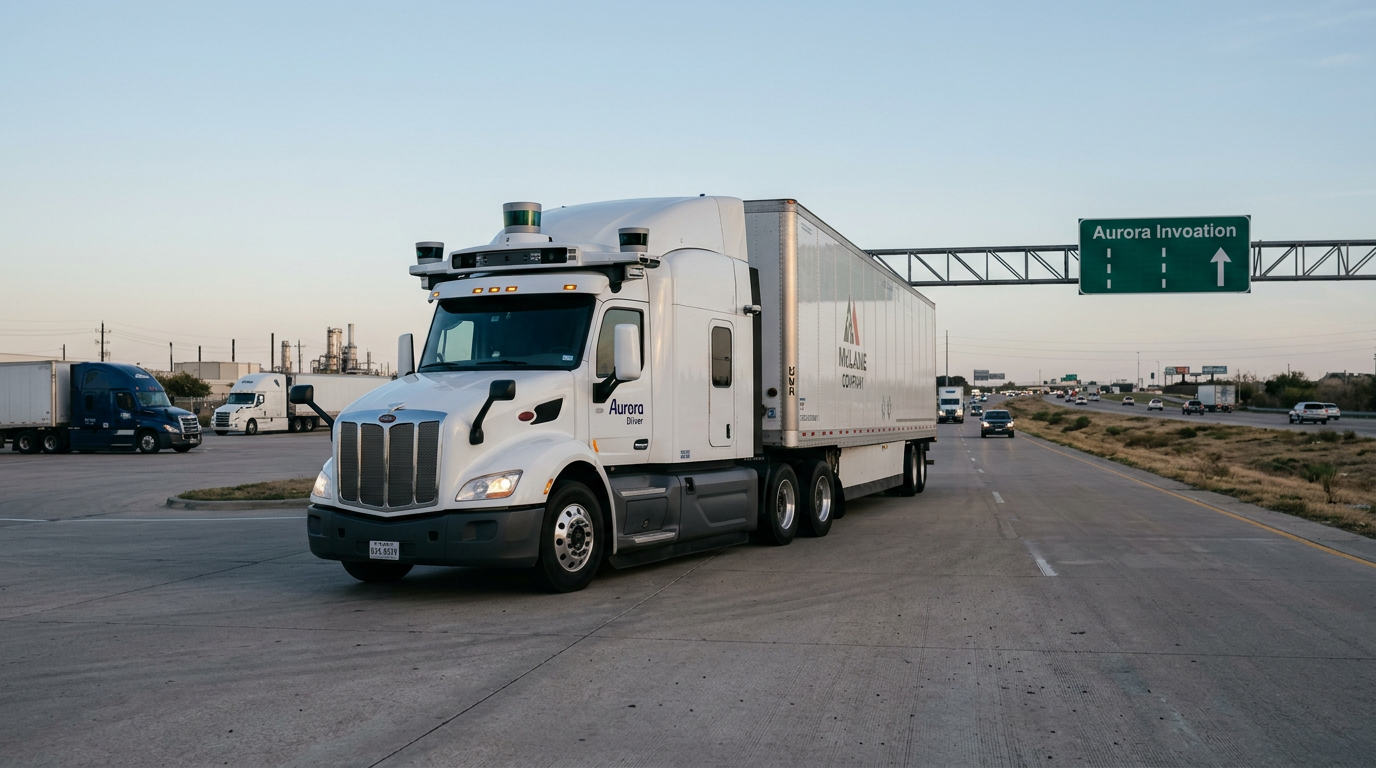
McLane Company – one of the largest supply chain distributors in the U.S., serving chain restaurants, convenience stores, and mass merchants – announced it will run driverless hauls in Texas using Aurora Innovation’s self-driving system. No safety driver. No observer. Just the Aurora Driver, an SAE Level 4 autonomous system, running long-haul routes between Dallas and Houston.
That is not a demo. That is commerce.
McLane has been using Aurora’s technology since 2023 and has logged 280,000 supervised autonomous miles in Texas before this step. The move to fully driverless operations is a direct result of that track record. Aurora now counts seven customers in its driverless cohort. The stock surged on the news – then pulled back. Trading volume hit 48.4 million shares in a single session, roughly 136% above its three-month average. Real operational milestones on one side, a cash burn and valuation problem on the other.
What the business actually is
Aurora develops autonomous driving systems for commercial trucks and passenger vehicles. Its core product – the Aurora Driver – powers two service lines: Aurora Horizon for trucking and Aurora Connect for ride-hailing. The model Aurora is building toward is capital-light: carriers pay per mile under a Driver-as-a-Service structure rather than owning hardware outright. Aurora owns and operates the current fleet during this initial commercial phase, then plans to transition customers to owning their own trucks starting in 2027.
The route network has expanded quickly. Aurora validated driverless operations on the Dallas–Laredo route in just six weeks of initiating supervised runs. A new bidirectional route between Dallas and Oklahoma City has also opened, where Aurora powers supervised autonomy for a Volvo Autonomous Solutions customer. The company’s commercial network now covers 12 distinct routes.
On the customer side: Hirschbach Motor Lines signed a memorandum of understanding for 500 Aurora-powered trucks, with deliveries slated to begin in 2027. Management describes that as a potential multi-year revenue stream worth hundreds of millions of dollars – though final binding terms have not yet been signed.
Worth a slight tangent here: Aurora’s partner list reads like a who’s who of the freight world. FedEx, Ryder, Schneider, Werner, PACCAR, Volvo, NVIDIA, Toyota, Uber Freight. That breadth of ecosystem buy-in is not accidental – and it does matter when you are trying to assess whether this company has the partnerships to actually scale.
Something unusual is reportedly coming out of Bastrop, Texas.
According to one new presentation, Elon Musk may be preparing to unveil a project he’s spent decades working toward — one some analysts believe could eventually rival the scale of Tesla, SpaceX, and xAI combined.
That’s a massive claim.
But investors are starting to pay attention because the project appears tied to a much larger long-term vision Musk has referenced for years.
And if the rollout begins soon, early attention could matter.
See why this strange package from Texas is generating so much curiosity >
Where it gets uncomfortable
Full-year 2025 revenue came in at $3 million. Q1 2026 revenue was $1 million – a 10% sequential increase from Q4 2025, driven by a record number of commercial miles. Aurora’s full-year 2026 guidance is $14 million to $16 million, which management describes as roughly 400% year-over-year growth at the midpoint. That is true. It is also true that $15 million against a $13.9 billion market cap is a price-to-sales multiple that defies conventional valuation logic.
The operating loss picture is stark. Q1 2026 operating loss including stock-based compensation was $244 million. Operating cash used in the quarter was $159 million, with capital expenditures of $25 million on top of that. Management guided for average quarterly cash outflows of $190 million to $220 million throughout 2026, with full-year capex of approximately $150 million. Aurora calls 2026 peak capital spend, with capex expected to decline significantly in 2027 as the Driver-as-a-Service model launches.
The balance sheet provides a runway. Aurora ended Q1 with nearly $1.3 billion in cash, short-term, and long-term investments. Management believes that is sufficient to support operations for at least the next twelve months and to reach positive free cash flow by 2028. The company also used an at-the-market equity program during Q1, issuing shares for net proceeds of $14 million – mostly to cover employee RSU tax obligations. Dilution is real, but contained so far.
- Market Cap: ~$13.9B (as of May 12, 2026)
- Full-Year 2025 Revenue: $3M
- Q1 2026 Revenue: $1M (10% sequential growth)
- Q1 2026 Operating Cash Used: $159M
- Q1 2026 Operating Loss (incl. stock comp): $244M
- Liquidity at Quarter-End: ~$1.3B
- 2026 Revenue Guidance: $14M–$16M
- Target Fleet by Year-End 2026: 200+ driverless trucks
- Run-Rate TaaS Revenue at 200 Trucks: ~$80M
- Positive Free Cash Flow Target: 2028
What Wall Street thinks
The analyst spread on this name is wide, which is itself informative.
Morgan Stanley raised its price target to $14 from $12 and kept an Overweight rating. Needham has a Buy with a $13 target. Goldman Sachs raised its target to $5 from $4 and maintained a Neutral rating. TD Cowen raised to $7 and kept a Hold. The average 12-month target across tracked analysts sits near $10. When your bull case is $14 and your bear case is $5, that range tells you everything about where the debate lives right now.
Morningstar’s quantitative model flags the stock as trading at a significant premium to estimated fair value. InvestingPro analysis echoes that view. Neither is a sell signal on its own – but both are worth knowing before you size a position.
Bull case, bear case, honest read
The bull case is real and it is growing. Berkshire’s indirect endorsement via McLane is not nothing. Aurora’s second-generation hardware kit – designed to last one million miles at less than half the cost of the first generation – is on track to launch in Q2 2026. California recently enabled autonomous trucking, expanding Aurora’s projected addressable market to 60 billion vehicle miles traveled by 2028. Consensus forecasts from S&P Global project total revenue reaching $3.1 billion by 2030, underpinned by $2.4 billion in trucking revenue. If Aurora gets to 200 trucks by year-end and scales toward the Hirschbach 500-truck deal in 2027, the unit economics start to look very different.
The bear case is also real. Quarterly cash outflows of $190 million to $220 million through 2026 require either continued dilution via the ATM program or additional capital raises. The Hirschbach deal is still an MOU – binding terms are not yet signed. Aurora has fewer than 200 trucks on the road today. The path from here to the scale implied by a $14 billion market cap requires years of clean execution in an environment where technology, regulation, and competition can all shift quickly.
The honest read: Aurora is operationally further along than most people expected at this point. The McLane relationship alone – 280,000 supervised miles, now fully driverless – is a meaningful proof of concept. But the stock is priced for a future that still carries substantial execution risk. This is not a value play by any conventional measure. It is a conviction bet on a technology that just crossed from theory into a Texas freight lane. The question is not whether autonomous trucking works. It is whether Aurora can scale fast enough, and cheaply enough, to justify what you are paying today.
Whether $14 billion is the right number for where Aurora sits right now – that is the question the market is still working through.