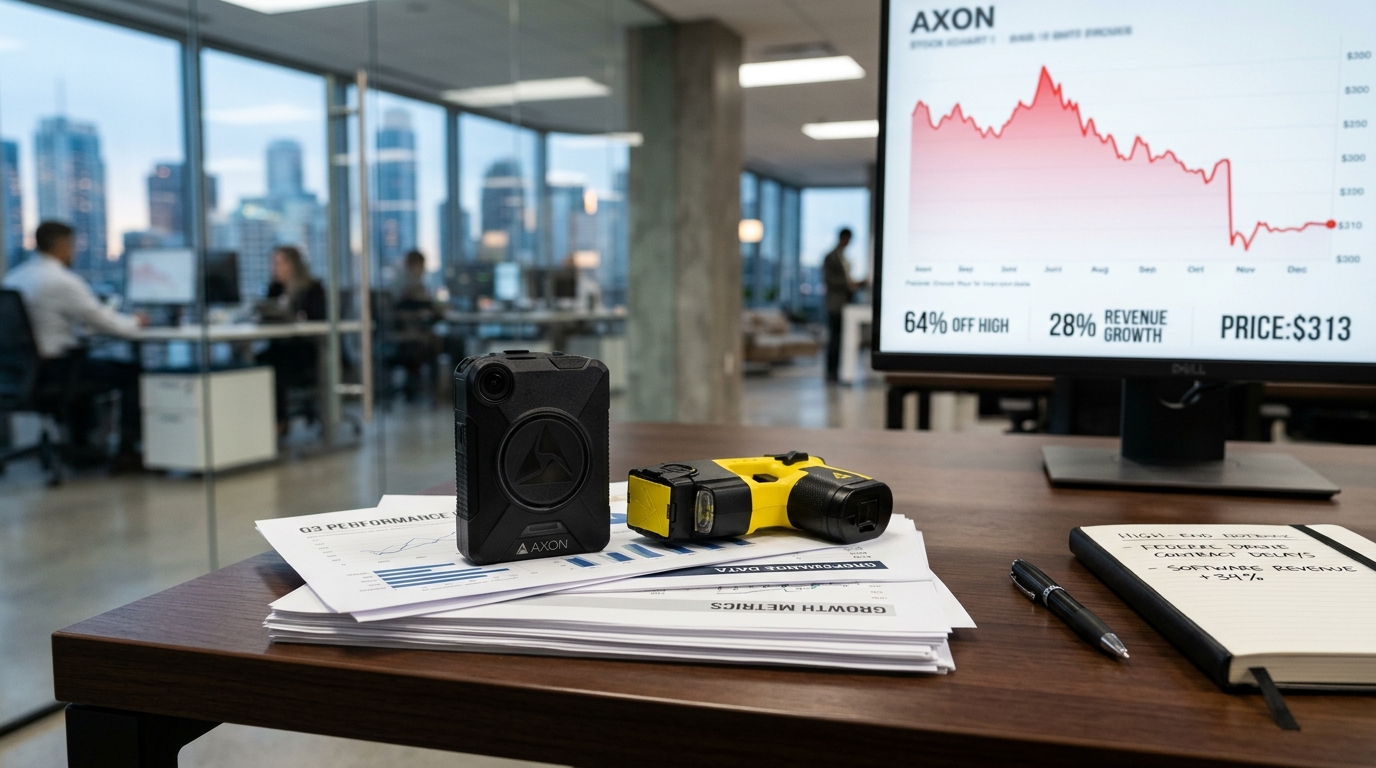
Axon Is 64% Off Its High and Still Growing 28%. Is $313 a Bargain?
Three delayed federal Dedrone deals pulled about $130M from 2026 guidance.
Hey there, bargain hunter. Axon just handed the market an 18% single-day selloff, and the stock is now sitting near its lowest close since August 2025. Before you decide whether to pick it up or walk past it, run the numbers with clear eyes.
Scoreboard
Q3 2026 results, reported November 5, 2026:
- Revenue: $908.6 million, up 28% year over year, missed consensus of roughly $934 million to $937 million
- Adjusted EPS: $1.72 versus $1.89 to $1.91 expected, up about 39% year over year
- Adjusted gross margin: 59.2%, down from 62.7% a year ago
- Adjusted EBITDA: $236 million, margin of 25.9%, up 33% year over year
- Stock: closed Friday at $313, down 18.18%, roughly 64% below its peak (about $885 intraday, about $871 on a closing basis)
What Actually Happened
The core miss was not a demand story. A single $30 million federal Dedrone deployment slipped out of Q3, keeping connected devices revenue to 16% growth when the market wanted more. Then the full-year guidance cut landed harder: three federal Dedrone deployments totaling approximately $130 million were removed from the 2026 outlook entirely, dragging the full-year revenue growth target from 32% to 34% down to roughly 30%.
Axon acquired counter-drone technology company Dedrone in 2024. Federal government deployments of that counter-UAS hardware are large, lumpy, and procurement-driven. They slip quarters. Management said going forward, large federal Dedrone deals will only be included in guidance once shipment is highly confident.
What the Business Actually Looks Like
Strip out the federal hardware timing issue and Axon’s software engine is running hot. Software and Services revenue grew 43% to $437 million, and software-only gross margin stayed above 80%. Annual recurring revenue was $1.75 billion, up about 40%, with net revenue retention at 126%, meaning existing customers are spending 26% more than they were a year ago.
Future contracted bookings hit $15.8 billion, up 39% year over year, beating analyst expectations that clustered around $15 billion. That backlog funds years of forward revenue regardless of any single quarter’s federal procurement calendar.
Is It Cheap?
At $313, Axon trades at roughly 7x trailing sales. For context, Motorola Solutions (MSI), the nearest public-safety tech peer, runs at approximately 6.8x sales with a gross margin of about 52%. Axon is still more expensive on a sales multiple, but it is growing materially faster and has a software layer that Motorola cannot match.
Axon’s normalized P/E sits near 46x. That is not cheap. The question is whether 28% to 30% revenue growth, a $15.8 billion backlog, 126% net revenue retention, and an Adjusted EBITDA margin holding at 25.9% justify that premium. For a company Axon’s size, those are elite metrics.
The free cash flow picture is weaker. Axon cut its 2026 free cash flow target to $350 million to $400 million, from $450 million, citing an accelerated inventory build. That is a real near-term ding.
Bull / Base / Bear
Bull: The three delayed federal Dedrone deployments slip into 2027 and close, adding a step-function revenue quarter. Software ARR continues compounding at around 40%. Analysts at Needham (target $500) and Piper Sandler (target $540) maintain Buy and Overweight ratings respectively, implying about 60% to 72% upside from Friday’s close.
Base: Federal Dedrone deals remain unpredictable quarter to quarter. Revenue growth stabilizes at 28% to 30% annually. The stock re-rates toward 35x to 40x forward earnings as federal execution risk gets priced in permanently. That implies a fair range of $340 to $390.
Bear: Federal procurement keeps slipping. Margin compression from counter-drone hardware mix worsens. Craig-Hallum downgraded the stock to Hold after the quarter, pointing to weakness in TASER and platform results alongside federal timing volatility. If growth decelerates toward 20% and margins compress further, $313 is still not cheap.
Valuation compression after a guidance cut is a pattern worth studying across software names. CRM and ADBE show how high-retention subscription businesses can trade near multi-year valuation lows while fundamentals remain intact.
Action Plan
This is a scale-in situation, not an all-in moment. The backlog and software metrics argue that the business is structurally intact. The federal deployment lumpiness argues that another miss is possible in Q4, where guidance of $990 million to $1.01 billion already sits below where the Street had been sitting before the report (around $1.06 billion).
- First tranche: Consider an initial position at current levels ($310 to $320) if you have a 12 to 18 month horizon and can tolerate further near-term volatility
- Second tranche: Add on confirmation that at least one of the three delayed federal Dedrone deployments has shipped, ideally in a Q4 update
- Trim trigger: ARR growth decelerates below 30% or net revenue retention drops below 120%
Cheap Investor Scorecard
- Revenue growth (28% in Q3): Pass, though decelerating from 35% in Q2
- ARR (about 40% growth to $1.75B): Pass
- Net revenue retention (126%): Pass
- Future contracted bookings ($15.8B, +39%): Pass, beat expectations
- Adjusted EBITDA margin (25.9%): Pass, expanding year over year
- Gross margin (59.2% adjusted, down from 62.7%): Watch, counter-drone mix is a headwind
- Free cash flow guidance ($350M to $400M, cut from $450M): Fail
- Federal Dedrone execution: Fail, about $130M removed from 2026
- Q4 revenue guidance vs. Street ($990M to $1.01B vs. around $1.06B prior): Fail
- Valuation vs. growth (about 7x sales, about 46x normalized P/E at 28% to 30% growth): Borderline
Bottom Line
If the three stalled federal Dedrone deployments land in 2027 and software ARR stays above 35% growth, Axon at $313 looks like a genuine discount on a category-defining business. If federal procurement continues to slip and counter-drone margin pressure compounds, the stock is cheaper than it was at its 2025 peak but still not cheap enough to own without a plan. Score: 6 of 10 on the checklist. Buy in tranches, not conviction size.