Dear reader,
This stock trades for under $5 today.
Dr. Mark Skousen believes it could hit $50 by January 1st.
Why?
It’s one of the top stocks Elon Musk is targeting.
He’s revealing the key details in his latest briefing.
Click here for the story before it’s too late to take advantage.
Good investing,
Rachel Gearhart
Publisher, The Oxford Club
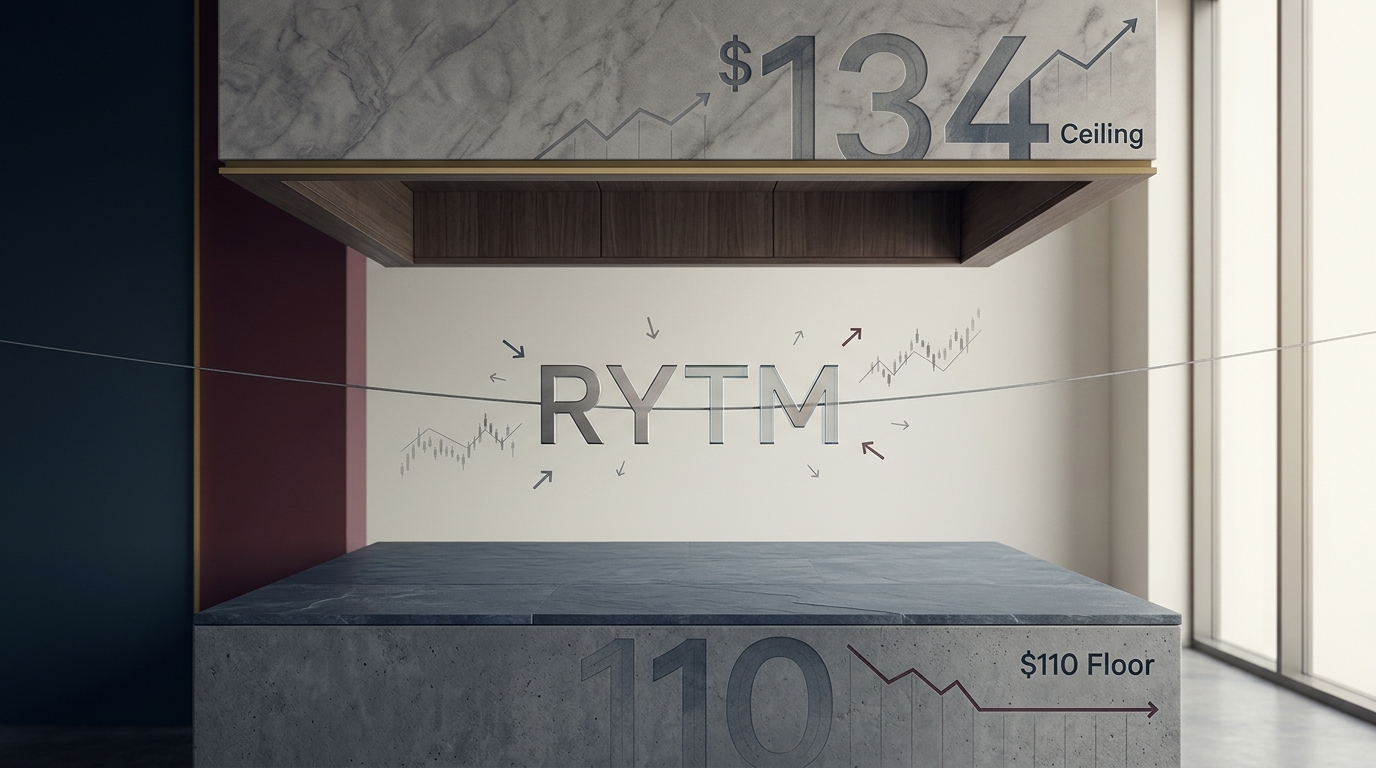
Rhythm Pharmaceuticals Has a $134 Ceiling and a $110 Floor. Mind the Gap.
Hey there, bargain hunter. A stock that closed at $110.68 against a reported acquisition ceiling of $134 a share is not a done deal. It is a spread. And right now, that spread is your entire investment thesis, one way or the other.
Scoreboard
Reuters reported on November 4, 2026 that AstraZeneca made a non-binding offer of about $10 billion for Rhythm Pharmaceuticals, worth as much as $134 a share including milestone payments. The Wall Street Journal had earlier reported a $124-per-share offer made last month. Rhythm closed up 28% at $110.68, giving it a market capitalization of about $7.64 billion. AstraZeneca shares rose about 2.8% on November 4, 2026.
What Actually Happened
The deal would run through Alexion, the rare-disease specialist AstraZeneca acquired for $39 billion in 2021, and would give the pharma group an established position in rare genetic forms of obesity. The offer is reported, not announced, and no agreement has been confirmed by either side.
Then Friday happened. On November 6, 2026, Rhythm shares rose about 4.2% following reports of a second potential bidder entering the fray, challenging AstraZeneca’s proposal. Analysts at Jefferies, Leerink Partners and William Blair all suggested a bidding war could develop, arguing Rhythm is unlikely to settle for AstraZeneca’s current pitch.
Competing bids in rare-disease and specialty pharma have become more common as large acquirers pay steep premiums to secure commercial-stage assets. Gilead’s $1.275 billion upfront payment for a Phase 1 drug illustrates how urgently large pharma is bidding for pipeline access.
What the Market Is Really Saying
The 21% gap between $110.68 and the $134 ceiling is not pure upside. It is the market pricing three things simultaneously: deal-completion risk, milestone uncertainty, and the chance AstraZeneca walks. At $124 flat (the hard-cash floor reported by the WSJ), $124 represented a 43.4% premium to Rhythm’s pre-leak close of $86.44, but against the post-news close of $110.68 it narrows to about a 12% premium, meaning the stock had already priced in a meaningful chunk before the number leaked. The milestone-weighted $134 ceiling requires Rhythm to hit clinical and commercial benchmarks that may be years away.
Deep Dive: What Rhythm Actually Sells
Rhythm’s approved therapy Imcivree (setmelanotide) treats rare obesity caused by specific genetic defects, and on March 19, 2026 the FDA expanded its use to acquired hypothalamic obesity, making it the first and only FDA-approved therapy for that condition in the United States. While Rhythm’s therapies target rare forms of obesity rather than the broader weight-loss market, an acquisition would give AstraZeneca an established commercial presence in a fast-growing field while expanding its rare-disease portfolio.
Data Section
- Q3 2026 Imcivree revenue: $92.1 million, up 29% sequentially from Q2 2026.
- Nine-month 2026 revenue: $223.5 million vs. $137.5 million for the same period in 2025.
- Cash, cash equivalents and short-term investments as of September 30, 2026: approximately $320.9 million.
- More than 700 patient start forms for acquired hypothalamic obesity in the U.S. as of September 30, 2026.
- Q3 revenue of $92.1 million came in below analyst estimates of $98.74 million.
- The obesity drug market is widely projected by major research firms and investment banks to reach about $100 billion a year around 2030, though forecasts vary.
Is It Cheap?
At $110.68, the stock trades at roughly 10x annualized Q3 revenue. That is not cheap by biotech standards. But Rhythm is not a speculative pipeline play anymore: it has a commercial product, accelerating quarterly revenue growth, and now two reported bidders. The embedded premium to pre-leak levels is real. What you are paying for above $110 is optionality on a higher final offer or a competing bid lifting the floor.
Bull / Base / Bear
Bull: A competing bidder from the Novo Nordisk or Eli Lilly ecosystem forces AstraZeneca to close the gap to $134 or above. RYTM clears $130.
Base: AstraZeneca returns with a binding offer at or near $124, the hard-cash figure. Shares converge there over 60 to 90 days. That is roughly 12% from the November 4 close, before any arb financing cost.
Bear: AZ’s reported bid for Rhythm comes after reported merger talks with Bristol Myers Squibb did not result in a deal, and alongside AstraZeneca’s recently disclosed restructuring program that targets $1.5 billion in annualized pre-tax run-rate benefits by the end of 2029. A buyer under cost pressure can walk. If AstraZeneca withdraws and no competing bid materializes, RYTM likely retraces toward the high $80s.
Action Plan
If you do not own RYTM: the base case at $124 offers a slim but real spread. Size accordingly, keeping position size small enough that a deal collapse does not wreck you. If you do own it from below $90: the spread to $124 is already substantial. Trimming half here and holding the rest for a potential auction outcome is defensible. Do not chase above $115.
Cheap Investor Checklist
- Non-binding offer reported by Reuters and WSJ: yes, unconfirmed by either company
- Hard-cash floor (no milestones): $124 per share
- Gap to $124 from $110.68 close: approximately 12%
- Gap to $134 ceiling: approximately 21%
- Second bidder reported: yes, as of November 6, 2026
- Goldman Sachs advising Rhythm: not confirmed
- Q3 revenue growth rate: 29% sequentially, about 80% year over year
- AstraZeneca restructuring underway: yes, $1.5 billion annualized benefit target by end of 2029
- Deal structure: through Alexion rare-disease arm
- Key downside trigger: AstraZeneca withdrawal with no competing bid
Bottom Line
If AstraZeneca firms up at $124 and no competitor appears, RYTM offers a narrow arbitrage that rewards patience. If a bidding war develops, the upside is meaningfully larger. If AstraZeneca walks, so does a lot of that 28% gain. The business underneath is real and growing fast. The offer is not. Treat the two separately, and size your position to survive the bear case before you daydream about the bull one.