
October 18, 2026
Bonus Content: Procter & Gamble at 22x Earnings Is Not as Safe as It Looks
Mining currently earns the highest profit margins of any major sector.
About 31%.
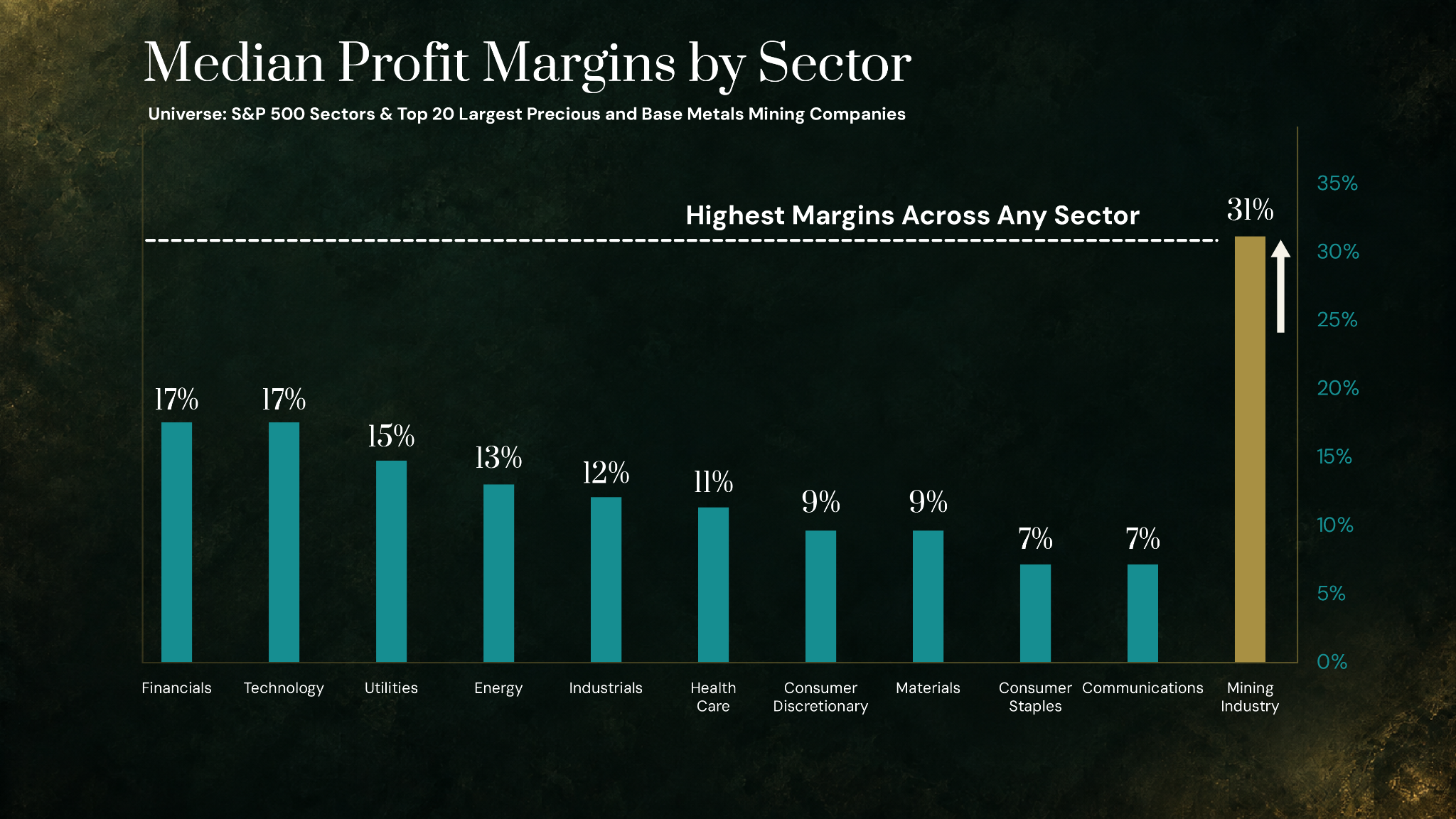
The next best sector earns just 17%. Now, here’s the kicker…
Mining only represents 1% of global equities.
Read those two facts again.
The sector with the highest profitability…
Is also the least owned – going back more than a century. Go here for the full story on the top-performing investment sector – and my top four picks
This kind of anomaly doesn’t last long.
That’s why I put together this special briefing – to tell you about the four best miners you can buy today. Go here for the full write-up.
My name is Garrett Goggin.
I’m one of 200,000 CFA charterholders worldwide. I’m also a Certified Market Technician, and I’ve spent more than two decades specializing in gold and mining.
Porter Stansberry calls me “THE most knowledgeable gold investor in the world.”
Right now, I’m looking at one of the strangest mispricings I’ve seen in my career.
Mining companies are churning out record free cash flow…
And almost no one cares.
Investors are still chasing AI tech stocks and won’t touch the most profitable sector in all of finance.
This kind of thing only happens a few times a century…
I call it the “Golden Anomaly.” Go here to read all about it before it’s gone.
Because if I’m right, this opportunity will disappear as investors rotate into gold miners to protect their wealth when the AI trade finally breaks.
These four miners offer the greatest upside.
Regards,
Garrett Goggin, CFA, CMT
Lead Analyst and Founder, Golden Portfolio
Procter & Gamble at 22x Earnings Is Not as Safe as It Looks

Hey there, bargain hunter. Consumer staples stocks are supposed to be the bunker you hide in when the world goes sideways. P&G is supposed to be the bunker inside the bunker. But before you treat Thursday’s fiscal Q1 2027 report as a green light, ask yourself what you’re actually paying for.
Scoreboard
Procter & Gamble releases fiscal Q1 2027 results before the open on Thursday, October 22. Analysts expect about $1.88 per share on roughly $22.7 billion in revenue. Last quarter, the company earned $1.43 per share, beating the consensus by two cents, but revenue of $21.20 billion fell short of the $21.38 billion estimate. Quarterly revenue grew 1.5% year over year. The stock has drifted about 4% higher over the past month as money rotated into defensives.
The Real Reason This Matters
The quarter drops into a cost environment that is genuinely ugly. The producer price index rose 6.3% year over year in September, the largest annual increase since December 2022, with energy costs driving the index higher and signs of price spillover into other categories. Core PPI, which excludes food and energy, still added 0.7% on the month. That core figure is the one that eats P&G alive. Resins, surfactants, packaging polymers, and freight all trace back to oil, and Brent settled at $109.86 per barrel on October 16, up about 3.7% on the day.
The oil move is not isolated to one session. Brent crossing $100 created two distinct trades, and the analysis of which one holds up under sustained supply disruption is the framework P&G’s cost model now has to survive.
That is not a footnote. That is P&G’s raw material basket on fire.
What the Business Actually Does
With a market cap around $337 billion, P&G is a household-name powerhouse behind brands spanning beauty, grooming, health care, fabric and home care, and baby and family products. Tide, Pampers, Gillette, Dawn. The brands are real and the loyalty is real. The question is whether brand loyalty pays for $110 Brent.
Data Section
- Consensus adjusted EPS for fiscal Q1 2027: about $1.88.
- UBS expects stronger sales momentum driven by improving US consumption trends, forecasting organic sales growth of 2.6% versus the Street’s 2.0% estimate.
- P&G has lagged the broader market over the past year as sluggish organic sales growth and muted consumer demand have weighed on results, with Wall Street expecting only 1.9% growth over the next 12 months.
- Operating cash flow in the April-June quarter was $5.1 billion.
- P&G has set full-year FY2027 adjusted EPS guidance at $6.89 to $7.11.
Is It Cheap?
P&G’s trailing price-to-earnings ratio sits at about 22 times as of mid-October 2026. That is not cheap in absolute terms, and it is not cheap relative to the group where it counts. Kimberly-Clark trades around the mid-teens on trailing earnings and Unilever around the low 20s, depending on the day and the listing. P&G’s dividend yield is roughly the high-2% range, which is below the yield on a 10-year Treasury in the mid-5% range.
You are paying a premium for safety. The problem is that 6.3% annual wholesale inflation is not a safe environment for a company growing revenue at 1.5%.
Bull / Base / Bear
Bull: P&G has beaten analysts’ bottom-line estimates in each of the past four quarters. If pricing holds and volume stabilizes, around $7.42 EPS for FY2028 gives you a more attractive forward multiple than it looks today.
Base: UBS sees P&G on track to meet its fiscal 2027 guidance of 1-3% organic sales growth and 0-3% core EPS growth. Margins stay pressured but the dividend is safe. The stock drifts sideways.
Bear: If oil holds above $100 through winter and volume slips again, earnings estimates come down and the multiple compresses. That is a painful double.
Action Plan
If you already own PG as a core position, hold it. The dividend is reliable and the brands are not going away. Do not add ahead of the report. Let Thursday give you the organic volume number. If volume is positive and guidance holds, the stock earns its multiple. If volume misses again into a 6.3% PPI, consider trimming and rotating toward cheaper staples where you are not paying as much for the same defensive story.
Cheap Investor Checklist
- Organic volume growth: positive or negative? This is the make-or-break line.
- Gross margin direction: expanding or contracting vs. prior quarter?
- Pricing realization: is P&G raising prices, or has consumer pushback capped it?
- FY2027 guidance: does management hold the $6.89-$7.11 adjusted EPS band?
- Brent crude: watch the October average; above $110 sustained means Q2 margin risk.
- Baby and Family Care volume: pressure last fiscal year was real. Stabilization required.
- Dividend coverage: free cash flow productivity above 100% is non-negotiable.
Bottom Line
If Thursday shows organic volume turning positive and management holds guidance, PG at about 22 times is a reasonable defensive hold. If volume disappoints again into the worst producer-price surge since late 2022, this is not a bunker. It is a premium-priced company with a cost problem.