
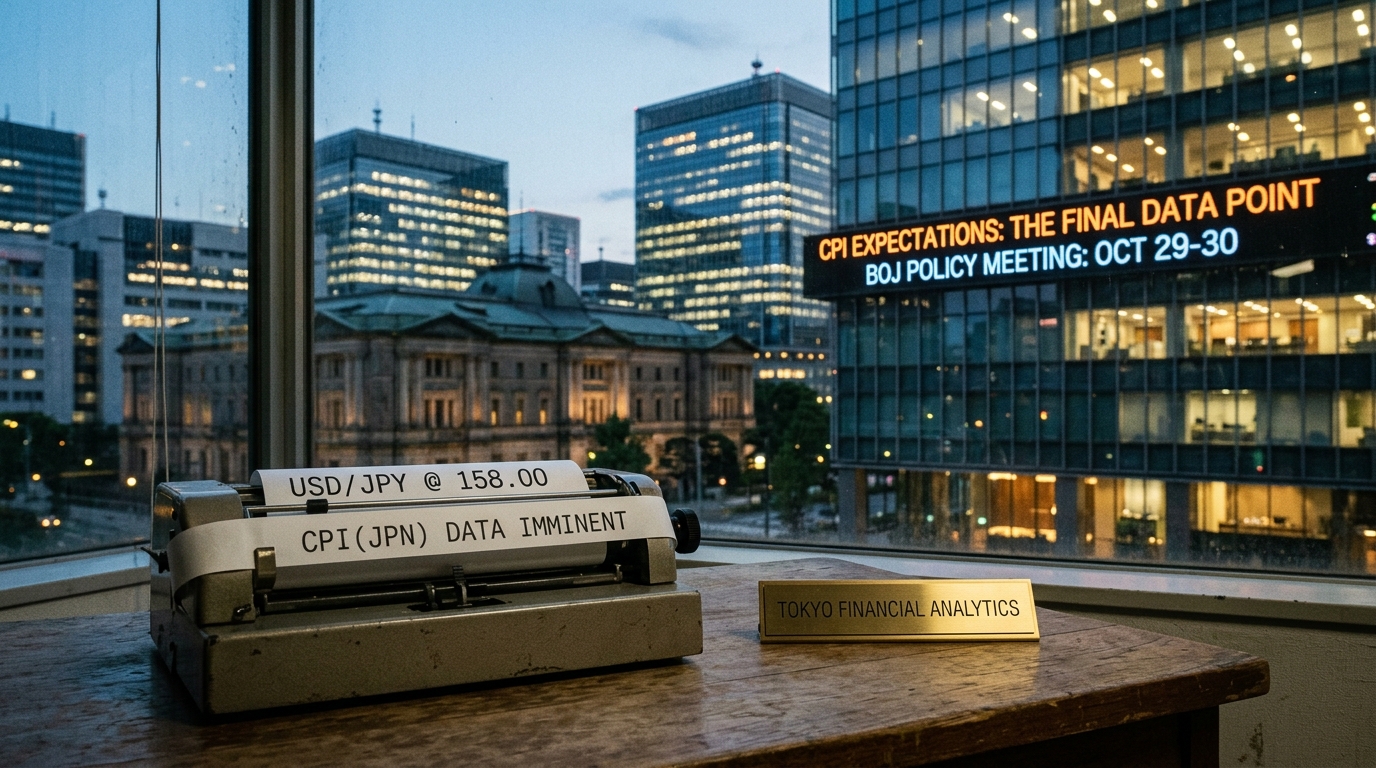
The standoff in USD/JPY is about as clean as currency markets get. The yen sits near 158, Tokyo has signaled that 160 is a line it is prepared to defend, and the Bank of Japan is said to be leaning against hiking at its Oct. 29-30 meeting. That leaves a narrow band of running room and one piece of data to resolve it: Japan’s national CPI for September, due Friday morning in Tokyo, which is Thursday night in the U.S.
The numbers heading into that release are complicated. Tokyo’s CPI for September surged to 2.7% year-on-year from 1.9% in August, beating expectations, with the ex-food-and-energy measure jumping to 3.0% from 2.0% the month before. That is the kind of acceleration that, in most economies, would put a rate decision in play. But the national figure has been lagging: core CPI rose 1.7% year-on-year in August, still below the Bank of Japan’s 2% target, with government energy subsidies doing much of the suppression work.
Whether that number moves policy at October’s meeting is a different question. Bloomberg reported Oct. 13 that BoJ officials are leaning against a back-to-back rate increase, seeing little need for consecutive hikes absent a sharp upside inflation surprise. The BoJ raised its policy rate to 1.25% in September, just three months after June’s hike, itself an acceleration from the prior pace of one move every six months. Markets have absorbed that message: December is now viewed as the more likely next opportunity than October.
The Politics Are Moving Too
Prime Minister Sanae Takaichi entered office with a reflationist reputation that markets priced in immediately, and the yen paid the bill. She has been walking it back. At an Oct. 8 parliamentary session, Takaichi said directly that Japan no longer needs reflationary policy, arguing the economy is no longer in deflation. Growth Strategy Minister Minoru Kiuchi reinforced the message in late September, ruling out reflationary policy and stressing the BoJ’s independence. Even Takaichi’s own camp has publicly left room for the next hike to come later rather than immediately.
The Washington angle adds pressure of its own. Reuters has reported that Japan and the U.S. conducted coordinated yen-buying intervention in late July, pushing USD/JPY down sharply from the mid-160s into the mid-150s in days. Finance Minister Satsuki Katayama has said the principles behind that coordinated action remain in place, signaling Tokyo’s readiness to act again if moves are judged disorderly.
Where the Risk Is Asymmetric
USD/JPY has closed above 159.00 since September, and recent sessions have mostly stayed in a tight band below 160. The range is tight, and the ceiling is credible. MUFG has noted that USD/JPY rising above 160 would likely prompt stronger warnings and raise the prospect of further coordinated action.
The Nikkei 225 has its own stake in the outcome. The index closed at 65,324 on Oct. 16, well off its June peak near 72,366, and has dropped sharply on yen-strength episodes before. The 10-year JGB yield sat near 2.93% on Oct. 16, still elevated by Japanese historical standards, with the 30-year near 4.00%.
What to Watch
A September national CPI print that clearly beats expectations revives at least a tail probability of an October surprise and sends the yen through 157 toward 155. A softer reading gives dollar buyers permission to probe 159 again, returning the pair to the uncomfortable proximity that has repeatedly drawn official warnings. The BoJ’s Oct. 29-30 decision then becomes the next binary.
The bear case for yen strength is straightforward: the BoJ holds in October, the Fed holds or hikes at its late-October meeting, and the rate differential keeps carry traders leaning short yen. But at 158, with a coordinated intervention already on the record and the ministry publicly defending 160, the cost of being wrong is not symmetric. The market knows where Tokyo’s line is. Thursday night is when we find out how close inflation is to making that defense unnecessary.