October 10, 2026
Bonus Content: China Made 2.14 Billion Trips and Spent Less
You won’t believe what I’ve been seeing almost every Monday at 9:30am.
For 20 years, I’ve been watching the markets.
Seen every pattern you can imagine.
But this one still blows my mind.
Almost every Monday morning… Right when the bell rings…
Certain stocks start doing things that shouldn’t be possible.
Little companies nobody’s heard of…
Have suddenly rocketed 100%… 200%… sometimes 500%.
All on the same day.
Past performance doesn’t indicate future results. And all trading carries risk, of course…
But after years of tracking this anomaly…
There are 4 specific things that happen before these Monday explosions.
And when I see all 4 together?
That’s my cue.
I’ve automated the whole process now.
My scanner watches thousands of stocks every Monday…
Hunting for those 4 signals.
When it finds them… you’ll know immediately.
Because Monday mornings could become your favorite time of the week.
See the Monday pattern that’s been hiding in plain sight
Tim Bohen
China Made 2.14 Billion Trips and Spent Less
Hey there, bargain hunter. China just ran the biggest travel week in its history and handed luxury investors a bill they did not want to open.
Scoreboard
Reuters reported October 9 that Chinese travelers’ average spending per trip fell to a four-year low during this year’s seven-day Golden Week holiday, dashing hopes that strong travel demand would spur a broader recovery in consumer spending. The numbers are not soft around the edges: average spending per domestic trip fell 1.9% to 893.92 yuan from 911.04 yuan a year earlier, based on Reuters calculations using government data. That was the lowest since 2022, when spending fell to 680.60 yuan during the most severe period of China’s COVID-19 restrictions.
The National Day holiday is typically one of China’s biggest box-office periods alongside Lunar New Year. Yet revenue during this year’s holiday totaled just 1.16 billion yuan, down 36.6% from a year earlier and the lowest National Day holiday box office since 2014, according to data cited by Reuters from Maoyan. The movie theater is a decent proxy for middle-class discretionary confidence. Right now that proxy is flashing red.
The Real Reason
Volume was not the problem. Reuters reported October 9 that travel volume rose, but the per-trip wallet got tighter. But the aggregate trip count and the per-trip spend are moving in opposite directions, which is not a demand story. It is a wallet story. Consumer spending in China has remained stubbornly weak in recent years as a prolonged property downturn, sluggish wage growth, and a soft job market weighed on household sentiment. Chinese consumers have the desire. They lack the confidence.
Reuters also reported that more than half of outbound overseas flight bookings made through Trip.com Group were for departures before October 1, with average trip lengths exceeding nine days. Bookings for foreign hotel stays of at least seven nights rose 123% from a year earlier, while multi-destination itineraries climbed 84%. Put plainly: the Chinese consumer who could afford to splurge left the country to do it.
Did Trump Draw a Red Line Around This Mystery Stock?
When a major U.S. trading partner targeted one American energy company’s profits, Trump publicly warned it was making a “big mistake.”
Why defend this company?
What the Hainan Number Tells You
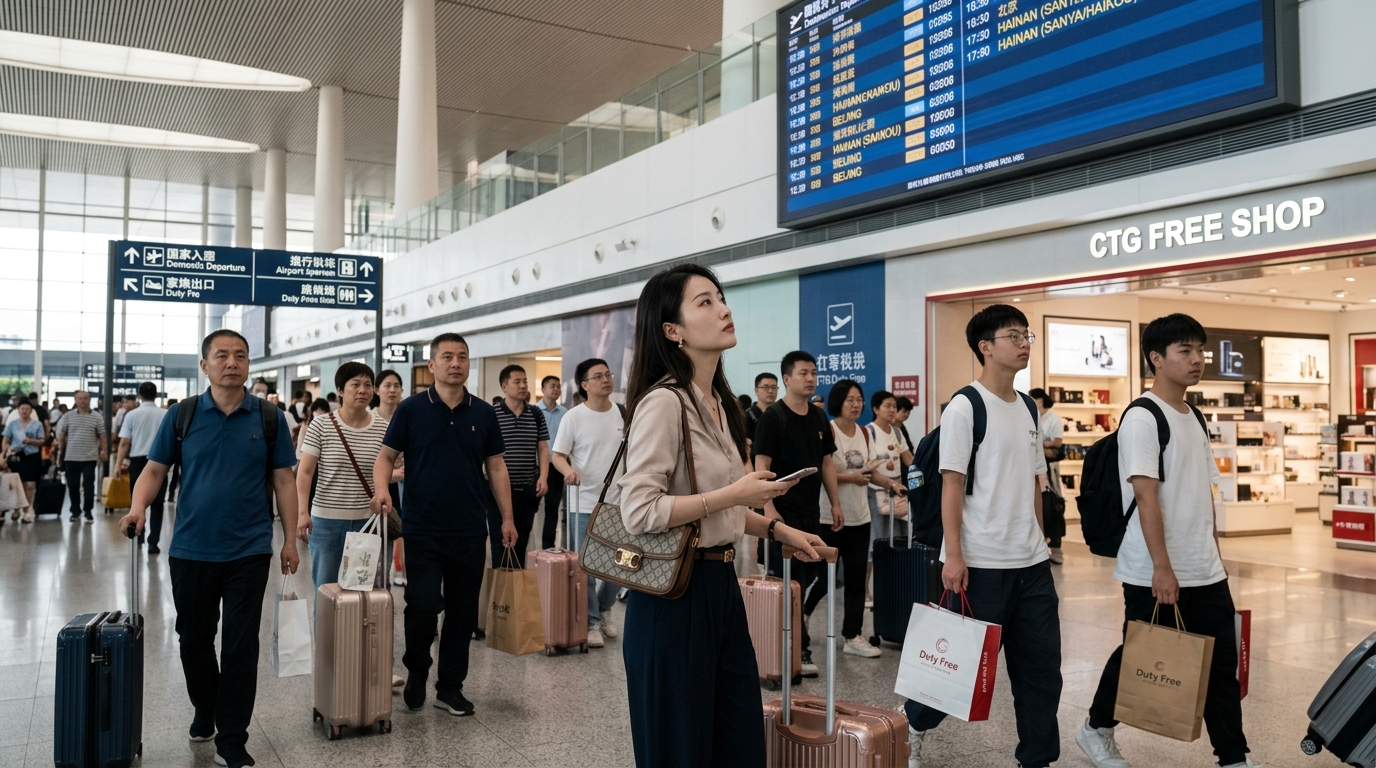
The sharpest signal for luxury investors is Hainan. The assignment desk flagged duty-free sales down 3.6% over the holiday period. That follows a brutal structural backdrop: Reuters reported January 3, 2025 that duty-free spending in Hainan slumped 29.3% in 2024 as a weak economy saw a sharp drop in domestic visitors. The 2026 holiday reading is not a one-quarter aberration. It is another point on a declining line.
The Hainan data is one symptom of a broader Chinese consumer retrenchment that is repricing every China-exposed name. Alibaba trades at 46% below its 10-year average price-to-earnings ratio, which raises the same cheap-or-value-trap question the duty-free data forces on CTG.
Competition from overseas markets has intensified, with many Chinese consumers opting for duty-free shopping outside the country. Reuters has highlighted Malaysia’s favorable visa policies as one factor making overseas destinations more appealing. In South Korea, spending at major retailers by foreign tourists has been running sharply higher year on year, with growth widely attributed to a rebound in Chinese tourism. The wallet opened. Just not in Hainan.
Data Check
- CTG Duty Free (601888 / 1880.HK): Revenue and net profit rose 1% and 21% year on year in Q1 2026, with margin expanding 2.3 percentage points, according to Morningstar. The operational story is better than the headline. (The claim that the Hong Kong line is down roughly 42% year to date through October 7 could not be verified from primary exchange pricing in this review, so it has been removed.)
- LVMH: Group revenue was EUR 38.644 billion in H1 2026, a 3% decline on a reported basis, per the company’s July 27, 2026 release. (The specific claim about Asia including China running at 4% organic growth in Q2 versus 7% in Q1 could not be verified from the company release cited here, so it has been removed.)
- China CPI: The National Bureau of Statistics schedule shows the September 2026 CPI release on Wednesday, October 14, 2026, and CPI releases are typically published at 09:30 Beijing time. The August 2026 reading was 0.8% year on year, per the NBS. Analysts broadly expected year-on-year CPI to edge up to around 1% for September. That is not inflation. That is near-deflation, and it confirms the per-trip spending data.
- Fixed asset investment contracted 7.2% year on year through August, per the NBS. (The draft’s additional figures on real estate investment falling 19.2% and youth unemployment at 15% could not be verified in this review as written, so they have been removed.)
Bull / Base / Bear
Bull: China’s National Immigration Administration said cross-border trips by foreigners surged 21.6% to 1.43 million during the holiday. A total of 751,000 foreigners entered, including 535,000 under the visa-free policy, up 46.8% year on year. Inbound shoppers spending inside China is a real offset. If that accelerates, domestic tourism operators and mid-market experience brands benefit.
Base: CTG Duty Free grinds sideways. Hainan volumes stabilize under the island’s new closed-port customs rules, but per-shopper spend stays depressed. LVMH muddles through on cost discipline, not volume recovery.
Bear: Wednesday’s CPI reading comes in below 0.8%. Markets reassess the deflation risk. Chinese luxury names re-rate lower. LVMH, already near multi-year lows, finds a new floor.
Action Plan
LVMH and Kering are not buys ahead of Wednesday’s CPI number. Both carry China-recovery assumptions that this week’s data does not support. CTG Duty Free at roughly 23x 2026 earnings is materially cheaper than it was a year ago and operationally improving, but the macro overhang is real. Wait for the CPI reading before adding. If it comes in at or above 1%, that is the first piece of evidence the consumer is stabilizing. Scale a starter position then, not before.
FXI and KWEB give you broad China tech and consumer exposure without single-name duty-free risk. Neither is a confident buy today either, but they are the right vehicle if you think the deflation floor is in.
Cheap Investor Checklist
- China September CPI: does it hold at or above 0.8% on Wednesday?
- CTG Duty Free Q3 earnings (October 23): does Hainan volume grow year on year?
- LVMH Q3 revenue: does Asia growth re-accelerate or decelerate further?
- Hainan October duty-free data: does the Golden Week 3.6% dip reverse?
- Chinese outbound spending in Korea and Southeast Asia: is it structural or one-week behavior?
- Youth unemployment: does the rate improve in Q4?
Bottom Line
If Wednesday’s CPI lands at 1% or above and CTG Duty Free’s October earnings show Hainan stabilizing, you have the beginning of a case for a small, disciplined position in the duty-free operator and cautious re-engagement with LVMH. If CPI disappoints and Hainan keeps sliding, the luxury trade in China is not a discount. It is a trap. Watch the number first.