China’s graphite export pause expires on November 10, 2026. That deadline is more revealing than any earnings report about where the real money in battery materials is moving right now.
China temporarily suspended enhanced graphite export controls to the United States through November 10, 2026, a pause that smoothed trade friction but solved nothing structural. China controls roughly three-quarters of natural graphite production and more than 90 percent of graphite refining into battery-grade spherical graphite. When Beijing can flip that switch at will, American manufacturers of drones, autonomous systems, and electric vehicles are exposed to a single point of failure that no tariff schedule can fix.
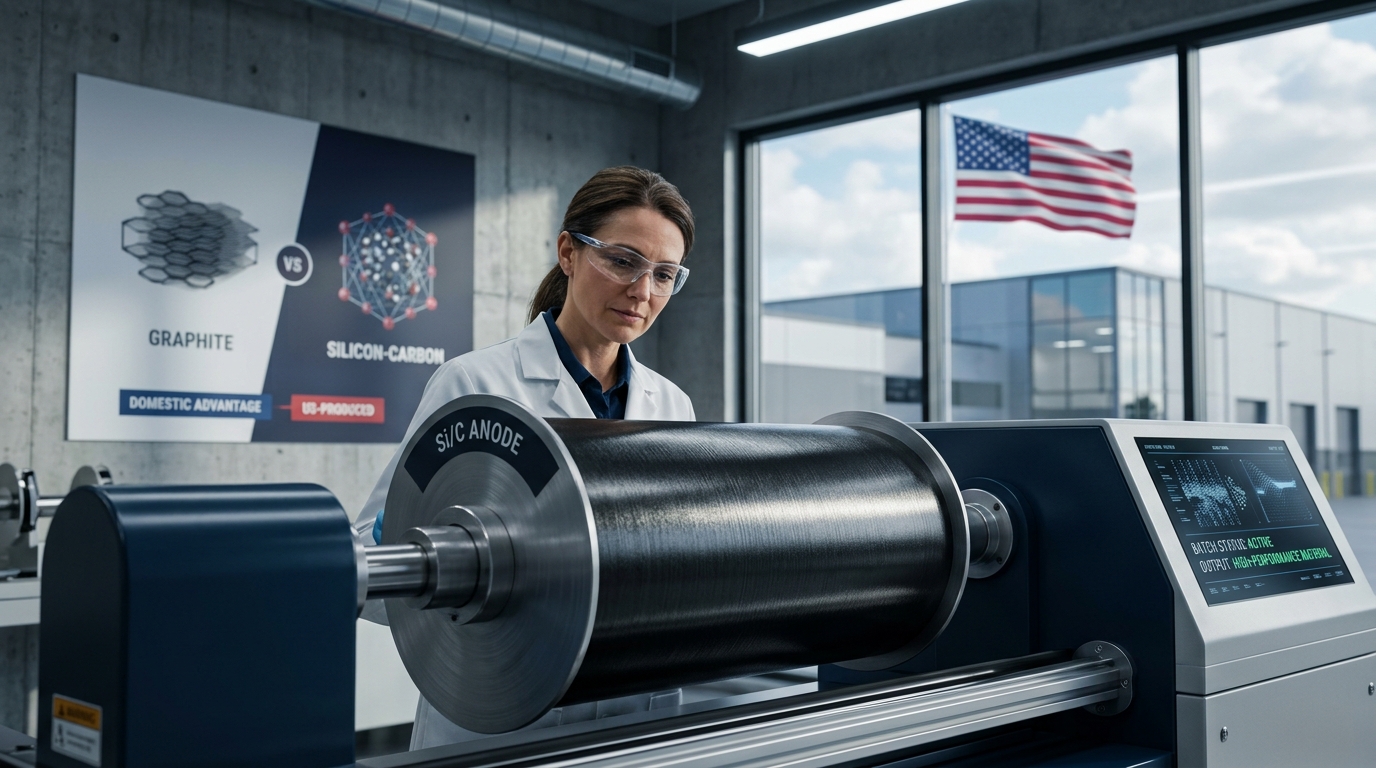
Washington’s answer arrived in August, and it was larger than most observers expected. Sila Nanotechnologies received a conditional loan commitment of up to $1.4 billion from the Pentagon’s Office of Strategic Capital to expand production of silicon-carbon battery anodes and support the buildout of a lithium-ion battery cell manufacturing facility. The financing would support expansion of Sila’s silicon-carbon anode manufacturing capacity at its Moses Lake, Washington facility as well as the buildout of a lithium-ion battery cell manufacturing facility.
The strategic logic is straightforward. Sila says its Titan Silicon can replace some or all graphite in a lithium-ion anode, and silicon-based anodes can store more energy than conventional graphite-heavy designs, a performance gain that translates into longer range for electric vehicles, smaller consumer devices, and lighter power systems for defense uses. Silicon-carbon is not merely a graphite substitute. It is a performance upgrade that happens to eliminate a geopolitical dependency.
Sila is not alone in this race. Group14 Technologies announced in March 2026 that its South Korea plant had started EV-scale production of its SCC55 material, designed for 2,000 tonnes annually, which the company says is roughly 10 GWh of energy-storage capacity. In June 2026, Sicona Battery Technologies secured Australian government support to advance its first commercial-scale silicon-carbon anode material production facility in the Wollongong area. The build-out is genuinely global among Western producers.
The investment risk is real. BTR New Material alone controls roughly 23 percent of current global silicon anode supply, and combined Chinese capacity from BTR and Shanshan exceeds all Western producers in current operational throughput through at least 2027. Western producers are scaling fast, but they are not yet competitive on volume.
What changed this year is who is paying attention. The Sila loan reflects a calculus driven by defense priorities and supply chain vulnerability rather than climate or transportation policy. That reframing matters for investors. Battery material companies that spent years pitching EV analysts now have a second audience: defense procurement officers whose budgets do not shrink in a downturn.
The graphite export pause expires in weeks. Whatever Beijing decides next, the domestic silicon-carbon build-out will not pause to wait for the answer.