August 11, 2026
Riot Platforms: Cheap or Just Confusing?
The market still prices RIOT as a bitcoin miner. The contracts tell a different story entirely.
First a note from InvestorPlace Media
Editor’s Note: Our friend Louis Navellier has been a guest at Mar-a-Lago, President Trump’s private residence in Palm Beach, Florida. He’s one of America’s top tech investors, managing a $1.1 billion portfolio – including $358 million in AI stocks. He called Nvidia before it went up 44,000%. He predicted the dot-com crash and the 2020 Covid rally. And now he’s revealing what he calls the biggest prediction of his 40-year career.
Dear Reader,
Deep in the Appalachian Mountains of Tennessee…
Behind a triple layer of razor wire and a security clearance most Americans will never hold…
Something extraordinary is being built.
You won’t hear about it on CNBC.
The Wall Street Journal hasn’t touched it.
And yet, according to my research, what’s happening inside this facility will trigger one of the most dramatic wealth transfers in American history.
I know this place well.
It’s the same “secret city” that gave America the atom bomb.
The same lab that turned the tide of World War II.
And now – under a directive from President Trump himself – America’s top scientists and engineers have returned to this site for one purpose:
To build a new category of AI computer so powerful…
Trump himself compared it to a Manhattan Project – but for AI.
And I believe – based on months of exhaustive research – this device is going online very soon.
When it does, it won’t just leapfrog ChatGPT, Gemini, and even Elon’s Grok…
It will accelerate AI breakthroughs by 360-fold.
Breakthroughs that used to take five years? They’ll happen in five days.
And that will trigger a $100 trillion reset of the AI markets – the biggest disruption I’ve seen in my 40-year career.
I called Nvidia before it went up 44,000%. Apple before it went up 36,000%. Microsoft before its 60,800% rise.
But nothing in four decades has looked quite like this opportunity.
I’ve prepared a full presentation with the details – including the name and ticker of the one company I believe is best positioned to profit.
Click here to watch it now, free of charge.
Regards,
Louis Navellier
Senior Quantitative Investment Analyst, InvestorPlace
P.S. The “secret city” in Tennessee has been off-limits to the public for decades. But what’s being built there right now is about to become impossible to ignore. When Trump flips the “on switch,” I expect it to trigger a $100 trillion shock to the AI markets. Go here for full details – including the ticker symbol – before this video comes down.
Riot Platforms: Cheap or Just Confusing?
Hey there, bargain hunter. Here is a question worth sitting with before you look at a single number: when a company’s two largest future revenue commitments involve neither a pickaxe nor a hash rate, what exactly are you buying when you own the stock?
Markets misprice companies all the time when the story being told by the current income statement diverges sharply from the story being told by the forward contract book. Riot Platforms (NASDAQ: RIOT) is living in that gap right now. The quarterly filing looks like a bitcoin miner running at a loss. The contract ledger looks like a data center REIT in the early innings of a 20-year build. The question The Cheap Investor always asks in situations like this: is the discount justified by real risk, or is the market simply using the wrong lens?
The Scoreboard: What Just Happened
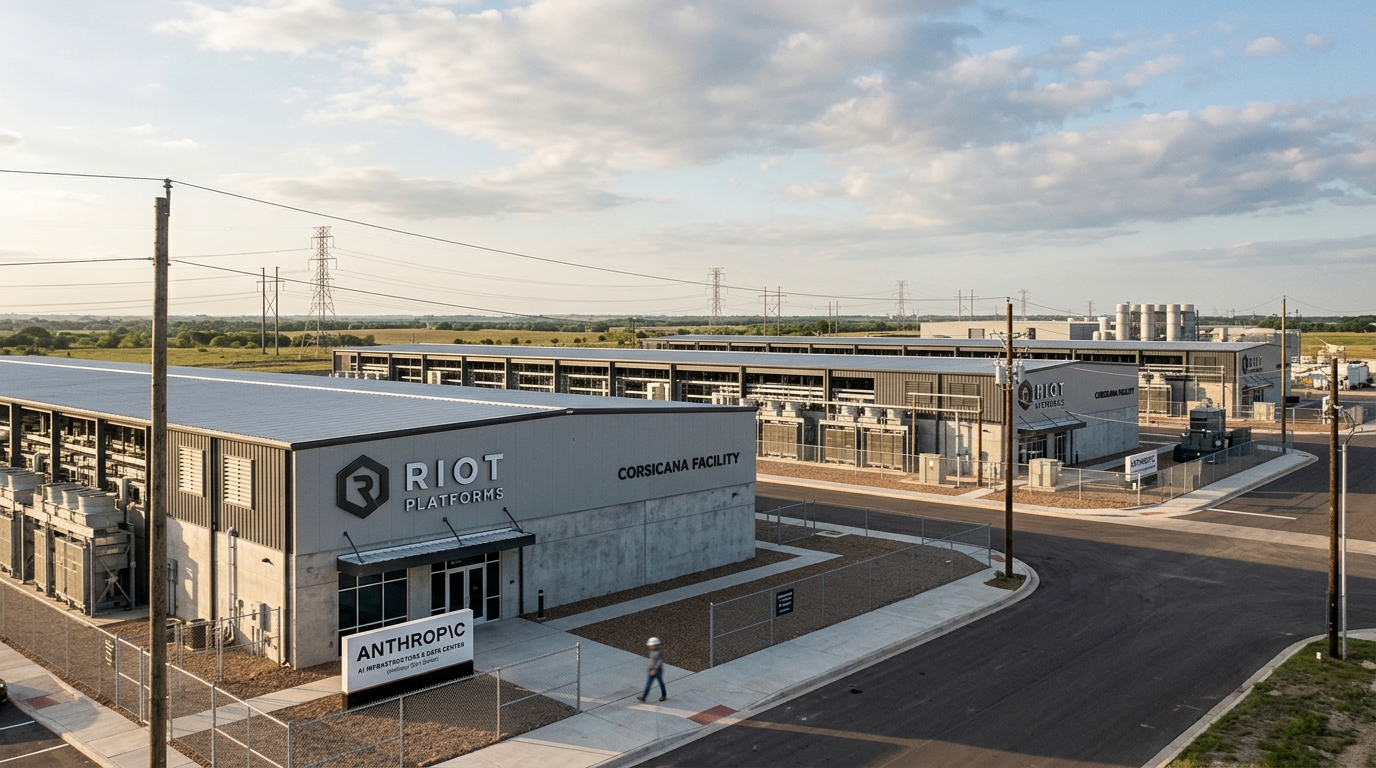
On the evening of August 10, 2026, Riot announced a 20-year data center lease with a counterparty it described only as a “leading frontier AI lab.” Bloomberg subsequently identified that counterparty as Anthropic. The contract covers 191 megawatts of critical IT capacity at Riot’s Rockdale, Texas campus and is expected to generate $9.1 billion in revenue through June 2048. Two five-year extension options could push that figure to $16.1 billion.
The market’s immediate reaction was unambiguous. RIOT closed down 5.46% on August 10 before the announcement, then surged more than 25% in after-hours trading. By the morning of August 11, a parade of analysts had revised their price targets upward: Bernstein lifted its target to $35 from $30; H.C. Wainwright raised its target to $40 from $25; Citi moved to $32 from $28; Cantor Fitzgerald raised to $30 from $23; Needham lifted to $30. Piper Sandler moved to $25. KBW maintained an Outperform with a $35 target, noting the implied total return from the prior session’s close of $19.40 exceeded 80%.
Alongside the Anthropic contract, Riot disclosed on the Q2 earnings call that it had signed a non-binding letter of intent with a single unnamed tenant for the entire 756 megawatts of planned net critical IT capacity at its Corsicana, Texas site. A lease covering the full Corsicana campus could generate more than $1 billion in annual rent upon full deployment, CEO Jason Les said, while noting that LOIs carry no guarantee of conversion.
The Real Reason for the Discount
Before the announcement, RIOT was trading around $19 to $20, roughly 37% below its 52-week high of $30.32 and well below the 52-week low of $10.95 that characterized the stock just months earlier. That pricing reflected one coherent but increasingly outdated belief: that Riot is a bitcoin miner whose value rises and falls with hashprice and the BTC cycle.
The Q2 income statement did nothing to challenge that assumption on its face. Total revenue for the three months ended June 30 came in at $174.2 million, up 14% year over year. Bitcoin mining contributed $113.7 million of that. Data center revenue was just $23.2 million, split between $4.9 million in operating lease revenue and $18.3 million in tenant fit-out services. The company posted a GAAP net loss of $237.2 million, driven by over $240 million in non-cash charges: a $75 million mark-to-market loss on bitcoin holdings and $98 million in depreciation and amortization. Adjusted EBITDA was a loss of $70 million.
A screener running on those numbers would classify this as an unprofitable crypto miner with no earnings multiple to anchor. It would be wrong. The mismatch between what is reported and what is contracted is the entire investment debate.
What the Business Is Actually Building
Riot’s Rockdale campus holds 700 megawatts of developed, energized power capacity with existing fiber and electrical infrastructure the company says can be repurposed for high-density computing. The Anthropic deal contracts 191 megawatts of that capacity, roughly 27% of Rockdale’s total developed power. The AMD lease, signed in January 2026 with AMD exercising an option to expand to 50 MW total, accounts for another tranche. Combined, Riot has 241 megawatts of contracted critical IT capacity and approximately $9.8 billion of expected revenue under initial contract terms across the two tenants.
The delivery schedule on the Anthropic lease is staged. Riot targets 96 megawatts online by December 2027 and full 191-megawatt completion by June 2028. Construction cost is estimated at $2.1 billion to $2.3 billion. Morgan Stanley is providing $573 million in interim financing for initial development costs while Riot finalizes a permanent investment-grade credit backstop. Cumulative net operating income over the base lease term is estimated by Riot at $7.3 billion to $8.2 billion. B. Riley calculated average annual revenue of $457 million from this single lease, equivalent to approximately $199 per kilowatt-month.
Riot also ended Q2 with more than $1.2 billion of liquidity, including $548.9 million of cash and approximately $666 million of bitcoin. That balance sheet context matters: this is not a company scrambling to survive its construction bill. It is managing a capital allocation transition.
Grid Emergency: 100X More Blackouts by 2030?
The Department of Energy warns blackouts could increase 100 times by 2030. Elon Musk and Sam Altman are already moving “off-grid” – and their next move could reward early investors most.
The Corsicana Optionality: The Larger Asset
Corsicana sits on Riot-owned land with 1 gigawatt of fully approved utility power, capable of supporting 756 megawatts of net critical IT capacity. The site is 60 miles from Dallas, with secured interconnection that is not subject to ERCOT’s current batch process, a point CEO Jason Les confirmed explicitly on the earnings call. Riot began full marketing of Corsicana only at the start of 2026 after acquiring all necessary acreage, taking a deliberate approach rather than generating headline announcements prematurely.
The LOI announced Monday covers the entire site under a single tenant. Analysts pressed Les on whether a single counterparty for a 1 GW site implies a hyperscaler. He declined to identify the party, confirming only that Riot is deeply engaged and expects to update the market in the coming months. Management estimates a binding lease here could generate over $1 billion in annual rent upon full deployment. That is a management estimate, not contracted revenue. The LOI is nonbinding. Converting it to a definitive lease, Les explained, requires substantial design, legal, and commercial work given the multi-year development timeline and the need to align delivery specifications across every phase of a 15 to 20-year build.
The pattern of Riot’s execution so far is relevant context. Every prior deal the company announced, including the AMD lease, had an LOI stage that Riot historically declined to disclose. The fact that management chose to disclose the Corsicana LOI at all reflects both the scale of the potential transaction and a shift toward greater transparency with investors who need to understand the forward picture, not just the trailing quarter.
The Mispricing Test: What Is the Market Getting Wrong?
The market’s pre-announcement pricing of RIOT reflected a company valued primarily as a bitcoin miner with speculative data center ambitions. That framing made sense through early 2025. It makes considerably less sense today. The Anthropic lease is not an ambition. It is a signed, 20-year contract with a counterparty whose revenue run rate has been reported as exceeding $30 billion annually, growing from approximately $9 billion at the end of 2025. Anthropic’s compute appetite is structurally insatiable, and the Rockdale lease adds 191 megawatts of Texas-based, interconnected capacity to a portfolio Anthropic is assembling across multiple continents.
The key structural insight Starboard Value articulated in a February letter to Les holds: Riot’s Texas sites carry the one input that cannot be easily built right now, which is approved power connectivity at scale. Rockdale’s existing interconnection bypasses the ERCOT batch process entirely. That is a genuine competitive advantage, not a talking point. The Anthropic contract is Starboard’s thesis validated in binding form.
Comparable companies facing similar transitions offer a useful anchor. Core Scientific, which has been executing a parallel pivot from bitcoin mining to AI colocation with $8.7 billion in CoreWeave contracts, carries an enterprise value of approximately $9.5 billion. Riot’s market cap sits around $7.3 billion to $8.1 billion post-announcement. Both companies are GAAP-unprofitable and valued primarily on contracted forward revenue rather than trailing earnings. The distinction is that Riot’s Rockdale contract alone is worth $9.1 billion, and the Corsicana optionality is not yet in the price.
Is It Cheap? Separating the Signal from the Noise
Traditional valuation tools offer little guidance here. RIOT’s P/E ratio is negative. EBITDA is negative. The stock does not screen as cheap on any backward-looking metric because the business generating the contracted future cash flows has not yet been built. This is the same framing problem investors face with any infrastructure company early in a multi-year construction cycle.
The more relevant framework is contracted revenue per dollar of market cap. Riot has approximately $9.8 billion in contracted revenue under initial terms across 241 megawatts. Its market cap post-announcement is roughly $7.3 to $8 billion. That means you are paying less than one times contracted initial-term revenue for the Rockdale and AMD assets alone, before assigning any value to the 73% of Rockdale capacity still available to lease, the Corsicana LOI, the balance sheet liquidity, the remaining bitcoin treasury, or the option value on any new sites the company identifies through its stated practice of evaluating at least 10 new power sites per week.
That framing does not make the stock cheap in a traditional margin-of-safety sense. The construction bill has not yet been paid. The permanent credit backstop has not yet been secured. The income statement currently earns nothing from the company’s largest forward commitments. What it does suggest is that the price-to-contracted-future-value ratio is more favorable than the miner label implies, and that the market is still anchoring to a business that, in contract terms, no longer fully exists.
The Risks: Where the Thesis Can Break
Permanent impairment risk here comes from three directions, and bargain hunters need to treat each one seriously rather than waving them away with optimism about the sector.
First, execution. Delivering 96 megawatts of mission-critical AI data center capacity to a frontier AI lab by December 2027 requires a construction standard that bitcoin mining never demanded. A missed milestone does not simply disappoint; it hands a $9.1 billion counterparty a contractual remedy and damages the company’s credibility for every subsequent lease negotiation. The first real test of Riot’s data center construction cadence comes in November 2026, when 10 additional AMD megawatts are due. That delivery will be watched closely by anyone trying to assess whether the Rockdale build schedule is credible.
Second, financing. The $573 million Morgan Stanley interim facility funds early procurement, but a $2.1 to $2.3 billion construction budget requires a permanent investment-grade credit backstop. CFO Jason Chung said on the Q2 call that the lease was structured with financing in mind and that multiple paths exist. Until a permanent facility is in place at acceptable terms, construction carries financing risk that equity dilution could worsen. Riot has also been selling bitcoin production to fund the equity portion of construction costs, ending Q2 with 11,380 BTC in treasury. If bitcoin appreciates sharply from current levels, that funding strategy becomes increasingly expensive in opportunity cost terms.
Third, Corsicana conversion risk. Investors pricing in a signed Corsicana lease are discounting a real probability of failure. The LOI is nonbinding. The site requires careful design alignment, multi-phase delivery coordination, and legal negotiation across a 15 to 20-year timeline before ink dries. Les said on the call that converting it is a priority for the balance of 2026, and that the company will update the market in the coming months. That is an honest assessment of where things stand, not a guarantee. Any investor building a thesis that relies on Corsicana executing needs to size the position accordingly.
Bull, Base, and Bear
- Bull case: Corsicana LOI converts to a definitive lease with a hyperscaler. Permanent credit backstop lands at investment-grade terms with minimal dilution. Rockdale AMD and Anthropic deliveries arrive on schedule. RIOT re-rates toward data center operator multiples on contracted NOI. Upside targets from H.C. Wainwright ($40) and Bernstein ($35) become achievable within 12 to 18 months.
- Base case: Rockdale delivers on schedule, Corsicana takes longer than expected to convert, and RIOT trades in a range between its post-announcement price and the low end of analyst targets as the market waits for construction proof points. The stock is neither deeply cheap nor expensive at current levels, but the contracted backlog provides a floor that pure mining comps never offered.
- Bear case: Construction delays trigger contractual remedies on the Anthropic lease. Permanent financing comes at dilutive terms. Corsicana LOI does not convert. Bitcoin falls, reducing the bitcoin treasury that backstops construction equity. The stock drifts back toward $14 to $16 as the data center thesis loses credibility and the mining business generates insufficient cash to fill the gap.
The Cheap Investor Scorecard
| Dimension | Score | Commentary |
|---|---|---|
| Business Quality | 7/10 | Contracted revenue with Anthropic and AMD is high quality. Mining segment is low-margin and cyclical. |
| Financial Strength | 5/10 | $1.2B liquidity is meaningful. Permanent credit backstop still pending. Construction bill is large relative to current cash flow. |
| Valuation | 6/10 | Market cap below contracted initial-term revenue. No traditional earnings multiple applies. Corsicana not yet in the price. |
| Competitive Position | 8/10 | Approved interconnection at Rockdale and Corsicana bypasses ERCOT batch process. Power at scale is genuinely scarce. |
| Balance Sheet | 5/10 | Cash and BTC holdings are substantial but bitcoin treasury introduces mark-to-market volatility. Debt structure in transition. |
| Cash Flow | 3/10 | Currently negative. Contracted NOI of $365M to $411M annually does not begin until Rockdale builds out in 2027 to 2028. |
| Management Execution | 7/10 | AMD initial 25 MW delivered on time and on budget. Two major AI leases in six months. Corsicana LOI disclosed proactively. |
| Catalyst Strength | 8/10 | Corsicana lease conversion, November AMD delivery, and permanent credit facility are three near-term, definable catalysts. |
| Margin of Safety | 4/10 | Construction and financing risk is real. LOI is nonbinding. Traditional margin of safety does not apply to a pre-revenue build. |
| Long-Term Potential | 9/10 | If Corsicana executes, total contracted capacity could exceed 1GW. 20-year cash flow visibility is rare at any scale. |
What to Watch Over the Next 18 Months
- November 2026: Delivery of 10 additional AMD megawatts. First live test of Riot’s data center construction cadence against a signed schedule.
- Q4 2026: Corsicana LOI conversion to a definitive lease. Management said updates are coming in the coming months. Any delay here will be read as a setback.
- Permanent credit backstop: Investment-grade terms that limit equity dilution. The interim Morgan Stanley facility is a bridge, not a destination.
- December 2027: Initial 96 MW of Anthropic capacity online. This is the first material cash flow test of the entire thesis.
- Anthropic spending trajectory: Compute pullback or pricing pressure from OpenAI or Google changes the long-term lease economics across the sector, not just for Riot.
- Bitcoin price: A sharp BTC move higher increases the cost of the strategy of selling production to fund construction equity.
The Action Plan
Riot is not a traditional value stock. It does not screen cheap on any backward-looking metric. What it offers is a contracted forward asset base trading at a market cap below the face value of its initial-term leases, in a company that has demonstrated it can win and execute on institutional-grade AI infrastructure deals in a market where power at scale is genuinely scarce.
For investors comfortable with construction and financing risk, a modest initial position with a clear plan to add on the November 2026 AMD delivery and the Corsicana LOI conversion is a rational approach. Neither of those events requires predicting the bitcoin price or betting on AI sentiment. They are binary execution milestones on a defined schedule. If Riot hits them, the thesis advances. If it misses, the thesis needs to be reassessed regardless of what Anthropic’s valuation does in the meantime.
Avoid sizing this as a conviction position before the November delivery. The income statement will look terrible for another six to twelve months regardless of what the contract book says. That is exactly the kind of temporary perception gap The Cheap Investor looks for. It is also exactly the kind of situation that punishes investors who mistake a compelling forward story for a present margin of safety.
Bottom Line
The market has spent years pricing Riot as a bitcoin miner. The contracts say otherwise. Riot now has $9.8 billion of contracted AI revenue across 241 megawatts, a 20-year anchor tenant in Anthropic, and a nonbinding LOI on a 1 GW site that would represent one of the largest single-tenant data center leases ever executed if it converts. The quarterly loss will persist through 2027. The income statement will not reflect the contracted forward value for another 18 months at minimum.
Is it cheap? Not in a traditional sense. But the perception gap between what the screeners show and what the contract ledger says is real, and it is measurable. If you are patient enough to hold through a construction cycle and disciplined enough to track the execution milestones rather than the quarterly earnings, Riot is one of the more interesting situations in the market today. If you need near-term earnings visibility or a traditional margin of safety, it is not your investment.
The bargain hunter’s job is to know which category you are in before you buy.