
August 4, 2026
Apple Crossed $9B in India. That’s Not the Real Story.
Featured: Apple Crossed $9B in India. That’s Not the Real Story.
Central Banks Are Quietly Walking Away From the Dollar.
What Does That Mean for Your Retirement Savings?
Dear Reader,
Something unusual is happening inside the world’s most powerful financial institutions.
And almost nobody on the evening news is talking about it.
According to a survey reported by CNN this summer, more central banks now plan to reduce their U.S. dollar holdings over the next decade than increase them.
And what are they buying instead?
Gold.
The same survey found a record number of central banks planning to expand their gold reserves in the years ahead.
Stop and think about what that means.
The institutions that create paper money for a living…
The institutions that understand currency better than anyone on earth…
Are trading dollars for the one asset that cannot be printed.
The headlines are getting harder to ignore:
The Guardian reported in January that central banks are scrambling for gold because, in the words of its own reporting, the dollar is losing credibility.
Goldman Sachs analysts, cited by Yahoo Finance, describe gold as a hedge against currency debasement.
And Reuters has repeatedly noted that when confidence wavers and the dollar softens, money tends to flow into gold.
This is not a fringe theory anymore.
This is the quiet consensus forming among the people who manage entire nations’ wealth.
Now here is why this matters to you.
If you have spent decades building your savings in an IRA, 401(k), TSP, or 403(b), nearly every dollar of it depends on one thing: the purchasing power of the U.S. dollar.
A currency does not have to collapse overnight to hurt your retirement. It only has to keep buying a little less, year after year, while you hold it.
Gold makes no promises.
It has no printing press.
It has no deficit.
And it has historically served as a store of value through periods of inflation, currency stress, and political uncertainty.
That is exactly why America’s Gold Company created a FREE Precious Metals Retirement Guide that shows how everyday Americans may be able to protect a portion of their retirement savings with physical gold and silver, the same asset the world’s central banks are stacking right now.
→ Click here to request your FREE Precious Metals Retirement Guide.
Inside your free guide, you will discover:
- ✔ Why central banks are shifting reserves out of dollars and into gold, and what it may signal for the savings you hold.
- ✔ How gold has historically responded during periods of inflation and weakening currency confidence.
- ✔ How a Gold IRA generally works, and how you may be eligible to move a portion of an existing IRA, 401(k), TSP, or 403(b) into physical metals.
- ✔ How physical metals can help diversify savings outside the paper system.
- ✔ A simple, conservative way to get started.
Here is the uncomfortable truth.
By the time a currency story is on the front page, the institutions have already moved.
The central banks are moving now. Quietly. Steadily. Deliberately.
The only question is whether you will see the signal before the rest of the country does.
→ Request your FREE Precious Metals Retirement Guide now.
Or speak with a precious metals specialist today at {phone number}.
To your financial security,
America’s Gold Company
P.S. The central banks that print the world’s currencies are choosing gold with their own reserves. Your free guide explains what that shift may mean for your retirement, and how to request yours takes less than a minute. Get your free guide here.
Apple Crossed $9B in India. That’s Not the Real Story.
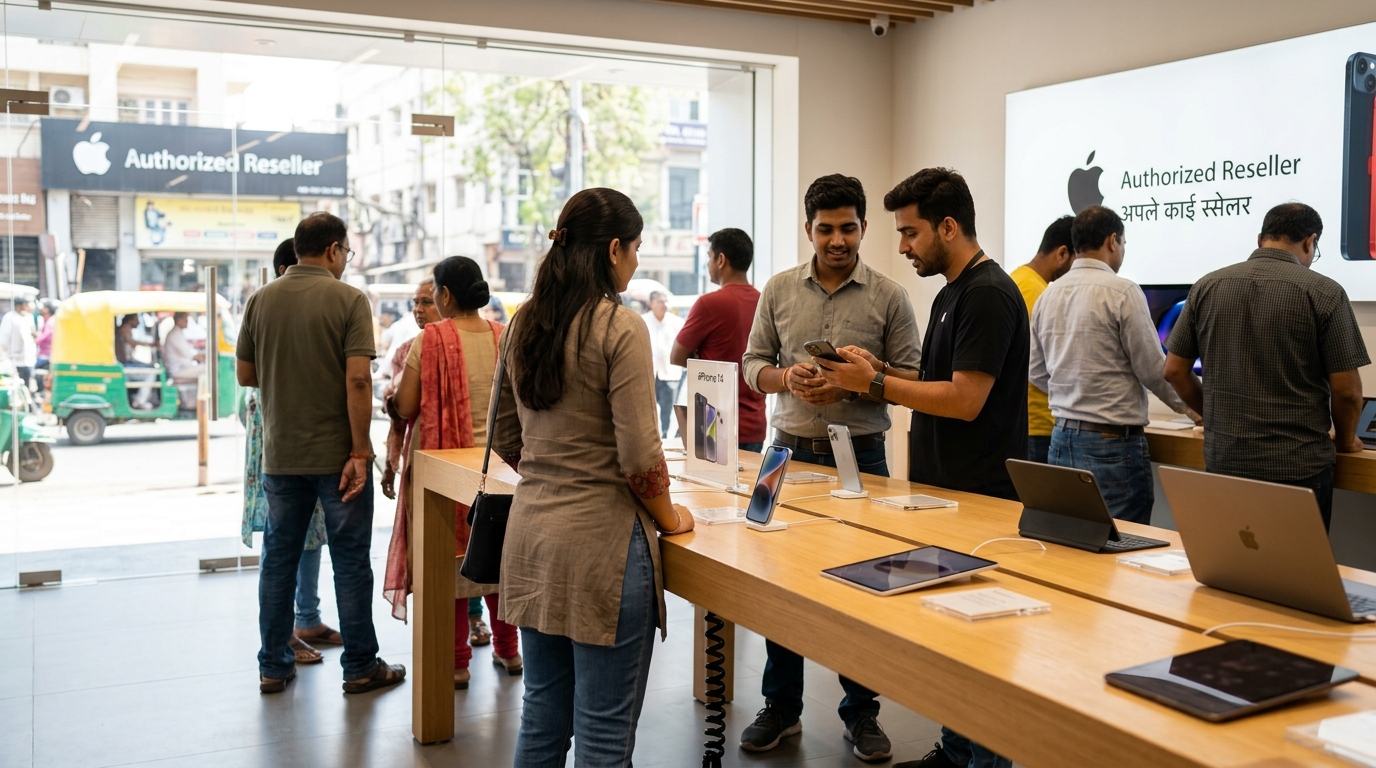
Here is what the headline says: Apple’s annual sales in India reached nearly $9 billion in the 12 months through March, underscoring surging demand for its pricey devices in a market where it’s steadily ramping up its retail network. Good number. Clean milestone. Investors will nod and move on.
But the more interesting question is how Apple actually pulled this off. Because the conditions were not friendly.
High taxes make iPhones pricey in India. Apple sells the entry-level iPhone 17 model at 82,900 rupees, roughly $870, in India, compared with the $799 price tag in the US, where carriers can finance the device for about $23 a month. So Apple is charging more in a country that earns less, and still growing at double digits. That deserves more than a passing mention.
Revenue grew about 13% in the 12 months through March from roughly $8 billion a year earlier. That’s the acceleration investors should notice, even if the $10 billion headline makes for a cleaner trophy.
What Actually Changed
Retail. Specifically, the company-owned kind.
CEO Tim Cook inaugurated the first two stores in India, respectively located in Mumbai and New Delhi, in 2023. As part of its India retail expansion, Apple opened a new store in the financial capital of Mumbai in February 2026, taking its official shop count in the country to six.
Those stores are not just selling points. They provide space for training sessions, product demonstrations, and technical services, helping the group build customer loyalty in a market where many purchases have traditionally been made through third-party retailers. The Apple Store online, launched in September 2020, remains an important part of the company’s strategy. It allows customers across the country to access trade-ins, custom Mac configurations, education pricing, and direct delivery, including in cities without a physical Apple outlet.
And then the financing piece. Sales were supported by premiumisation in the smartphone market, trade-in programmes, and instalment plans that reduced the upfront cost of devices. To grow its market share, the company has partnered with banks for credit card rebates, and also offers student discounts and trade-ins on older devices. That is how you sell an $870 phone in a $2,700-per-capita-GDP market. You engineer the monthly number down until it feels manageable.
The Part Most Investors Are Skipping
India is not just a sales story for Apple. It is also the supply chain story of the decade.
iPhone exports from India surged sharply, reaching about $10 billion in the first half of FY26 alone. A significant portion of iPhones manufactured in India is now destined for export markets, particularly the United States.
Slight tangent, but it matters: this is why Trump’s pressure on Cook to stop building in India never really landed. Apple had already crossed the point of no return. Over five years, Apple produced iPhones worth nearly $70 billion under India’s Production-Linked Incentive scheme, with exports contributing about $51 billion, or nearly 73 percent. iPhones also emerged as India’s single largest exported commodity in 2025.
The country is expected to account for about a quarter of global iPhone production during 2026. That share was essentially zero a decade ago.
The Market Position Is More Fragile Than It Looks
Here is where the bull case needs a stress test.
By total unit shipments, vivo led the Indian market in 2025 with a 23% share. Samsung came in second with 15%, followed by OPPO at 13%, according to Omdia. Despite its record results, Apple didn’t crack the top three sellers by volume. That underscores how Android brands targeting budget-conscious buyers still control most of India’s market, even as premium devices claim a growing share.
The 60-Second Change That Stays With You
One small setting could change how you enter and exit every options trade. It’s easy to overlook, but many beginners learn its importance the hard way. Discover the permanent rule inside Your First Trade Playbook – free for a limited time.
What’s interesting is that this is actually fine for Apple’s model. In India, Apple commands a significant share of the premium smartphone market, particularly in the $600-plus segment. Apple does not need to beat vivo on volume. It needs to own the segment where India’s growing middle class arrives when it finally upgrades. That funnel is widening.
Smartphones priced above 30,000 rupees grew in 2025 and accounted for a record share of total shipments, according to Counterpoint.
What Ternus Inherits
Tim Cook is set to step down as CEO on September 1, 2026. As Cook prepares to transition into executive chairman, passing the CEO role to John Ternus, India has emerged as a cornerstone of the company’s future strategy.
Under incoming CEO John Ternus and Chief Hardware Officer Johny Srouji, Apple is pivoting toward a foldable and AI-driven future. Analysts believe India will be central to that shift.
The real question is not whether India keeps growing. It probably does. The question is whether Ternus can build the relationship Cook spent 15 years cultivating.
That kind of capital does not transfer automatically on September 1.
The roughly $9 billion figure is a boon for Apple’s efforts to find new growth markets. While India still represents a small slice of its overall business, the South Asian country is emerging as one of its key sales regions outside of the US and China. That framing is generous. At the pace India is moving, the word “small” is going to feel dated very quickly.
Worth watching closely: how Ternus prioritizes India once he’s in the seat, whether manufacturing commitments hold under continued US political pressure, and how far the premiumization wave inside the Indian smartphone market still has to run. The $9 billion is a waypoint, not an endpoint.