Hey there, bargain hunter. Amazon just created a new line item that nobody had in their model, and the question you should be asking is not whether $1 billion matters to a $2.5 trillion company. It is what that $1 billion is actually buying, and what happens if it stops working.
Scoreboard
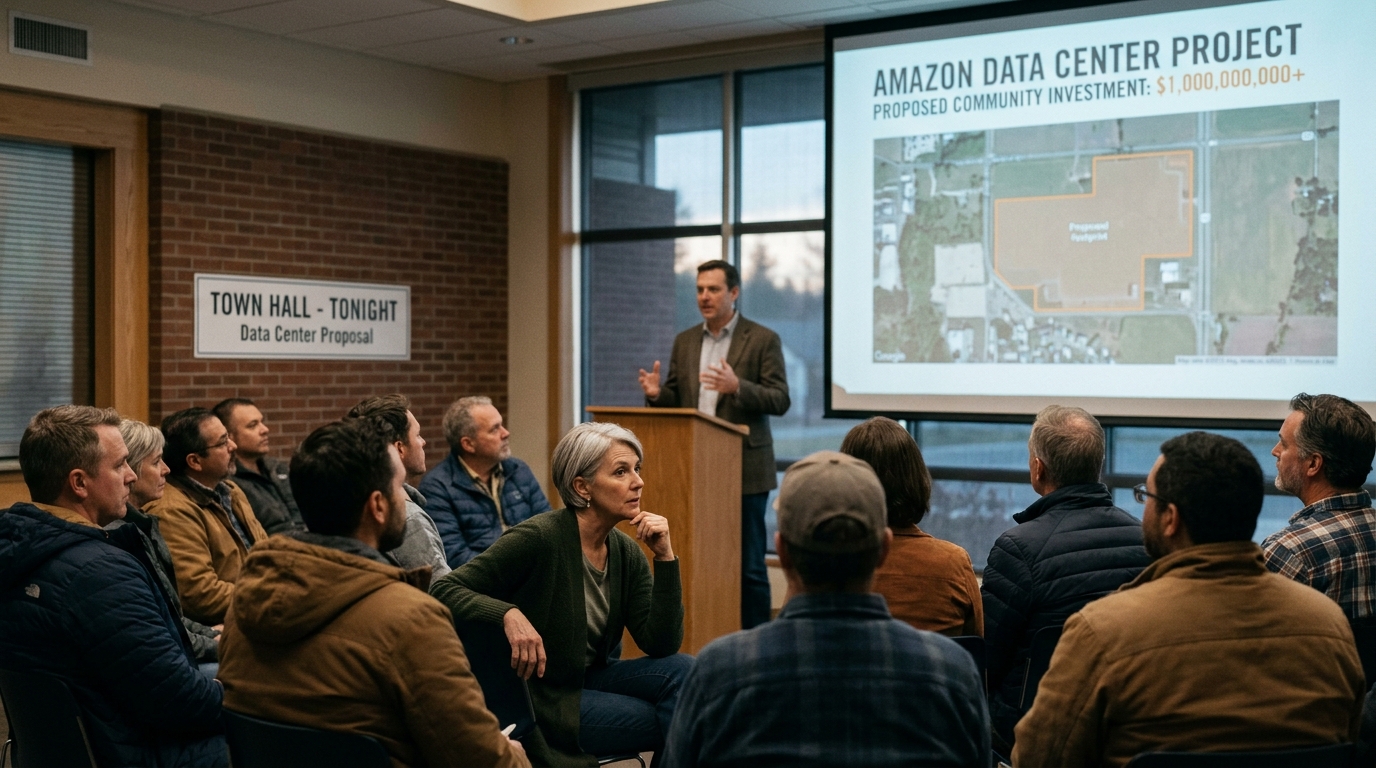
On October 2, 2026, Amazon announced it will invest more than $1 billion over the next five years into communities where it operates data centers, covering education, job training, water preservation, and energy affordability. The pledge is on top of existing commitments, not a reallocation of prior spending. AWS CEO Matt Garman framed the move as urgent, warning that local opposition now threatens America’s position in the global AI race.
What Actually Happened
According to Data Center Watch, at least 75 data center projects worth around $130 billion were blocked or delayed across the nation in the first quarter of 2026 alone. The group described the period as the “largest single-quarter concentration of blocked and delayed data center projects on record,” saying the disruption roughly matched the scale of all of 2025 in just three months.
Garman said local opposition, which he called fueled by “misinformation and outright lies,” threatens the country’s position in the global race for AI leadership. He acknowledged that more than 100 local data center moratoriums are under consideration nationwide. A Gallup survey released in May found that 71% of Americans oppose building AI data centers in their local area, compared with 53% who oppose nearby nuclear power plants.
The Math Against $220 Billion
Here is where the Cheap Investor angle sharpens. Amazon raised its full-year 2026 capital expenditure guidance to roughly $220 billion on its late-July earnings call, up from an original $200 billion target. Against that, $1 billion spread over five years is $200 million per year, or roughly 0.09% of this year’s capex alone. Rounding error territory.
But that framing misses the point. The company’s new “Built Together” program funds free community college, job training, energy upgrades for homes and schools, and other local projects, on top of more than $1 billion Amazon says it has already given to communities over the past three years. Amazon also says it will stop using NDAs with government agencies on data center projects, install lower-emission backup generators at new sites, publish its energy and water use each year, and pay enough for power to keep local electricity bills from rising. Those last commitments carry real, recurring cost that will not appear on a single line.
AWS revenue hit $42.2 billion in Q2 2026, up 37% year over year, with a $496 billion backlog. The supply constraint is not demand. It is permits, power interconnections, and community approval. Every quarter a site stalls is a quarter Amazon cannot monetize committed backlog.
Is AMZN Cheap?
AMZN’s trailing PE sits around 20x, with a forward PE also around 20x. The catch: Amazon plans to invest approximately $200 billion in cash capex in 2026, and Q1 cash capex alone hit $43.2 billion. Free cash flow is barely positive, and community-relations costs are a new, recurring drag nobody priced in.
Bull / Base / Bear
- Bull: $1 billion unlocks $130 billion-plus of stalled capacity faster than rivals can act. AWS backlog converts, margins expand, and the stock re-rates toward its historical multiple.
- Base: Community spending becomes a permanent cost of doing business, absorbed without drama, while AWS revenue growth at 37% and a $496 billion backlog carries the thesis.
- Bear: Data Center Watch reported that lawmakers from both parties introduced more than 300 data center bills in the first six weeks of 2026, and 14 states proposed statewide moratoriums. If state-level bans pass despite community investment, the $1 billion buys goodwill, not permits.
Action Plan
Hold existing AMZN positions. The community investment is not a valuation-moving cost at current sizing, but it confirms that permitting friction is now a structural feature of hyperscaler capex, not a one-cycle event. If you are adding, wait for Q3 earnings in late October to see whether AWS growth held above 35% and whether any moratorium news cut into guidance language. A scale-in on pullbacks below $240 offers a reasonable margin, given the forward multiple and the backlog size.
Cheap Investor Checklist
- AWS quarterly revenue growth rate: watch for sustained above-35%
- Number of active local moratoriums: more than 100 under consideration nationwide
- Data center projects blocked or delayed per quarter: Q1 2026 baseline was 75 worth $130 billion
- Community investment spend vs. announced $200 million annual run rate: track separately in filings
- NDA policy rollout: does the no-NDA pledge reduce opposition timelines measurably?
- AWS backlog conversion: does the $496 billion backlog translate to revenue acceleration?
- Free cash flow trajectory: watch for recovery as capex peaks
- Peer response: Microsoft and Alphabet facing identical political exposure
Bottom Line
Amazon’s $1 billion community fund is not what moves the stock. What moves the stock is whether $220 billion in capex converts into usable compute before rivals do. If “Built Together” buys six months off a permit fight on a $3 billion campus, it pays for itself many times over. If moratoriums keep spreading despite the goodwill spending, the real cost is measured in quarters of delayed backlog, not in community college endowments. Watch the moratorium count, not the check size.