
August 1, 2026
The Government Just Bought Stakes in Chip Startups
Featured: The Government Just Bought Stakes in Chip Startups
Editor’s Note: Famed $1 billion fund manager Louis Navellier has informed us that his system recently assigned an A rating to a tech company that’s popular with both Elon Musk and President Trump. In his new presentation, Louis gives away the name and ticker symbol of this firm for free. Click here to watch it now, or read below for more details.
Dear Reader,
When this struggling PC maker went private in 2013, many were skeptical.
Forbes wrote that the CEO’s track record “does not inspire confidence in the company’s future.”
And according to the New York Times, private equity giant BlackStone withdrew a bid after “discovering that [its] business was deteriorating faster than previously understood.”
But its business didn’t deteriorate. It transformed.
And when it returned to the public markets, it was no longer just another computer company.
It had acquired all the software and hardware to become – as the Wall Street Journal put it – “a globe-straddling AI-supercomputer builder.”
That’s why, when Elon Musk set out to win the AI race, this firm was the first company he called.
That said, no one is a bigger fan of this company than President Trump.
He’s repeatedly told crowds to buy this firm’s flagship product…
Awarded it a five-year, $9.7 billion Pentagon contract…
And personally invested up to $5 million in its shares.
This company is the comeback story of the century – and it’s only just beginning.
My system recently assigned it an A rating…
The same rating Comfort Systems, Supermicro, and Applovin received before they soared by as much as 1,117%, 2,007%, and 1,863%, respectively.
Over the years, I’ve poured over $9 million into building and maintaining this system, and it’s rarely failed me.
Nevertheless, timing is everything.
Trump, Elon, and this company are rapidly building out an AI infrastructure that will secure our country’s dominant position in the global economy for decades to come.
And on August 6, I believe a major event will occur that could bring the magnitude of this plan to light.
If you don’t get on the winning side of this shift before that date, you run the risk of missing out entirely.
Regards,
Louis Navellier
Senior Analyst, InvestorPlace
P.S. No e-mail, credit card, or subscription is required to access this pick. Click here to view (must act before August 6)…
The Government Just Bought Stakes in Chip Startups
Here is a question worth sitting with: what does it mean for a stock’s risk profile when the U.S. government becomes a co-owner?
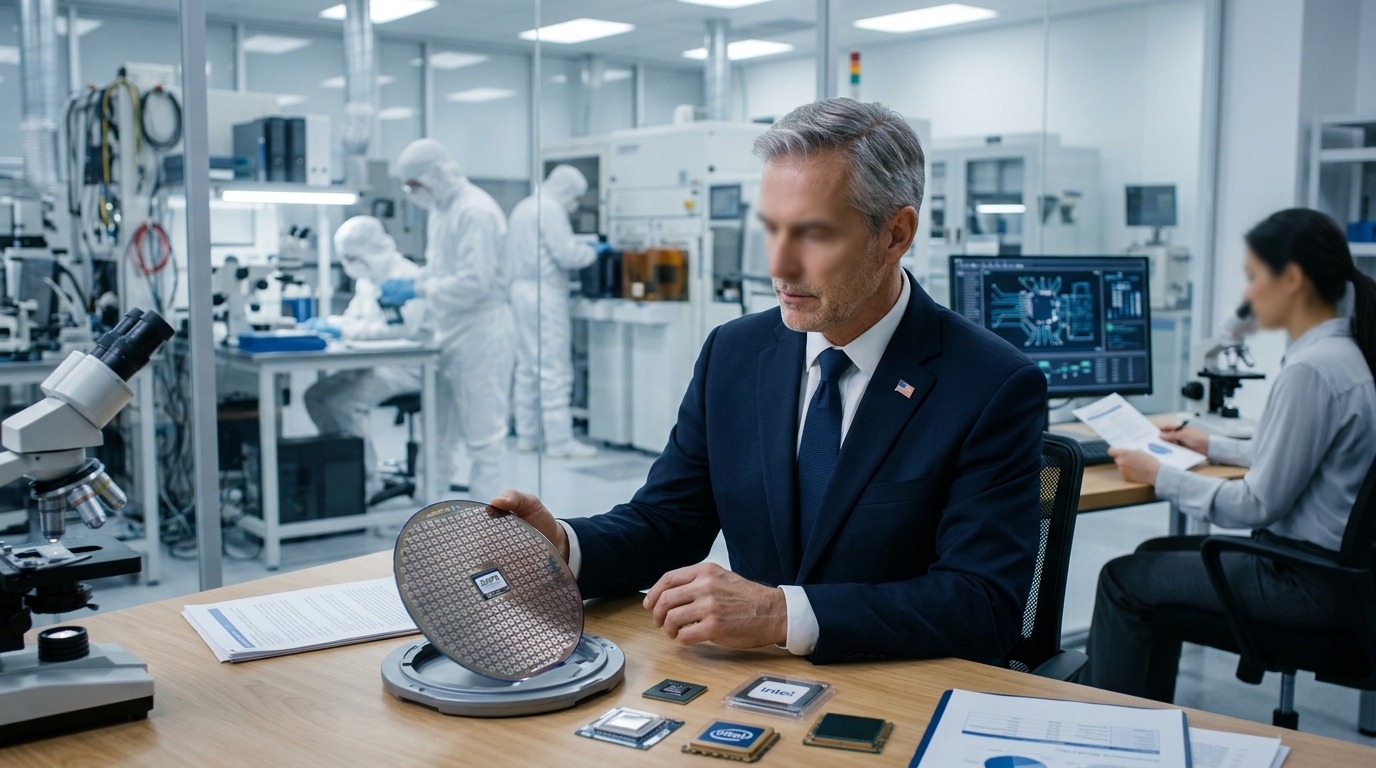
That question got considerably more urgent on July 29, when the Commerce Department’s CHIPS Research and Development Office announced it had signed letters of intent with seven semiconductor companies, taking minority equity stakes in exchange for up to $874 million in CHIPS Act research funding. If finalized, the awards will distribute up to $874 million across Kepler, Multibeam Corporation, Extropic, Thintronics, OBSIDIA Semiconductors, and Aeluma, in awards ranging from $30 million to $245 million. GlobalFoundries rounds out the seven with a separate co-packaged optics R&D deal, alongside an equity stake for the government.
These new deals, set to be finalized in the months ahead, would add to what Tad DeHaven of the Cato Institute has described as a growing federal equity portfolio. Twelve months ago, that sentence would have sounded like a misprint.
It’s one of Trump’s biggest holdings. Do you own it?
President Trump owns up to $5 million in shares of this AI company (not Nvidia or SpaceX). He’s strongly endorsed its leadership and products. And he just awarded it with a nearly $10 billion Pentagon contract. No wonder one legendary fund manager says it could become the cornerstone of your retirement.
The Intel Precedent Is the Whole Story
To understand why these six small companies matter to investors beyond their balance sheets, you need to start with Intel.
In August 2025, the Trump administration struck an agreement under which the U.S. government would receive 433.3 million Intel shares at $20.47 apiece, giving it a 9.9% stake. The public reporting around the deal described it as a passive stake, and it was widely framed as a conversion of previously awarded federal support into equity rather than a fresh cash outlay.
Since that deal was announced in late August 2025, Intel’s stock has risen sharply at points, but the claim that it has hit record highs and produced an unrealized profit north of $70 billion is not one I can verify from primary filings or major-market records. Trump has still made the general point a talking point in public remarks, but the specific numbers have varied and should be treated as rhetoric rather than audited returns.
The structural detail that most commentary skips: the 9.9% stake was deliberately structured to avoid nationalization. Public descriptions of the arrangement emphasized its passive character, with no board seat and no day-to-day management role. Washington gets the upside without running the company. That is a meaningful distinction for anyone trying to assess what the government’s presence actually does to a company’s competitive position.
Emboldened by the optics of that Intel arrangement, the administration is now applying the same logic to smaller, earlier-stage technology bets.
What the Government Is Actually Buying
These six companies are not household names. They are, however, targeting the specific technical chokepoints that constrain AI compute today. Each award is calibrated to a different layer of the problem.
Kepler will receive up to $245 million for R&D to develop a new class of high-performance AI memory technology enabled by innovative 3D and ferroelectric technologies. Memory bandwidth is the constraint AI chip designers keep running into, and ferroelectric approaches offer a potential structural fix rather than another round of stacking more DRAM.
Multibeam Corporation will receive up to $140 million to develop advanced packaging technology to assemble and stack multiple chips and connect them at high density, which will enable more advanced systems necessary for AI and other advanced computing applications.
Extropic will receive up to $75 million to develop thermodynamic sampling units that use natural thermal fluctuations to probabilistically solve complex problems spanning simulation, optimization, and artificial intelligence, while using less energy than conventional computing approaches. The physics here is genuinely unusual: rather than computing a result conventionally, the device uses its own thermal noise as a sampling mechanism, with the broader ambition of pushing energy efficiency toward fundamental limits.
OBSIDIA Semiconductors receives up to $34 million for non-invasive counterfeit and malicious component identification systems for AI and the electronics supply chain. That particular problem, detecting fake or tampered chips in supply chains with geopolitical fault lines running through them, is one the Department of Defense has treated as a serious procurement and security issue. Aeluma signed an LOI for up to $30 million to develop its non-InP photonics platform; the proposed award aims to scale Aeluma’s large-diameter substrates for AI and advanced computing, reinforcing U.S. semiconductor capacity and supply-chain resilience.
GlobalFoundries will receive up to $300 million to accelerate U.S. R&D of co-packaged optics, integrating photonics with AI processors to improve speed and energy efficiency. At the same time, the U.S. government will receive an equity stake representing approximately one percent ownership of GlobalFoundries, according to the company’s own disclosures. The draft’s claim that the stake is worth roughly $269 million is not something I can verify from the LOI language itself and will vary with market price, so it should not be stated as a fixed figure.
The Conflict Nobody Wants to Name
The Intel trade was unusual in important ways. But the claim that it produced a $26.5 billion unrealized gain, or that it ranks as one of the most profitable government investments in American industrial history, is not one I can substantiate from an authoritative public accounting. The new six deals are better described as deliberate extensions of the equity-for-incentives model.
That shift raises a genuine governance question that value investors should think carefully about. The federal government is now acting as regulator, customer, financier, and shareholder simultaneously. Decisions involving contracts, trade restrictions, permits, and additional subsidies can affect the value of its holdings. Competitors have reason to question whether the playing field is level.
Tad DeHaven of the Cato Institute has argued in recent commentary that the federal government is increasingly acting as regulator, customer, financier, and shareholder simultaneously, warning that competitors have reason to question whether the playing field is level and that future administrations will inherit the same tool.
A new way to profit from the AI boom
There is a new way for you to play the AI boom.
One that has nothing to do with buying stocks or guessing who will win the AI race.
Best of all, every 90 days you get fresh chances to make a profit.
It all comes down to what Wall Street legend Larry Benedict calls “AI Profit Loops.”
Played the right way, one of these “Loops” could have turned every $1,000 into $9,000 in a matter of weeks.
Discover how you can get started with “AI Profit Loops” today.
Even more pointed, Senator Todd Young of Indiana, a Republican who helped draft the legislation that became the foundation of the CHIPS and Science Act, has said the equity-stake arrangement was not intended under the law and that he did not know of anyone who voted for the bill who thought this practice was permitted. He also noted the Intel equity was structured as non-voting.
That legal ambiguity does not make these deals bad investments. But it is a risk factor that belongs in any honest analysis.
The Mispricing Question
Most of the six companies are private or small-cap. Kepler and Extropic, in particular, are pre-revenue startups whose valuations are not publicly anchored. That makes the government’s minority stake difficult to price from the outside. But the publicly traded name here is GlobalFoundries, and GFS is the one worth examining through a value lens.
GlobalFoundries ceased its efforts in leading-edge node research, development, and manufacturing as the industry pushed into the most advanced nodes, and it has since focused on differentiated technologies and specialty processes. The market has been slow to fully reflect how valuable those bets can become as AI infrastructure demand pulls more of the stack into packaging, interconnect, and photonics.
Silicon photonics has become a fixation for the chip industry as AI workloads strain conventional interconnects. By using light instead of electrons, the technology can deliver more bandwidth per watt, a metric that matters when hyperscale data centers burn through enormous amounts of energy. The draft’s specific claim that the award targets 400 gigabits per second and up to five times greater energy efficiency compared with current pluggable optical transceivers is not something I can confirm from a primary Commerce or company document for this July 29 LOI, so it should not be stated as a precise spec.
Jensen Huang weighed in directly on the GlobalFoundries announcement, calling silicon photonics “essential” to scaling U.S. AI infrastructure. When Nvidia’s CEO volunteers a public endorsement for a specific company’s technology, that is not background noise.
Perhaps most striking about the announcement, as DeHaven observed in his broader critique of the policy direction, is how unremarkable government ownership is becoming. That normalization cuts both ways. On one hand, it removes the shock premium that might have inflated early CHIPS Act recipients. On the other, it suggests the government views these stakes as durable, not transitory. Companies in the portfolio are not getting a one-time grant and a handshake. They are getting a co-investor who has strong incentives to see their technology succeed.
Where the Real Opportunity Sits
The Intel deal was the proof of concept. The six chipmakers announced this week represent the strategy operating at scale across the AI compute stack.
For value investors, the most honest framing is this: the government’s presence in a company does not automatically make its stock cheap or expensive. What it does is introduce a new category of downside protection and upside asymmetry that standard DCF models do not capture well. A company with Washington as a minority shareholder faces less risk of being starved of capital in a downturn and more likelihood of favorable treatment in procurement and regulatory review.
Trump Did What!?!?
“I recently visited Mar-a-Lago… And now I’m prepared to put my reputation on the line. One investment I just uncovered could be my biggest winner of all… It involves President Trump, Elon Musk, trillions of dollars, China… And a MAJOR upgrade to the artificial intelligence revolution. If you buy just one stock in 2026, I urge you to make it this one.” – Louis Navellier
Click here to see the name and ticker symbol of the company at the center of it all.
Whether that implicit backstop is already priced into GFS shares or not is the actual question. The answer, as of August 1, 2026, is that the market is still sorting it out. That gap between what the government’s equity stake implies and what the stock reflects is where the patient investor’s work begins.