
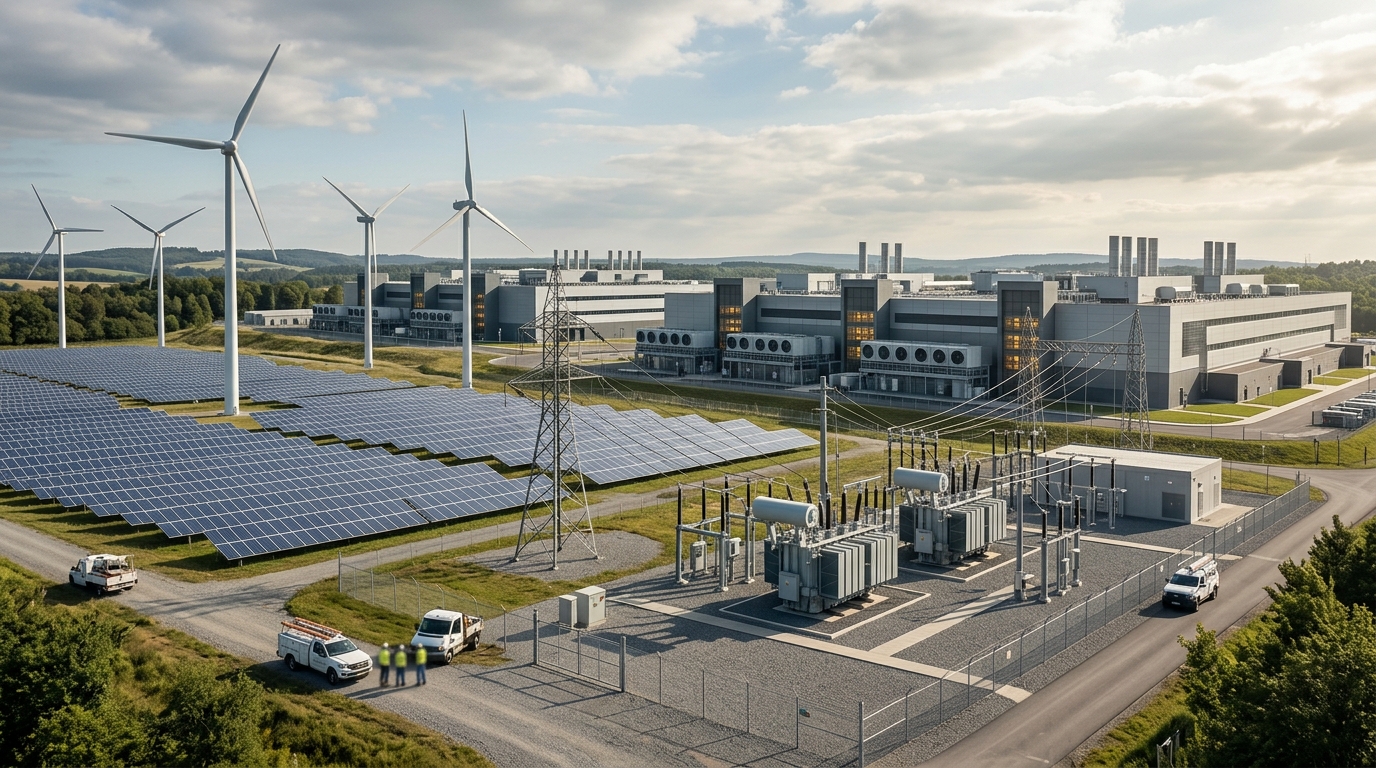
Every major AI hyperscaler has the same problem right now. They can build the data centers. They can buy the chips. What they cannot manufacture is the electricity to run them.
That is the business NextEra Energy (NEE) is in. And this morning, July 24, the company reports Q2 2026 earnings before the opening bell.
Analysts are expecting roughly $1.10 to $1.11 per share in earnings on revenue of about $8.15 billion to $8.17 billion, which would represent roughly 22% year-over-year revenue growth. NextEra has beaten the consensus EPS estimate in each of its last four quarters, with an average surprise of 6.18%.
But the earnings number itself may not be the most interesting thing here. The more important story is what this company is becoming.
On May 18, 2026, NextEra announced a $66.8 billion all-stock acquisition of Dominion Energy, creating what would be the world’s largest regulated electric utility by market capitalization. The combined company would serve roughly 10 million customer accounts across Florida, Virginia, North Carolina, and South Carolina and operate about 110 gigawatts of generation capacity.
The strategic rationale is almost entirely tied to AI. Virginia is the world’s largest concentration of data centers. The deal gives NextEra a direct foothold in Northern Virginia’s Data Center Alley, the exact geography where every hyperscaler is scrambling to secure long-term power commitments. The combined company says it has a more than 130-gigawatt large-load pipeline.
The deal also drops NextEra into the PJM Interconnection region, the nation’s largest power grid, covering all or parts of 13 states and the District of Columbia. Utility companies across the US have reportedly projected spending $1.4 trillion over five years to meet rising electricity demand tied to AI, a figure that is up more than 20% from prior estimates.
NextEra was already well-positioned before the Dominion deal. In Q1 2026, the company added 4 gigawatts to its renewables and storage backlog, including 1.3 gigawatts of battery storage, bringing the total backlog to roughly 33 gigawatts. The US Department of Commerce separately selected NextEra Energy Resources to build 9.5 gigawatts of new gas-fired generation in Texas and Pennsylvania.
The combined entity’s guided earnings per share growth rate of 9%-plus per year would represent an acceleration for both companies relative to their standalone trajectories. NextEra’s trailing ROE of 12.25% already exceeds the industry average of 11.21%.
There are real risks here. The Dominion transaction still requires shareholder votes, state regulatory approvals, and Nuclear Regulatory Commission sign-off, with a timeline of 12 to 18 months to close. Regulatory complexity at that scale is never trivial. The stock also pulled back after the deal announcement, which is a common pattern when the acquiring company in an all-stock deal is asked to absorb a massive new capital structure.
That pullback could be the entry point. Or it could be the market telling you something about the regulatory risk premium. Both are valid reads depending on your time horizon.
What is harder to argue with is the macro current running underneath this. Alphabet just told investors it is spending $195 to $205 billion on AI infrastructure in 2026 alone, with more to come in 2027. Meta and Microsoft report next week. Every one of those dollars eventually needs a power source. NextEra is one of the only companies in the country building that infrastructure at the scale the AI economy requires.
Today’s Q2 numbers are the first real-time data point on how that strategy is translating into financial results.
This article is for informational purposes only and does not constitute investment advice. Past performance is not indicative of future results. Always conduct your own research before making any investment decisions.