
October 31, 2026
Bonus Content: Qualcomm Is Down 37% From Its High. Earnings Will Say If It Deserves to Be.
December 3: Elon Musk’s
NEXT Millionaire Day
The last time Elon did this, he made 4,400
overnight millionaires…
Elon’s at it again…
Because he’s got a new plan to help create thousands of new American millionaires.
He recently pulled this off with SpaceX, when their record IPO created 4,400 “overnight” millionaires.
One day, these lucky Americans weren’t millionaires…
And the next day they were.
All thanks to Elon’s Millionaire Day.
And it wasn’t just SpaceX executives, because welders and cafeteria workers became overnight millionaires, thanks to Elon.
It’s unbelievable but this wasn’t even the first time Elon pulled off this incredible feat.
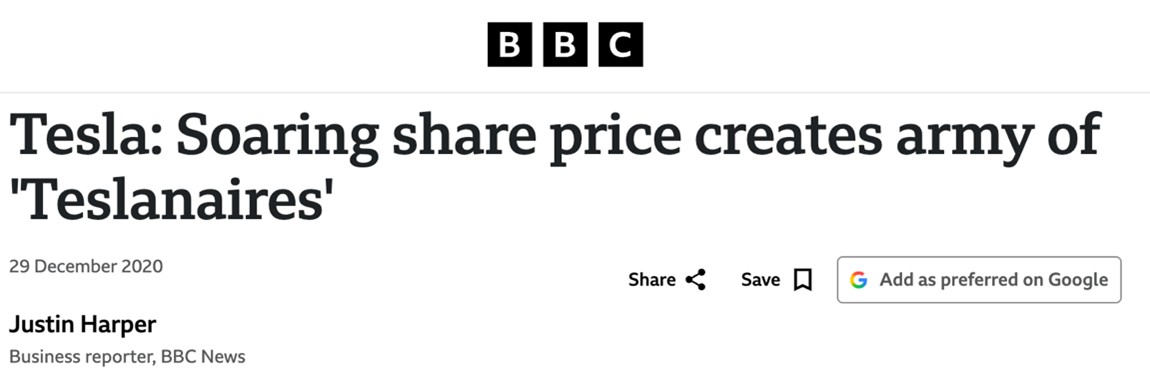
Because he helped create “an army of millionaires” with Tesla a few years ago!
And now he plans to help create a THIRD wave of millionaires by combining his TWO biggest companies in what I call a “Power Merger.”
History shows that when a newly public company combines with another big company, that’s where the REAL money gets made.
And these rare Power Mergers have led to extraordinary gains in AI-related companies…
Like Broadcom and Avago…
Avago went public at $15 a share… then combined with Broadcom, taking Broadcom’s name…
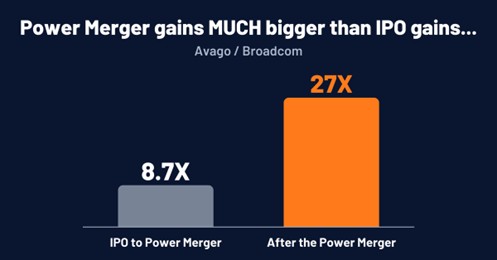
From its IPO to the Power Merger, Avago’s stock rose about 8.7 times in 6 years…
But after the Power Merger the stock soared ANOTHER 27-fold in 11 years…
And Broadcom became one of the world’s biggest AI chip companies…
That’s enough to turn $37,000 into $1,000,000 in 11 years.
That’s a huge gain – but Elon has pulled off an even bigger gain with a Power Merger of his own…
Because Elon helped start SolarCity.
It went public at $8 a share.
Four years later, Tesla bought it.
From its IPO to that point, SolarCity’s shares rose about 2.75 times in 4 years…
But after its Power Merger, the stockholders could’ve made ANOTHER 29X in 10 years…
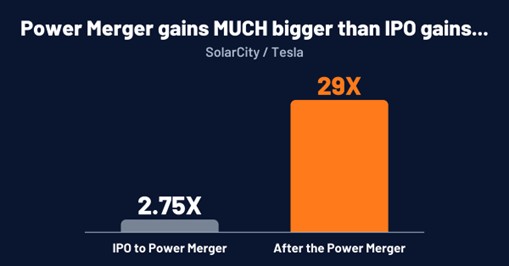
That’s enough to turn $35,000 into $1,000,000 in 10 years.
And now Elon is lining up what could be the biggest Power Merger in history.
Because he confirmed that SpaceX and Tesla have formed special committees to combine the two companies.
If it happens, Tesla shareholders would swap their shares for SpaceX stock…
And the combined company could be worth “nearly $5 trillion,” according to one top Wall Street analyst.
That’s bigger than Apple… and the entire economy of Japan.
And Elon could make his move within weeks. Barclays says the Power Merger could be announced by December 3.
And the timing couldn’t be better…
Because SpaceX just posted the best quarter in its history:
- Revenue soared 161%…
- They booked a huge first profit of $4.4 billion…
- And their AI business grew 830% in a single year…
Elon says that’s exactly why a Power Merger makes sense.
As he put it, “There’s a lot to be gained from cooperating on super intelligence.”
But it gets even bigger…
Because this Power Merger isn’t really about rockets or cars.
Instead, it’s about Elon building his own AI superintelligence, top to bottom.
And the key to it all is a little-known segment of the AI industry…
That NVDA’s CEO calls a “once in a generation opportunity…”
And that Elon expects “80% of Tesla’s value” will come from.
(Hint: it’s not AI chips, ChatGPT or internet AI…)
If you own any AI stocks, you need to see the story…
Including details on the #1 AI stock to own in this little-known sector.
Qualcomm Is Down 37% From Its High. Earnings Will Say If It Deserves to Be.

Hey there, bargain hunter. Qualcomm closes its fiscal year in early November, and it does so with a fresh double-digit hole in its stock price, a year-over-year EPS estimate that implies a steep drop from last November, and an entire semiconductor complex still smoking from Intel’s latest earnings shock.
Scoreboard
QCOM fell about 12% on Friday, October 30, 2026, to close at $162.56. That move did not come from anything Qualcomm said. Intel sent the whole PC-adjacent corner of semis into a tailspin after its latest results and commentary, with shares down more than 28% in the aftermath. Intel also pointed to a roughly 12% decline in 2026 PC unit volumes, tying part of the pressure to higher component prices, including memory. AMD sold off in sympathy on the PC warning, while Nvidia was comparatively less affected given its exposure mix. Qualcomm, sitting squarely in the handset lane, got hit in the crossfire.
AMD’s sympathy selloff on the Intel PC warning is a reminder of how contagion spreads through the semiconductor complex. AMD’s own earnings showed how a stock priced for perfection can punish investors even when the underlying numbers hold up.
The actual earnings come on Wednesday, November 4, 2026, after the close. Wall Street is looking for about $2.17 per share on roughly $10.14 billion in revenue. A year ago, the company reported about $3.00 per share on $11.27 billion. That is not a typo. Both the top and bottom line are moving the wrong direction.
The Real Reason This Is Complicated
The AI boom is increasing demand for memory and server chips used to train and run models. Tight memory supply and higher memory pricing can raise device build costs, which can feed into weaker unit demand for PCs and, potentially, smartphones. Smartphones share that same memory bill. At the same time, Qualcomm’s non-handset businesses have been growing, with automotive and IoT carrying more weight while handsets remain pressured.
Add Apple. Qualcomm has been warning for years that Apple is building an in-house modem and that Apple product revenue will step down over time as that transition plays out. On Qualcomm’s most recent earnings call, management said Apple product revenues were set to fall roughly 50% sequentially from the September quarter to the December quarter as the step-down accelerates. That compression shows up directly in the roughly $10.14 billion revenue consensus.
What the Business Actually Looks Like Now
Qualcomm makes chips for smartphones (QCT handsets), vehicles, and connected devices, then licenses wireless patents through its QTL division. The handset segment still dominates revenue, but the mix is shifting faster than the stock price reflects.
- Handsets: $5,086M (down 20% year over year last quarter)
- Automotive: about $1.6 billion, up 61% year over year, a quarterly record
- IoT: about $1.8 billion, up 9% year over year
- Combined automotive and IoT growth of 28% year over year offset a substantial portion of the handset shortfall
Last quarter, Qualcomm said it raised its automotive annualized revenue run-rate outlook to approximately $7 billion exiting fiscal 2026, up from its prior $6 billion target. And Qualcomm’s expanded BMW agreement positions it as BMW Group’s lead compute silicon provider for digital cockpit and next-generation ADAS and automated driving programs with model programs starting next decade.
Is It Cheap?
Qualcomm’s trailing P/E is roughly in the high teens, which puts it in the neighborhood of its recent history depending on the data source and timing. On price-to-sales, it sits around the ~4x range.
The bear case says historical multiples do not apply when EPS is falling sharply year over year. The bull case says the market is pricing Qualcomm as a commoditized handset chipmaker right when autos and IoT are scaling fast enough to structurally reshape the revenue mix. On the Q3 fiscal 2026 call, management said it expects non-handset growth in fiscal 2027 to replace total Apple product revenues from 2026. If that holds, the trough is already visible.
Bull / Base / Bear
Bull: Auto revenue hits another record Wednesday, guidance shows non-handset momentum accelerating, and the memory squeeze proves shorter-lived than Intel’s CFO implied. Stock recovers toward the analyst consensus target near $194.
Base: Q4 results land in-line, guidance is cautious on handsets, auto stays strong. Stock grinds sideways as the market waits for fiscal 2027 numbers to confirm the mix shift.
Bear: Memory costs bite harder into Android volumes than expected, Apple revenue falls faster than guided, and auto growth cannot offset the scale of the handset decline. The 52-week low of $121.99 becomes relevant again.
Action Plan
Do not buy the selloff today based on valuation alone. The Intel warning introduced a real variable, and Qualcomm’s Q4 guidance Wednesday will either confirm or rebut whether memory costs are squeezing smartphone volumes the same way they are squeezing PCs.
If guidance holds the automotive run-rate at or above $7 billion annualized and signals handset stabilization, scale into a starter position near current levels. If guidance cuts the automotive target or flags incremental handset pressure from memory, wait for the $140s before committing size.
Cheap Investor Checklist
- Q4 automotive revenue: confirm another record, watch the $1.7 billion threshold
- Q4 handset revenue vs. $5.2 billion guidance: any miss signals deeper Apple bleed
- Q1 fiscal 2027 guidance: this is the number that shows whether the trough is behind them
- Gross margin: management has flagged gross margin pressure from supply-chain costs, expected to recover as pricing actions take hold
- Memory commentary: listen for any updated view on smartphone unit demand
- Apple revenue detail: how fast is the step-down?
- Design-win pipeline update: Qualcomm has cited a $65 billion automotive design-win pipeline; any revision matters
- Dividend safety: payout ratio is roughly in the low-40% range, depending on methodology and the quarter used
Bottom Line
If Wednesday’s report shows automotive revenue above $1.7 billion and fiscal 2027 guidance that confirms non-handset segments can carry the weight Apple is dropping, QCOM around $165 is genuinely cheap for a company putting up 61% year-over-year growth in its fastest-scaling division. If the guidance disappoints on both handsets and autos, cheap-for-a-reason wins the argument. The answer arrives Wednesday after 4 PM Eastern.