
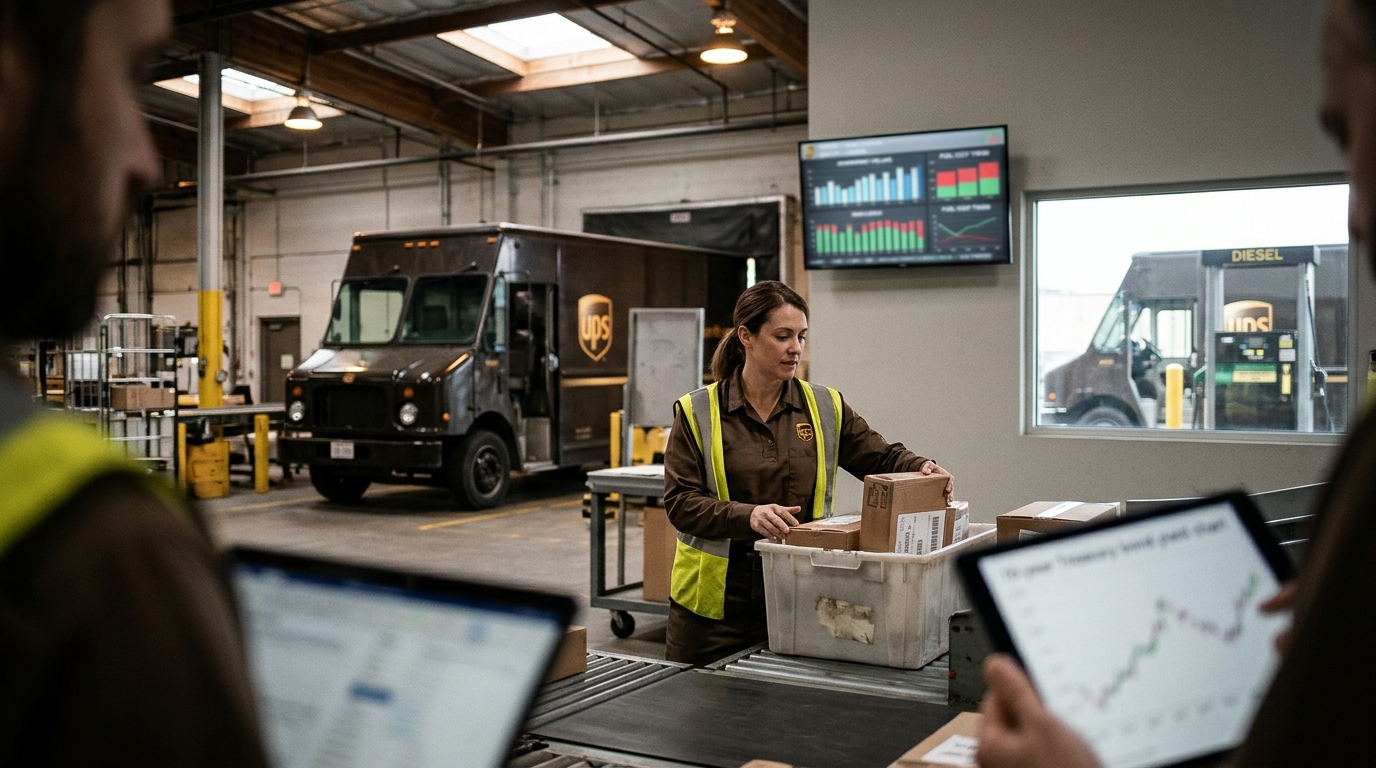
Hey there, bargain hunter. UPS drops its Q3 report before Tuesday’s open, and the math on the cover looks soft. Consensus sits around $1.63 a share on revenue of roughly $22.2 billion. A year ago the company earned $1.74. That is a 6%-plus earnings decline against modest revenue growth, which means the business is getting squeezed somewhere between the top line and the bottom line. Spoiler: that somewhere is a truck tank full of diesel.
Scoreboard
On-highway diesel hit $6.28 per gallon the week of October 19, up about 99% from $3.16 a year earlier. The all-time record was $6.53 on September 21. UPS runs one of the largest ground fleets in the country, and that fuel bill does not disappear quietly. The company has passed some of it along through surcharges. But higher surcharge revenue is still revenue built on a cost spike, and UPS management said on the Q2 call that the net impact to operating profit dollars was, in CFO Brian Dykes’s word, “modest.” Modest is a long way from good.
The Real Reason EPS Is Shrinking
Fuel is only half the story. UPS has spent 18 months deliberately shrinking its own network. The company cut Amazon volume by more than 50% under what it calls its “Better, Not Bigger” strategy, eliminating low-margin packages in favor of higher-yield shipments from healthcare shippers and small and medium businesses. Amazon had contributed more than 13% of UPS revenue at its peak; in Q2 2026 management said Amazon was about 9% of total UPS revenue.
The cut was the right long-term call. Revenue per piece rose 9.3% in Q2, outpacing the 8% rise in adjusted cost per piece. But you cannot halve one customer’s volume and keep the same cost base overnight. UPS has closed facilities and cut roles as part of its network reconfiguration. Heading into peak season, the network is leaner, higher-priced, and carrying less Amazon tonnage than at any point in the modern relationship.
Data Section
- Q3 consensus EPS: $1.63 vs. $1.74 a year ago, a 6.3% decline
- Q3 consensus revenue: ~$22.2 billion, up roughly 4% year over year from $21.42 billion
- Q2 actual EPS: $1.76, beat the $1.65 estimate by $0.11; revenue $22.83 billion, up 7.6%
- Full-year 2026 EPS guidance: $7.22; full-year revenue guidance raised to ~$91.2 billion
- Dividend: $1.64 per quarter, $6.56 annualized
- Dividend yield: roughly 6.4%-6.7% depending on the week you check the price
- 10-year Treasury yield: 5.00% as of October 23
Is It Cheap?
Here is where it gets uncomfortable. UPS yields around 6.5% at current prices near $100. The 10-year Treasury yields 5%. That 150-basis-point spread sounds like fair compensation for owning a cyclical logistics company in a fuel shock. But the payout ratio is north of 80% on 2026 earnings using the company’s $7.22 adjusted EPS guidance, and higher if profits come in below that. UPS is not leaving itself a big cushion. UPS has guided to about $5.5 billion of full-year free cash flow. The yield is real today. Whether it stays real depends on whether earnings recover in 2027, with a full-year EPS estimate of $7.96 implying the street expects a meaningful rebound.
Bull / Base / Bear
Bull: Diesel softens from its September peak, the “Better, Not Bigger” margin expansion accelerates, peak-season pricing holds, and 2027 EPS of nearly $8 makes today’s price look cheap at roughly 12-13x forward earnings. Dividend intact, yield compresses as the stock recovers.
Base: Q3 comes in near consensus. Guidance is maintained but tight. The stock treads water. You collect the dividend and wait for fuel costs to normalize and Amazon-replacement volume to mature through 2027.
Bear: Diesel stays above $6.00 through Q4, peak-season volume disappoints in the now-smaller network, operating margins compress further, and free cash flow falls short of the dividend. A payout cut is not impossible if cash coverage gets tight. That risk, priced against a 5% risk-free rate, is the core question Tuesday’s call must answer.
UPS is not the only logistics bellwether worth watching this earnings cycle. FedEx’s Q4 results offered an early read on global package volume trends and pricing power across the same network economy.
Action Plan
Do not chase ahead of the report. If UPS beats and management raises the Q4 bar, the stock has room to move. But a full position before you know what management says about peak-season volume trends and Q4 fuel assumptions is an unforced error. Scale in: a half-position at current levels makes sense for income-focused bargain hunters who can tolerate a 10%-15% drawdown if the dividend gets pressured. Watch the operating margin line above all else Tuesday morning.
Cheap Investor Checklist
- Q3 adjusted operating margin: watch for anything below 9.4%, which signals fuel is winning the cost battle
- Revenue per piece growth vs. cost per piece growth: the spread must stay positive for “Better, Not Bigger” to work
- Q4 volume guidance: is peak-season demand filling the Amazon-vacated capacity?
- Full-year free cash flow reconfirmation: ~$5.5 billion is the dividend’s floor
- Any mention of dividend sustainability or 2027 capital allocation on the 8:30 AM call
- Diesel fuel cost commentary: did October’s $6.28 hit harder than Q2’s run-rate implied?
- Amazon revenue as a percentage of total: is the glide down complete or still compressing?
Bottom Line
If Q3 beats and management confirms the dividend with credible free cash flow guidance, UPS at roughly 13x forward 2027 earnings with a 6.5% yield is a defensible income hold. If the call reveals margin deterioration beyond what the street has modeled, or any ambiguity around the payout, the yield stops being compensation and starts being a warning. Tuesday at 8:30 AM ET is when you find out which one you own.