
October 24, 2026
Bonus Content: UK Banks Are Cheap or Cheap for a Reason. This Week Settles It.
Ian Cooper here,
Alert!
If you still haven’t saved your copy of “The $50-to–$500 Options Strategy”…
… do it right now before the download link expires.
We’ll be moving this book behind a paywall in the near future so grab it now while you still can.
You’ll thank me.
FREE: The $50-to–$500 Options Strategy
To your success,
Ian Cooper
Tradewins
Reminder: Grab your copy of “The $50-to–$500 Options Strategy” before we move it behind a paywall.

UK Banks Are Cheap or Cheap for a Reason. This Week Settles It.
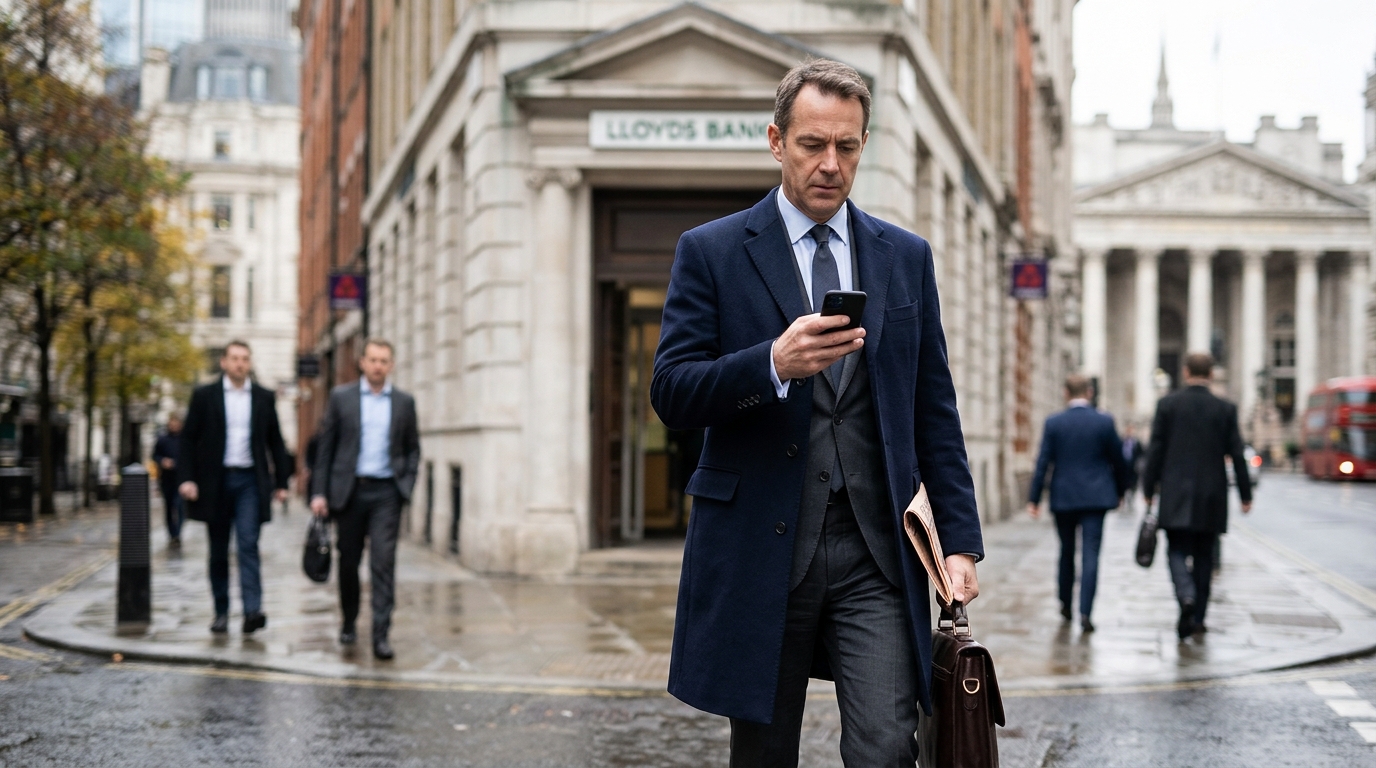
Hey there, bargain hunter. This week you get a four-day stress test for the UK banking sector, served in the worst possible order: HSBC results Tuesday, the Autumn Budget Wednesday, Lloyds Thursday, NatWest Friday. One of these is a wildcard with a price tag attached to it.
Scoreboard
Lloyds trades near 105p ahead of the 28 October Budget and its Q3 results on 29 October, having closed at 104.75p as recently as 14 October. That is a long way from where it was. At that level, Lloyds sits about 11% below the multi-year high of 117.90p it hit in early August. NatWest has made a similar journey, falling from a high of 726p to around 626p. HSBC, by contrast, has held up better, because its earnings are global rather than sterling-denominated and UK-sourced.
The Real Reason
The drop is not a mystery. The bank surcharge is widely expected to be raised in Chancellor John Healey’s 28 October Budget, potentially back to 8% from 3%. That levy was cut to 3% from 8% from April 2023 under the prior Conservative government. Healey is now expected to reverse that cut.
Goldman Sachs estimates that restoring the surcharge to 8% would trim Barclays’ net profit by 2% to 3%, and cut Lloyds and NatWest by 6% to 7%. Lloyds and NatWest, which are much more exposed to the UK market than HSBC, would likely bear the brunt of any new levy. UK banks already face total tax rates around 46%, compared with about 39% for Frankfurt and about 28% for New York. Slapping more on is not a neutral act for competitiveness.
What the Business Actually Looks Like
Strip the Budget noise out, and the underlying numbers are solid. Lloyds reported H1 2026 statutory profit before tax of £4.3 billion, up 23% year on year, with net interest income up 10% to £7.1 billion. A £246 billion structural hedge continues to provide a significant income tailwind, with the group expecting structural hedge earnings to be greater than £7.0 billion for 2026.
Lloyds initially saw a sharp dip after its Q2 results at the end of July, before briefly rallying to the highest levels since 2008. NatWest told a similar story: NatWest shares briefly rose to new post-financial-crisis highs after a solid Q2 and H1, with H1 profit after tax up 18.9% to £3.18 billion.
HSBC is the outlier in this group. H1 numbers saw the HSBC share price push to record highs before sliding gradually lower; profit before tax rose 23% to $19.5 billion while revenues rose 11% to $37.7 billion. All eyes for Q3 will be on the Budget and a possible increase to the bank surcharge, which could further sour sentiment toward UK-focused earnings exposure.
Is It Cheap?
Analysts’ average 12-month targets for Lloyds sit between 117p on MarketBeat and 121.3p on MarketScreener. At 105p, that is a 12% to 15% discount to where the street thinks fair value sits, before any Budget surprise.
Lloyds has been building alternative sources of income, including insurance, credit cards and wealth management, which could lessen the reliance on more traditional income streams. That diversification is exactly what a tax on core lending profits makes more valuable, not less.
The same tax-and-rate squeeze hitting Lloyds is visible across the Channel. European bank stocks have been falling on the same logic — margin expansion meets tightening credit risk — and the valuation question there is nearly identical.
Bull / Base / Bear
- Bull: The Budget lands with a surcharge below 8%, or phased in slowly. Lloyds beats Q3 consensus on NII. Management reaffirms full-year guidance. Shares re-rate toward 117p.
- Base: The hike raises about £2 billion per year for the UK Treasury while slicing roughly 6% off lenders’ earnings. Shares remain range-bound, with income from the structural hedge partly offsetting the tax drag. Lloyds trades sideways near 105p to 110p through year-end.
- Bear: The surcharge goes to 8% immediately, gilt yields stay elevated, and motor finance liability uncertainty resurfaces at the Q3 results. Any change in the tax treatment of bank profits could influence how much surplus capital the group has available to return to shareholders. Dividend expectations fall, and Lloyds tests the 100p level again.
Action Plan
Wait for Wednesday. The Budget is the only event that materially changes the earnings calculus for Lloyds and NatWest this week, and no Q3 beat erases a confirmed mid-single-digit earnings hit. If the surcharge comes in below 8% or is staged, the marked-down price at 105p looks like an overshoot. Buy in two tranches: a first position on any post-Budget relief, a second after Lloyds confirms Q3 guidance Thursday. HSBC remains the least exposed to a domestic UK surcharge and is the cleaner hold if you want UK bank exposure without the binary risk.
Cheap Investor Scorecard
- Bank surcharge rate confirmed in Budget: target below 8%, phased implementation a bonus
- Lloyds Q3 NII: watch for any revision to full-year guidance
- NatWest Q3 revenue: watch for any change in income guidance post-Budget
- HSBC Q3 update: watch for any change in return targets and capital return framing
- Structural hedge trajectory: Lloyds expects structural hedge earnings greater than £8.0 billion in 2027
- Motor finance liability: any updated provisions at Lloyds would reset the earnings base
- Gilt yields: 10-year UK yields near multi-year highs pressure valuations even as they lift NII
- Shareholder returns: watch buyback guidance from both Lloyds and NatWest post-Budget
Bottom Line
If the surcharge lands lighter than feared, Lloyds at 105p is a mispriced income stock with a structural hedge expected to keep growing beyond 2027. If the full 8% hits immediately and gilt yields stay elevated, that discount is there for a reason. You get the answer in 96 hours. Position small now, size up after Wednesday.