September 20, 2026
Every macro tailwind is blowing its way. The comps will say whether any of it is showing up at the counter.
Hey there, bargain hunter. When new cars cost $50,000 and the 10-year Treasury is north of 5%, households do one thing: they fix what they already own. That is AutoZone’s entire business model in one sentence, and Tuesday morning you get to see whether it is working.
Pilots Use One. Smart Traders Should Too.
A pilot never takes off without running a checklist. Not because they don’t know how to fly – because they know that the moment something feels routine is the moment a step gets skipped.
Options trading punishes skipped steps faster than almost anything else. So, I put the 7 that matter most on one page.
It’s called the Smart Trade Options Checklist. Normally $29.97. Free today.
Run it before any options trade. Takes about 30 seconds. You’ll catch the bad ones before they cost you.
Scoreboard
AutoZone (AZO) reports fiscal fourth-quarter 2026 results before the open on September 22. The quarter ended August 29. Wall Street’s consensus, per 21 analysts tracked by AlphaStreet, sits at $54.22 a share on $6.71 billion in revenue. That implies 11.3% earnings-per-share growth from the $48.71 reported in last year’s Q4, and about 8% top-line growth from roughly $6.2 billion. The call starts at 10 a.m. ET.
The stock itself sits around $2,855, roughly 34% below its 52-week high of $4,332. That gap is the only reason this report feels interesting rather than routine.
The Real Reason It Matters Now
GM shed roughly $3.5 billion in market value in a single Friday session, its worst day since July 2025. Diesel crossed $6.30 a gallon after a drone attack hit Saudi pipeline infrastructure, and the Federal Reserve’s first rate increase since 2023 helped push the 10-year yield to about 5%. That combination kills new-car demand and raises every distribution cost in the DIFM channel simultaneously.
AutoZone sits at the intersection of both forces. Higher rates price buyers out of new vehicles, extending the life of the existing fleet and pushing repair spending higher. Higher diesel raises AZO’s own distribution costs. Tuesday’s report tells you which force is winning.
Central Banks Are Buying Gold at a Historic Pace
Central banks are quietly stockpiling gold… and reducing their dependence on the U.S. dollar. That raises an important question: what are they preparing for? The reason is worth understanding for your retirement savings. America’s Gold Company breaks down the trend in a free, no-pressure guide, including how precious metals can diversify your retirement.
What the Business Actually Does
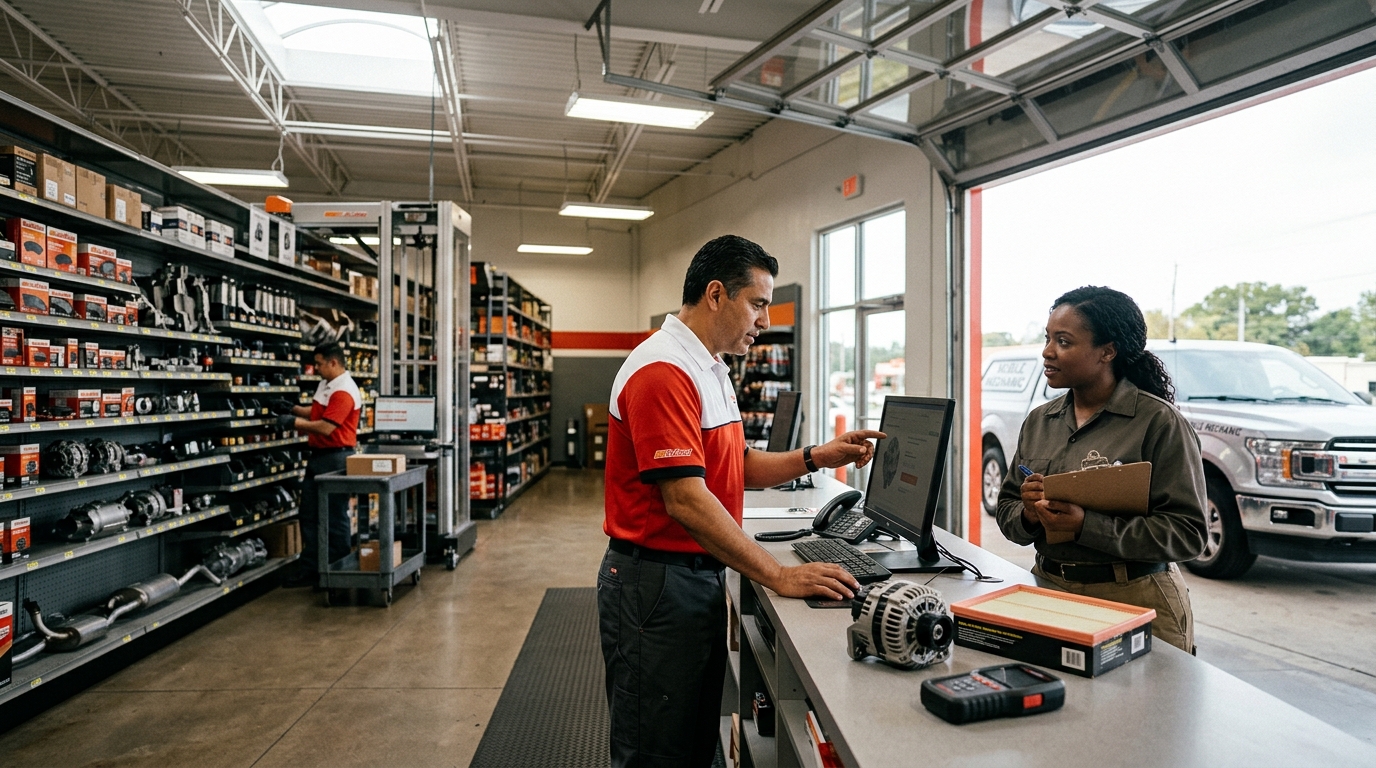
AutoZone operates 8,031 stores across the U.S., Mexico, and Brazil, selling replacement parts, accessories, and maintenance products to both retail consumers (DIY) and professional repair shops (DIFM). It does not do repairs itself. Revenue comes from the counter. The average U.S. vehicle is now 12.8 years old, meaning parts proliferation is a structural tailwind, not a cyclical one.
The commercial DIFM segment is the growth engine. In Q3 FY2026, domestic commercial sales hit $1.4 billion, up 10.4% year-over-year. CEO Phil Daniele has said AutoZone holds roughly 5% of the commercial auto parts market. In a fragmented industry, that underpenetration is the core of the bull argument.
Key Metrics to Track Tuesday
- Same-store sales (domestic): Consensus calls for 3.7% growth. Q3 came in at 4.1%. A miss here is the biggest bear trigger.
- Commercial DIFM revenue: Consensus pegs domestic commercial sales at $1.95 billion, up 10.6% YoY. Watch whether diesel costs are compressing shop demand.
- Gross margin: Q3 gross margin was 52.2%, with a 77 basis point unfavorable net non-cash LIFO impact. Prior-year Q4 gross margin was 51.5%, a slightly easier comparison.
- EPS range: Analyst estimates span $51.46 to $56.97, an unusually wide band that reflects genuine uncertainty on ticket size and LIFO.
- Share count: AZO had about 16.5 million shares outstanding as of its most recently reported quarter. The buyback machine is the EPS multiplier. In Q3 alone, the company repurchased 164,000 shares for $586 million.
Is It Cheap?
At $2,855 and roughly 16x forward earnings, AZO trades at a meaningful discount to O’Reilly (ORLY), which is closer to the mid-to-high 20s. The gap reflects a revenue miss in Q3 (revenue came in slightly below consensus despite the EPS beat) and persistent LIFO charges tied to parts inflation. The average analyst price target sits around $4,030, implying more than 40% upside from current levels, though the specific target cuts and numbers cited here could not be verified from primary sources.
The buyback is the asterisk on every number. Since 1998, AutoZone’s board has authorized $42.2 billion in repurchases. The share count keeps shrinking. That structural EPS lift is real, but it cannot offset a genuine comps miss.
Bull / Base / Bear
Bull: Domestic same-store sales beat 3.7%, commercial pushes toward $2 billion, LIFO normalizes further, and management raises the buyback authorization again. The stock closes the gap to O’Reilly.
5 Little-Known Stocks Behind Today’s Defense Tech Shift
Behind the headlines, a major transformation is underway.
Modern warfare is being driven by AI, autonomous systems, and next generation technology. A handful of lesser known companies are helping power this shift.
This report uncovers five stocks quietly playing a critical role in the future of defense.
Base: Comps land at consensus, commercial delivers double-digit growth, margins hold near last year’s Q4, and shares drift toward $3,200 over the next two quarters as the buyback does its work.
Bear: Record diesel costs slow shop traffic enough to miss the DIFM estimate. DIY same-store sales soften as financially stretched consumers postpone non-emergency repairs. Gross margin stays under pressure from LIFO. Stock tests the 52-week low near $2,815.
Action Plan
Do not chase before the number. At $2,855 the stock is near its 52-week low, which creates asymmetry, but Q3 taught us that even a solid EPS beat with a revenue miss can drop AZO 9% in a session. If Tuesday’s report shows domestic comps at or above 3.7% and commercial revenue above $1.9 billion, consider a half position. Add the other half only if the margin line holds above 51%. If comps miss and commercial disappoints, the thesis needs a quarter to reset.
Cheap Investor Checklist
- Domestic same-store sales at or above 3.7%
- Commercial DIFM revenue above $1.9 billion
- Gross margin above 51%
- LIFO charge smaller than Q3’s $20 million headwind
- EPS at or above $54.22 consensus
- Revenue at or above $6.71 billion
- Buyback activity sustained (shares purchased and authorization remaining)
- Management commentary on diesel cost impact to DIFM channel
- International same-store sales trajectory (Mexico and Brazil)
- Full-year fiscal 2027 guidance or any forward color
Bottom Line
If comps hold near 4% and commercial keeps growing double digits, AZO at 16x forward earnings is the kind of discount the buyback machine was built to exploit. If comps slip and margins compress, the stock has more room to fall before it gets genuinely cheap. Tuesday morning tells you which version you are buying.