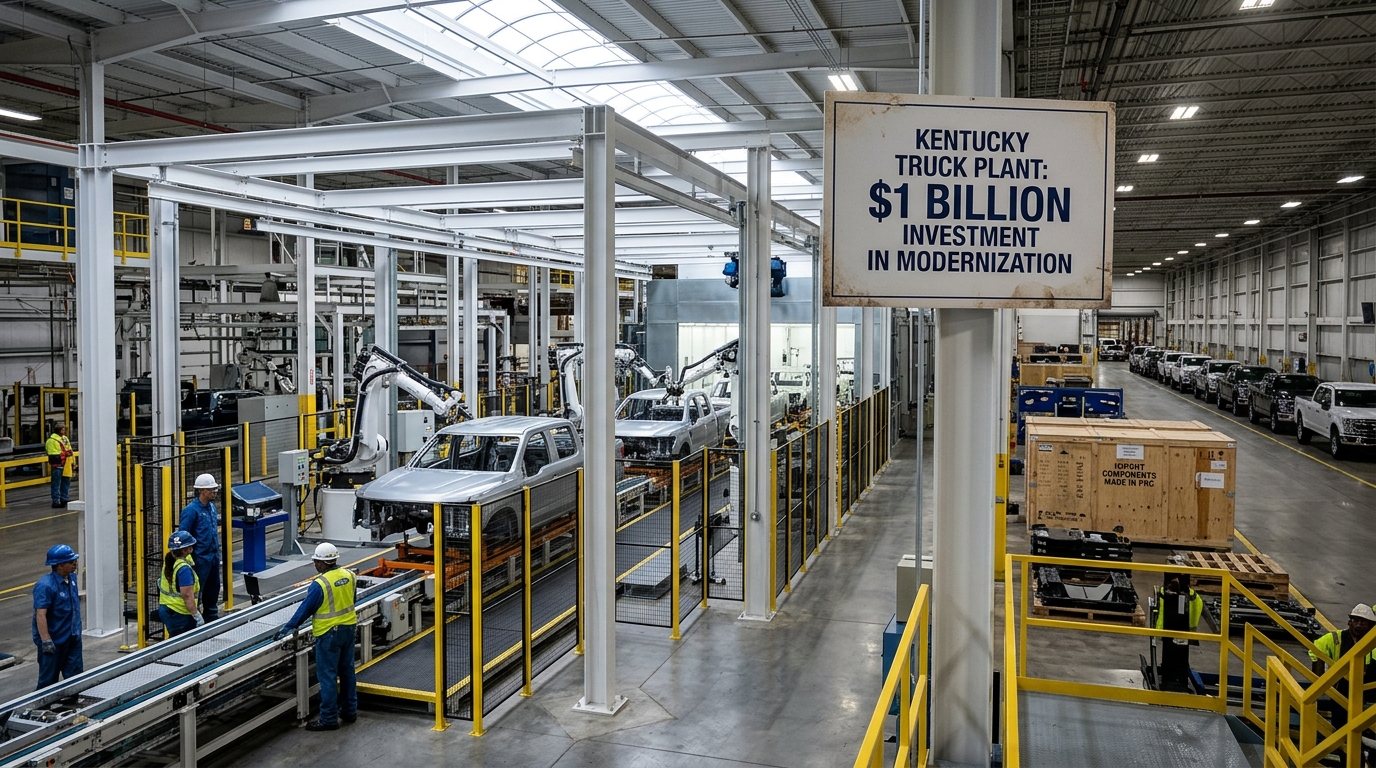
The timing was not accidental. Two days after Transportation Secretary Sean Duffy sent a letter to CEO Jim Farley accusing Ford of “actively intertwining its future with Chinese state-backed enterprises,” Ford announced a $1 billion commitment to build a new paint shop at its Kentucky Truck Plant in Louisville. Construction starts before year-end. The message was meant to land as a rebuttal. For shareholders, it is worth separating what this investment actually says from what it does not.
Start with what it says. The Kentucky Truck Plant builds Ford Super Duty trucks, Ford Expeditions, and Lincoln Navigators. As Ford’s highest-revenue U.S. manufacturing plant, it remains a cornerstone of Ford’s manufacturing footprint. A company does not drop a billion dollars modernizing a factory unless that factory is generating the cash to justify it.
Upgraded technology in the new paint shop will deliver cleaner and more efficient paint quality, supporting continued production excellence with improved efficiency and advanced environmental sustainability. That is the company’s language, but the underlying logic is straightforward: paint is a significant cost center and quality bottleneck in truck assembly. Modernizing it at a plant operating at this volume is a margin move as much as a manufacturing one.
The financial backdrop supports the capital commitment. Ford reported first-quarter 2026 revenue of about $43.3 billion and net income of about $2.5 billion, a sharp recovery after a difficult 2025. Ford shares closed at $13.45 on September 9, 2026. The trailing dividend yield sits at 4.29%, which means income investors holding F are being paid to wait while the company reinvests in its most profitable lines.
Now for what the Louisville announcement does not resolve. The DOT said it is “alarmed” by Ford’s use of technology from Chinese battery manufacturer CATL at its BlueOval Battery Park facility in Marshall, Michigan, and that dispute is structurally different from a factory upgrade. Seven Chinese companies together control 72.8% of the global EV battery market between January and July 2026, with CATL alone accounting for 39.9% of that share. Ford cannot paint its way out of that reality.
Ford’s defense has been consistent: its agreement with CATL is a limited technology-licensing and services agreement, not a joint venture or foreign-owned manufacturing operation. Ford says the Marshall plant supports 1,700 jobs, with Ford holding ownership of the facility, directing its day-to-day operations, and serving as the employer of record for its workers. It also pointedly noted that the White House highlighted the Marshall battery project in a recent press release, making the DOT’s letter look like an uncoordinated shot across the bow rather than settled administration policy.
CATL has also supplied Hyundai, a fact conspicuously absent from Duffy’s letter. GM CEO Mary Barra hosted Trump and Duffy at the Milford Proving Ground in Michigan on July 27, 2026, which gives context to why Ford, not GM, became the target.
For F shareholders, the Louisville investment is the easy part to evaluate: it protects and extends the profitability of Ford’s most valuable manufacturing asset. The CATL question involves technology dependency, regulatory risk, and a battery supply chain that no American automaker has yet replaced domestically. A new paint shop answers one argument. It does not answer the other.
The wealth-building lesson here is durable: capital allocation reveals management priorities. Ford chose to defend its highest-margin franchise loudly and visibly. Investors should credit that, while keeping a clear eye on the technology risks that a billion-dollar paint job simply cannot coat over.