September 10, 2026
Investor Day is today. Here is exactly what the numbers need to show for LH to be worth buying.
Labcorp investor day puts the “discount” thesis on trial
AI Meltdown has Began: Take These Five Steps Now
Do you see the similarities? That’s why Jim Rickards is warning Americans to prepare for an imminent AI meltdown.
As the main supplier of internet infrastructure, Cisco was the “Nvidia of the internet.”
When the dotcom bubble popped, shares crashed 90%…
And spent the next 25 years trying to recover.
If you cannot afford to suffer that kind of devastating loss…
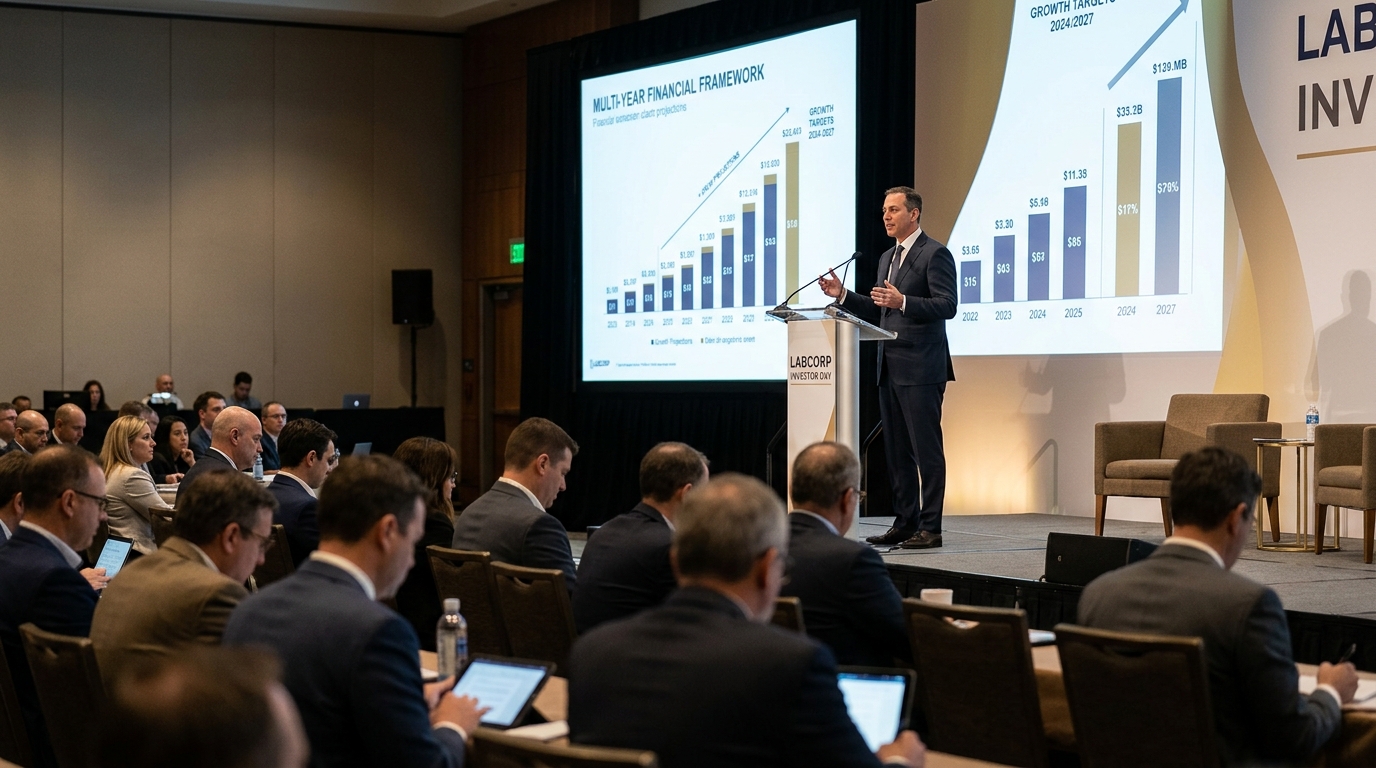
CEO Adam Schechter puts multi-year numbers on the table today. Here is what a bargain hunter actually needs to hear.
Hey there, bargain hunter. Labcorp (LH) is hosting its investor day this morning, running from 9 a.m. to noon ET, and for once the timing actually matters. This is the first time management has put a long-term financial framework in front of investors since hospital-outreach acquisitions became a bigger part of the company’s growth engine. The question is not whether Labcorp is a good business. It is whether the stock is priced like one, and whether today’s targets are enough to close the gap with Quest Diagnostics (DGX).
Scoreboard
Labcorp’s most recent quarter, reported July 30, showed enterprise revenue of $3.73 billion, up 5.8% year over year. Adjusted EPS came in at $4.99, up 14.9%, beating the $4.79 consensus. Adjusted operating margin hit 15.8%, 70 basis points better than the year-ago period. Management raised full-year adjusted EPS guidance to $18.10–$18.55, with enterprise revenue growth expected in the 5.4%–6.3% range. The stock is trading below its 52-week high, which is $341.80.
Quest, for context, is projecting full-year revenue of $11.95–$12.05 billion, growth of 8.3%–9.2%, which is faster than Labcorp’s current enterprise growth outlook. DGX and LH both trade in the mid-to-high teens on forward earnings depending on the estimate set you use, so the “obvious discount” case is not as clean as it looks in a quick headline.
Don’t Place Your First Options Trade Blind
Before you ever place your first options trade, there’s one thing you should understand: how options actually work. This free beginner’s guide explains the essentials in plain English-without overwhelming you with complicated trading jargon.
What the Business Actually Does
Labcorp runs two engines. Diagnostics (Dx) is the core, generating $2.76 billion in Q1 revenue, growing 5.8% year over year. Biopharma Laboratory Services (BLS) supports clinical trial sponsors and closed Q2 with an $8.73 billion backlog. Specialty testing, covering oncology, women’s health, autoimmune disease, and neurology, has been a key growth area in 2026, and that mix matters because specialty tends to carry better economics than commodity routine testing.
The acquisition machine has been running hard. Labcorp spent $528.6 million on deals in the first half of 2026. It has also been active in hospital outreach, including the Parkview Health outreach laboratory assets in Indiana and northwest Ohio, and it agreed in late June to pay $155 million for select assets of an outreach laboratory services business. The strategy is consistent: acquire outreach businesses from regional health systems, convert those patient relationships to Labcorp’s testing platform, and extract margin through scale. In Q2, acquisition volume contributed about 1.3 percentage points to Dx requisition growth.
The Real Friction Today’s Framework Needs to Address
Two cost overhangs sit on the table that management has not yet quantified in a multi-year context. First, the Section 232 investigation covering medical equipment including devices, which the Commerce Department initiated on September 2, 2025. The statutory review clock is 270 days for Commerce to deliver a report to the President, and then there is a separate decision window for the President, so the potential policy endpoint can land in 2026 depending on timing and extensions. Labcorp’s lab equipment supply chain is exposed. How much, and what the mitigation plan looks like, is one of the cleaner questions investors should be asking Adam Schechter today.
Second, automation and AI integration are cited constantly but measured rarely. Labcorp’s LaunchPad initiative is positioned as a productivity lever. Today is the day to attach numbers to that claim, whether in the form of cost-per-test trajectory, headcount efficiency, or margin guidance that exceeds the current run rate of 15.8%.
Inside the Nuclear Revival Reshaping Energy Markets
Governments worldwide are investing billions to revive a proven energy source. Supply chains are tightening, demand is rising, and select companies stand to benefit. The Nuclear’s Second Act report explains what’s happening next.
Is It Cheap?
Honestly, not obviously. LH trades above its own multi-year averages depending on the period you pick, and the peer comparison is tighter than it looks because Quest is growing faster. For Labcorp to justify a real re-rating, management needs to show a credible path to mid-to-high teens adjusted operating margins over the next two to three years, not just another quarter of 70-basis-point steps. Free cash flow guidance for 2026 sits at $1.24–$1.36 billion, which is solid, and the company disclosed a $1.0 billion increase in share repurchase authorization, bringing the remaining total authorization to $1.4 billion.
Bull / Base / Bear
- Bull: Schechter delivers a multi-year adjusted operating margin target of 17%+, acquisitions stay accretive within year one, specialty testing sustains strong growth, and Section 232 tariffs are either narrow or passed through to payers.
- Base: Margin trajectory continues at current pace, revenue growth holds in the 5–6% range, and LH trades at a modest discount to DGX given the slower top-line profile. Stock grinds modestly higher.
- Bear: Section 232 tariffs land broadly on medical equipment including diagnostic gear, acquisition integration costs disappoint, payer mix and reimbursement tighten, and the multiple compresses back toward prior-cycle norms.
Action Plan
Do not buy ahead of the presentation. Wait for the margin targets. If management commits to a multi-year adjusted operating margin above 17% with a credible cost bridge, the current price becomes interesting for a partial position. If the framework is vague on tariff exposure or relies entirely on acquisition-driven growth with no organic margin story, hold cash and revisit after Q3. For existing holders, the $1.4 billion buyback authorization is your cushion. Let it work.
Cheap Investor Checklist
- Did management set a specific multi-year adjusted operating margin target? (Looking for 17%+)
- Did they quantify potential Section 232 exposure in dollar terms and outline mitigation?
- Is AI/LaunchPad tied to a measurable cost-per-test or headcount metric?
- Does the acquisition framework include return hurdles, not just payback language?
- Is specialty testing growth projected to stay strong through 2027?
- Is free cash flow guidance tracking toward the high end of the $1.24–$1.36 billion range in 2026, and higher beyond that?
- Did the capital deployment priority explicitly rank buybacks vs. M&A vs. dividend growth?
Bottom Line
If Schechter walks out of this morning’s event with a hard margin target and a credible answer on Section 232 exposure, LH is worth building a position in on any post-day dip. If the framework is aspirational and light on specifics, the premium to the company’s own historical ranges is not supported. The discount to Quest is not automatically a discount worth buying. It depends entirely on what gets said between 9 a.m. and noon today.