September 5, 2026
Is a Kroger growing identical sales 1-2% cheap? It depends on what private label does to margin.
Hey there, bargain hunter. On Friday, September 11, Kroger hosts its second-quarter 2026 earnings call at 8 a.m. ET. Thirty minutes later, the Bureau of Labor Statistics drops the August CPI reading at 8:30 a.m. ET. Two data points, same morning, both telling the same story about how American families are handling a grocery bill that won’t stop climbing.
You’re Being LIED To About The Iran War
Forget EVERYTHING you’ve heard about the Iran war.
Especially the reasons why we’re bombing the country.
Scoreboard
Heading into Friday, TipRanks puts the Wall Street consensus at $1.05 EPS for the quarter. The full-year guide, reaffirmed after Q1, sits at adjusted EPS of $5.10-$5.30, identical sales growth of 1-2% excluding fuel, and free cash flow of $2.7-$2.9 billion. Citi cut its price target to $57 from $61 on September 1, placed the stock on a 30-day downside catalyst watch, and kept its Neutral rating. The stock is down about 5% year-to-date and roughly 14% over the past twelve months.
Kroger’s valuation debate is not new territory. Earlier this summer, the stock was already drawing scrutiny alongside a handful of other names facing similar guidance-versus-reality tensions. our earlier breakdown of Kroger and four other stocks worth watching that week walked through what the numbers actually said before the noise set in — useful context for anyone trying to separate the signal from the analyst target shuffling happening now.
The Real Reason This Print Matters
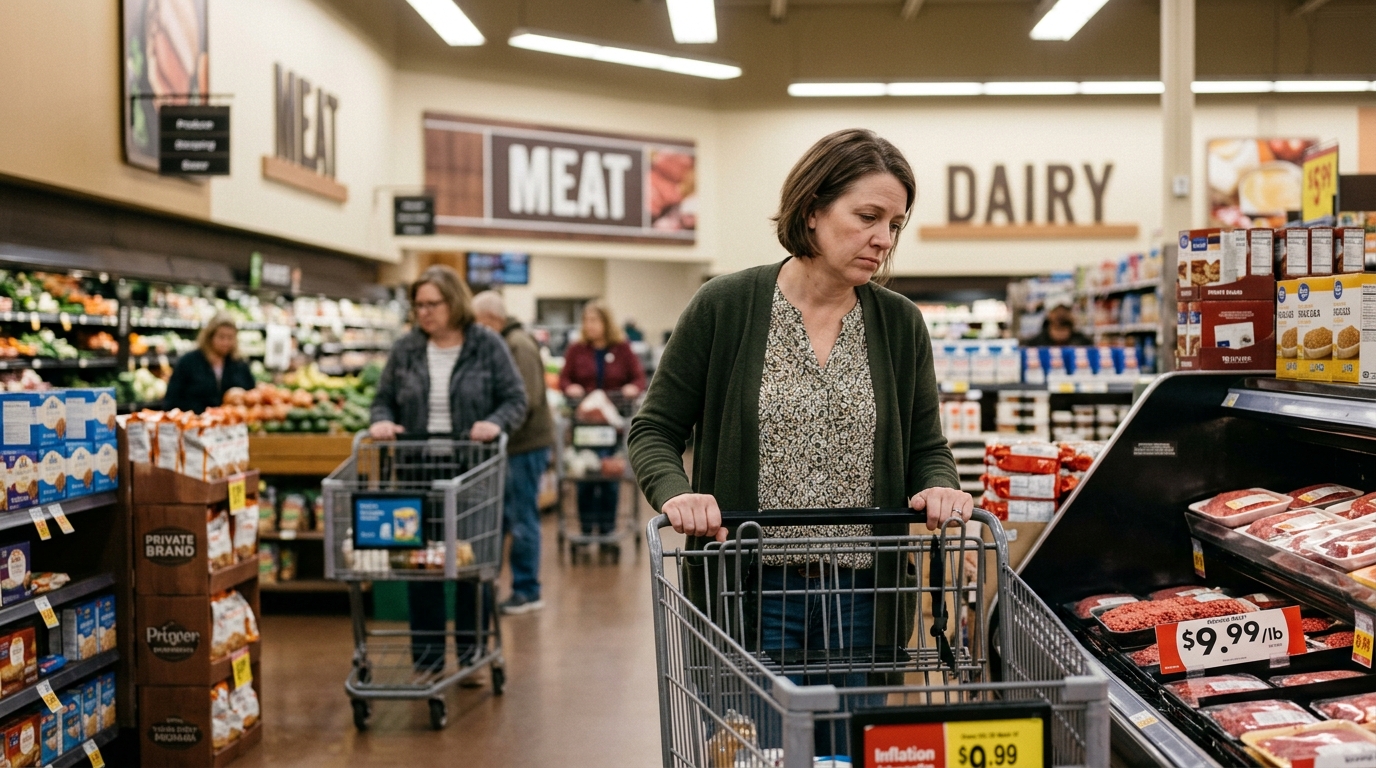
Tyson Foods updated its fiscal 2026 outlook on September 3, warning of “significant margin compression amid volatile cattle prices and one of the most severe cattle shortages in U.S. history.” The beef segment loss estimate widened to a range of $625 million to $775 million. Beef at retail has been running materially higher year over year, and ranchers have been slow to retain heifers for breeding after years of drought shrank the U.S. herd to multi-decade lows.
That pain lands on Kroger’s shelves. The question is how much of it stays there versus gets absorbed by a shopper already trading down.
Understanding how much pressure the shopper can absorb requires looking beyond the grocery aisle. Memorial Day weekend served as a real-world stress test of consumer resilience, and the results were instructive for anyone modeling whether budget-conscious households will keep trading down or eventually pull back further. our consumer spending report tracking how U.S. shoppers behaved over the holiday weekend offers a ground-level read on the same trade-down dynamic Kroger’s private-label numbers are now reflecting.
How Kroger Actually Makes Money
Kroger operates 2,697 supermarkets, 2,250 pharmacies, and 1,731 fuel centers. The core grocery model runs on wafer-thin margins, which is exactly why the mix shift toward private label and retail media matters so much. In Q1 2026, total sales reached $46.1 billion, adjusted EPS came in at $1.58 (up 6% year over year), and e-commerce turned profitable, with adjusted eCommerce sales up 19%.
5 Little-Known Stocks Behind Today’s Defense Tech Shift
Behind the headlines, a major transformation is underway.
Modern warfare is being driven by AI, autonomous systems, and next generation technology. A handful of lesser known companies are helping power this shift.
This report uncovers five stocks quietly playing a critical role in the future of defense.
The higher-margin levers are compounding. Kroger Precision Marketing profit grew more than 20% in Q1, supported by a loyalty database that tethers over 95% of transactions to a Kroger loyalty card. The Our Brands portfolio spans more than 13,000 items, and in Q1, private label outpaced national brands by 175 basis points. Simple Truth and Private Selection are growing fastest.
Key Data to Track Thursday
- Identical sales ex-fuel: Q1 came in at 1.0%, the low end of the 1-2% full-year guide. Management flagged Q2 would likely mirror Q1.
- Gross margin: Slipped from 23.0% to 22.7% in Q1, pressured by fuel mix, transportation costs, and egg deflation. Watch whether beef inflation widens that gap.
- Private label penetration: The single clearest read on whether shoppers are defending their budgets inside the store.
- Full-year guidance tone: Citi’s concern is that management turns more conservative on the second half, not that Q2 misses.
- Free cash flow: Net total debt-to-adjusted EBITDA at 1.75x, well inside the 2.3-2.5x target range.
Is It Cheap?
At roughly $56, Kroger trades at about 10.7 times forward earnings on the $5.10-$5.30 guidance range. That is a discount to the broader Consumer Defensive sector and a steep discount to Walmart. Costco commands a premium the model here cannot justify. The honest comparison is a grocer growing identical sales at 1-2% in a tough consumer environment, with beef costs structurally elevated for the cattle cycle. Ten times forward earnings sounds cheap. It is not obviously expensive. But “not expensive” and “a great buy right now” are two different things.
Bull / Base / Bear
Bull: Private label mix accelerates, e-commerce profitability expands, Kroger Precision Marketing keeps compounding, and the company takes the high end of its EPS guide. At $5.30 and 12x, shares reach $63.
Base: Identical sales land at 1-1.5%, beef costs keep gross margin compressed, management narrows the full-year EPS range to $5.10-$5.20. Stock trades sideways around $56-$60.
Inside the Nuclear Revival Reshaping Energy Markets
Governments worldwide are investing billions to revive a proven energy source. Supply chains are tightening, demand is rising, and select companies stand to benefit. The Nuclear’s Second Act report explains what’s happening next.
Bear: Citi’s thesis plays out. Walmart’s price aggression accelerates the comp deceleration. Management guides the second half down, sending adjusted EPS toward $4.90. Shares test the $50 level.
Walmart’s role in the bear case is worth examining on its own terms, not just as a competitive threat in the background. The question of whether Walmart is priced as a grocer or as something else entirely changes how you think about the pressure it can sustain on price. a detailed look at whether Walmart’s valuation reflects a grocer or an expensive tech platform lays out the case for why its pricing aggression may be structurally durable in ways Kroger’s model cannot easily match.
Action Plan
Do not chase ahead of Friday. The setup is binary: guidance either holds or it doesn’t, and Citi has told you the risk is skewed toward a conservative second-half tone rather than an outright Q2 miss. If Kroger reports in-line and reaffirms $5.10-$5.30 with a specific callout that private label mix is rising and gross margin is stable, that is a green light to build a half position at current prices. Scale the second half only after the November update confirms the trend is holding.
Cheap Investor Checklist
- Q2 identical sales ex-fuel: at or above 1.0%?
- Gross margin: stable at 22.7% or better?
- Private label share: outpacing national brands by 150+ basis points?
- Full-year EPS guidance: held at $5.10-$5.30?
- Second-half tone: any language about intensifying Walmart price pressure?
- E-commerce profitability: confirmed as an ongoing trend, not a one-quarter event?
- Free cash flow guidance: $2.7-$2.9 billion held?
- Beef cost commentary: any sign of cost pass-through or volume hit to the meat case?
Bottom Line
If Kroger holds its guide Friday and private label mix is visibly rising, a grocer at 10-11 times forward earnings deserves a spot on your watchlist. If management signals the second half softens, Citi’s $57 target becomes the ceiling, not the floor. Watch the guidance tone first. The CPI reading landing 30 minutes later will tell you whether the shopper helping Kroger trade up to private label can keep doing it.