August 30, 2026
Bonus Content: HP at $29.62: Value Trap or Cheap Cash Machine?
Editor’s Note: When the 2008 financial crisis hit, 60 Minutes turned to Whitney Tilson to explain it – a segment that went on to win an Emmy. Billionaires Bill Ackman, David Einhorn, and Joel Greenblatt were among the earliest followers to his research. Now he’s connecting the dots on what he calls possibly the biggest energy story of the decade. See below…
Dear Reader,
First, Bill Gates’ climate fund led a $100 million investment.
Next, the fund bankrolled by Jeff Bezos, Michael Bloomberg, Richard Branson, and Ray Dalio piled in.
Then Wall Street’s biggest banks underwrote what Fortune called clean energy’s biggest-ever IPO.
The prize they’re all chasing?
An overlooked renewable energy source Whitney Tilson believes could be dramatically repriced as AI’s power crisis deepens.
Whitney has a track record for getting huge calls right.
From urging his subscribers to buy Netflix when it bottomed in 2012… to recommending Apple shares when the company was valued at only $7 billion…
The man CNBC called “the Prophet” seems to have a sixth sense for imminent market shifts.
And right now, he believes this potential energy market repricing could be happening as soon as this October… as soon as a new power plant venture in the Utah desert is tipped to switch on commercially.
Click here to see 3 ways folks could ride the boom – before the heavyweights reprice the market.
Sincerely,
Matt Weinshenck
Publisher and Director of Research, Stansberry Research
HP at $29.62: Value Trap or Cheap Cash Machine?
Hey there, bargain hunter. HP just handed Wall Street a beat and got punished for it. That gap between the headline and the reaction is exactly where the real question lives.
Scoreboard
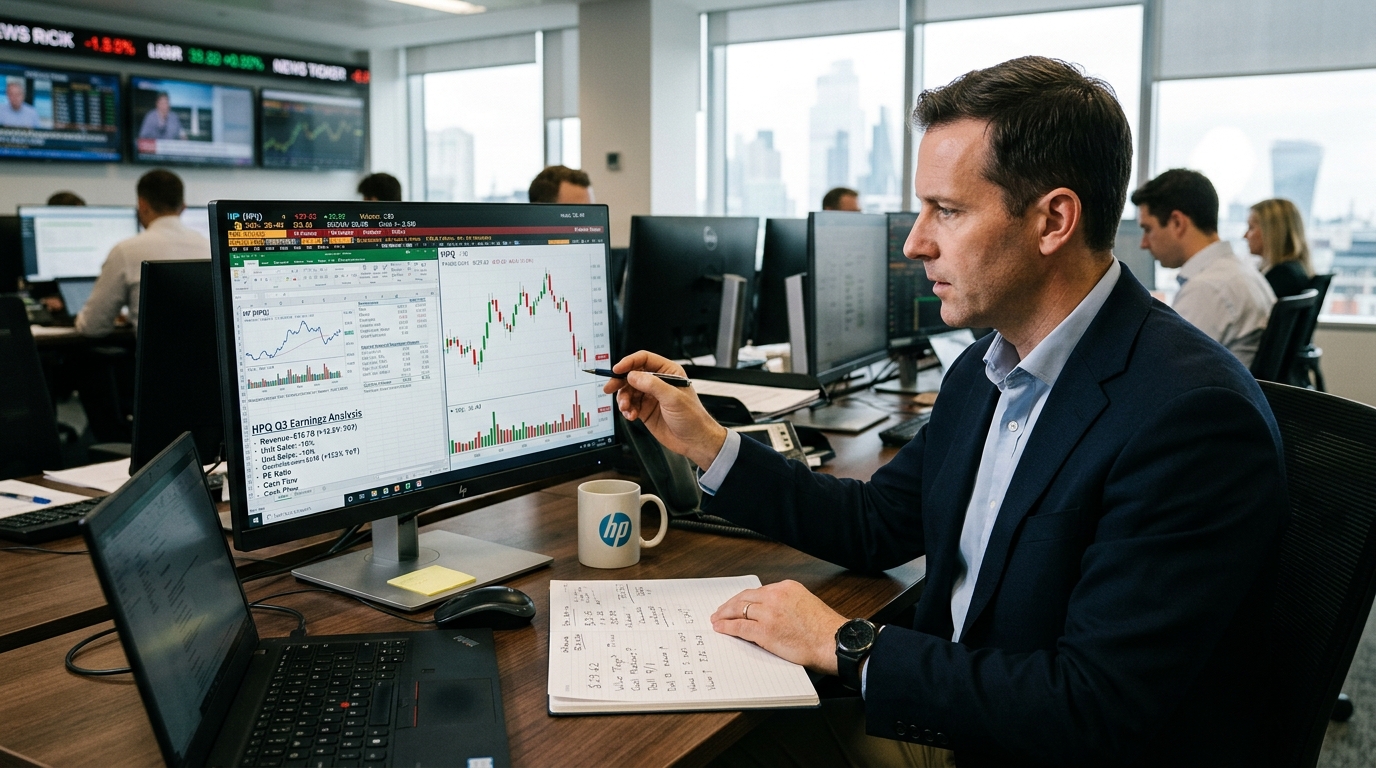
HP closed August 27 at $29.62, down 2.93%, on volume of 38.4 million shares, roughly double its three-month average. The Q3 numbers themselves were not the problem. Revenue came in at $15.7 billion, up 12.5% year over year, beating consensus by about 7%. Non-GAAP EPS of $0.83 topped the $0.75 estimate by 11%, good enough for a guidance raise: full-year non-GAAP EPS now $3.19 to $3.29, free cash flow guidance lifted to $3.0 to $3.2 billion. Management called it a record third quarter.
The market looked past the beat and stared at the unit line. PC shipments fell 16% year over year while Personal Systems revenue reached $11.8 billion, up 18%. You do not need a spreadsheet to spot the problem: HP is growing only in dollars, not boxes.
The Real Reason the Stock Fell
Price and volume are moving in opposite directions, and that is the definition of demand destruction. Memory and commodity costs compressed Personal Systems operating margin to 4.6%, down from 5.2% the prior quarter. Bank of America retained its Underperform rating, citing pricing pressure, slower unit growth, and leadership uncertainty. The EPS beat also carries a footnote: $0.11 of the $0.83 came from tariff refunds, a one-time benefit that rolls off. Strip that out, and the beat versus the $0.75 estimate shrinks considerably.
Memory is the structural issue. Earlier this fiscal year, CEO Enrique Lores said memory represents 15% to 18% of the cost of a PC; by fiscal 2026 Q1, management said memory and storage costs were tracking toward roughly 35% for the year. By Q3 2026, management again flagged ongoing pressure, with margin recovery not expected until fiscal 2027. When a single component commands that share of bill of materials and its price is rising, a hardware maker has two bad choices: absorb it or pass it through. HP chose the latter, which explains the revenue growth and the unit decline in the same breath.
Is It Cheap?
Here is where the story gets genuinely interesting for a cost-conscious investor. At $29.62:
- Forward PE: 9.9x on the raised $3.19-$3.29 guidance range
- EV/FCF: 8.3x against a $32 billion enterprise value and $3.0-$3.2 billion guided free cash flow
- Price-to-FCF: 7.4x, roughly 18% below HP’s own 10-year median
- Dividend yield: approximately 4% at current prices
- Q3 alone generated $1.6 billion in free cash flow; the company returned $600 million to shareholders in the quarter through dividends and buybacks
Those numbers are not the multiples of a broken business. They are the multiples of a business the market does not trust to sustain them, which is a different problem.
Bull / Base / Bear
Bull: Memory costs peak in fiscal 2026, margins recover in 2027 as guided, AI PC mix hits 50% of shipments by fiscal year-end, and the FCF yield near 10% funds continued buybacks that shrink the share count. The stock re-rates toward 12x forward earnings, implying mid-$30s.
Base: Memory costs stay elevated through at least mid-2027, units keep declining at high single digits, and margins hover near 4.5% in Personal Systems. FCF stays in the $3 billion range, the stock oscillates between $27 and $32, and you collect the 4% dividend while you wait.
Bear: Unit declines accelerate beyond double digits, pricing power breaks under competitive pressure from Lenovo and Dell, and the tariff-refund tailwind disappears in Q4. Margins fall further; the guided FCF range proves optimistic; and the stock tests the $25 level last seen earlier this year.
Action Plan
Dell reports September 1 with consensus EPS of $4.88, representing triple-digit year-over-year growth. Dell’s AI server mix gives it a different growth engine and a different margin story. If Dell signals that memory costs are manageable at its scale, that is a mild positive read-through for HP. If Dell’s PC-adjacent commentary sounds worse than HP’s, you have confirmation that the unit problem is industry-wide, not idiosyncratic.
For HPQ specifically: the FCF yield and the dividend yield together argue against a full exit. But adding aggressively at $29.62 before seeing Q4 margin data, and before Dell’s call provides a peer read, is accepting unnecessary risk. Hold existing positions; consider a small initial buy only below $27, where the FCF yield approaches 11% and the margin-of-safety improves meaningfully.
Cheap Investor Checklist
- PC unit shipments: watch for stabilization above negative 10% in Q4
- Personal Systems operating margin: needs to hold above 4% to preserve the FCF story
- Memory cost trajectory: any signal from MU or SNDK on DRAM pricing direction
- AI PC mix: management targets 50% of shipment mix by fiscal year-end; track whether revenue per unit is actually rising
- Tariff refund line: $0.19 full-year tailwind expires; monitor how underlying EPS looks ex-refund in Q4
- Dell September 1 call: PC and commercial hardware margin commentary is your read-through
- Buyback pace: shares outstanding fell 2.9% year over year; continued shrinkage supports EPS even in a flat revenue environment
Bottom Line
HP is not obviously a value trap, but it is not obviously cheap either. At 9.9x forward earnings and 8x FCF, you are paying a distressed-hardware multiple for a business that is, so far, generating real cash. The trap springs if memory costs stay elevated past fiscal 2027 and units keep falling. The opportunity is real if margins recover on schedule and the AI PC cycle brings pricing power back. Watch Dell on September 1. Watch the Q4 margin line in November. Neither bull nor bear case is settled yet, and that uncertainty is priced in at $29.62. For a bargain hunter, patience here is not a weakness. It is the trade.