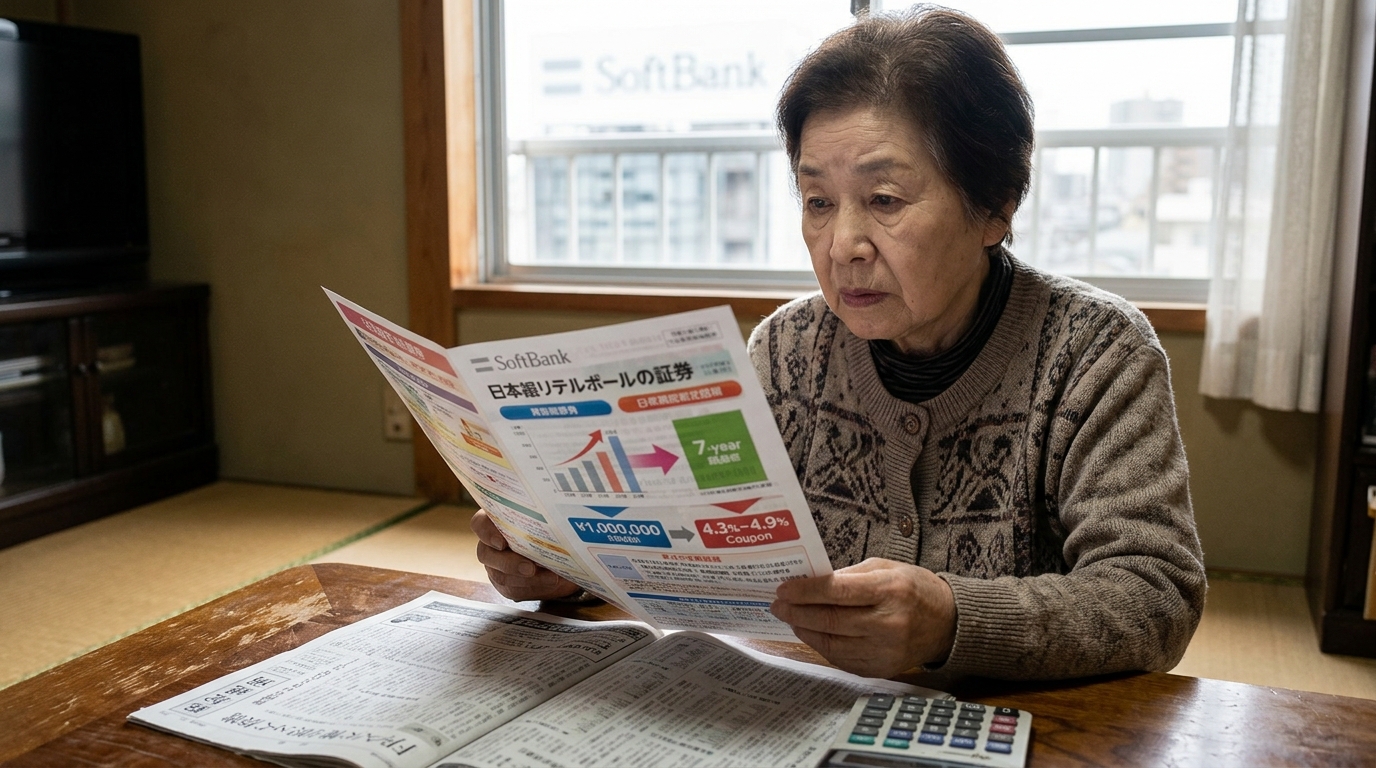
The deal announced Monday is structurally simple and analytically uncomfortable. SoftBank plans to raise ¥1 trillion ($6.3 billion) through a seven-year retail bond, described by multiple outlets as the largest retail bond offering ever by a Japanese company, explicitly to fund its commitments to OpenAI. The indicative coupon sits between 4.3% and 4.9%, with pricing expected on September 4. SoftBank shares fell more than 4% on the day.
The committee’s first question is always: what are you being paid to bear? Here, the answer is uncomfortable. S&P carries SoftBank at BB+, one notch below investment grade, while Japan Credit Rating Agency assigns a domestic A. The divergence is not a technicality. International agencies are pricing a company with high leverage, concentrated exposure to volatile technology assets, and capital commitments that dwarf internal cash generation. Some analysts have argued that even after a ¥1 trillion issuance, SoftBank may still need additional funding to meet its AI-related commitments, implying further borrowing could follow.
Consider the math. SoftBank has disclosed $30 billion of follow-on investments tied to OpenAI’s fundraising round, and reporting has described the group’s cumulative investments and commitments to OpenAI as expected to exceed $60 billion. It has also been reported that SoftBank has pursued a margin loan backed by its OpenAI stake, with Reuters reporting renewed talks for a $10 billion facility in July. This ¥1 trillion offering is the third retail bond SoftBank has brought to market in 2026; prior retail-focused offerings this year have been reported at ¥418 billion in April and ¥260 billion in June. Proceeds are described as split between AI-related investments and refinancing previously issued bonds, meaning some of the new money simply replaces the old money.
The asymmetry is where the analysis sharpens. A retail bondholder earns a fixed 4.3% to 4.9% per year for seven years and takes senior credit risk on a BB+ issuer whose primary asset is an illiquid stake in a private company. On the equity side, SoftBank’s fiscal first-quarter net income fell about 18% year over year, and reporting has described a roughly ¥1.33 trillion gain on Intel shares as a major driver of investment gains in the quarter. The equity already prices in a great deal of OpenAI upside. Bondholders receive a fixed coupon regardless of whether that upside materializes, but they absorb the downside if the AI investment cycle turns or if rising BOJ rates compress SoftBank’s refinancing capacity.
Japanese markets are currently pricing roughly an 82% probability of a Bank of Japan rate hike in September. That context is not incidental. Higher short-term rates tighten the spread between SoftBank’s domestic funding cost and what it can earn recycling capital into AI infrastructure. JPMorgan Asset Management has flagged that AI concentration risk is migrating from equity markets into credit markets, a warning this deal puts in sharp relief.
The committee would not take this bond at the offered coupon. The spread over a comparable sovereign does not compensate for the credit quality gap, the structural subordination to SoftBank’s secured borrowings, and the illiquidity of a seven-year retail instrument. Equity investors in SoftBank own the option on Masayoshi Son’s AI vision; they accept binary outcomes. Retail bondholders own the liability side of the same bet while capped at sub-5%. That is not a payoff the committee would recommend to any client seeking risk-adjusted income.