August 22, 2026
The S&P 500 Comfort Trap
In 2026, the fee war is over. The real risk is crowding, and the opportunity cost is showing up in small caps.
Hey there, bargain hunter
You did the sensible thing. You bought the low-fee S&P 500 fund and stopped donating money to high-cost underperformance.
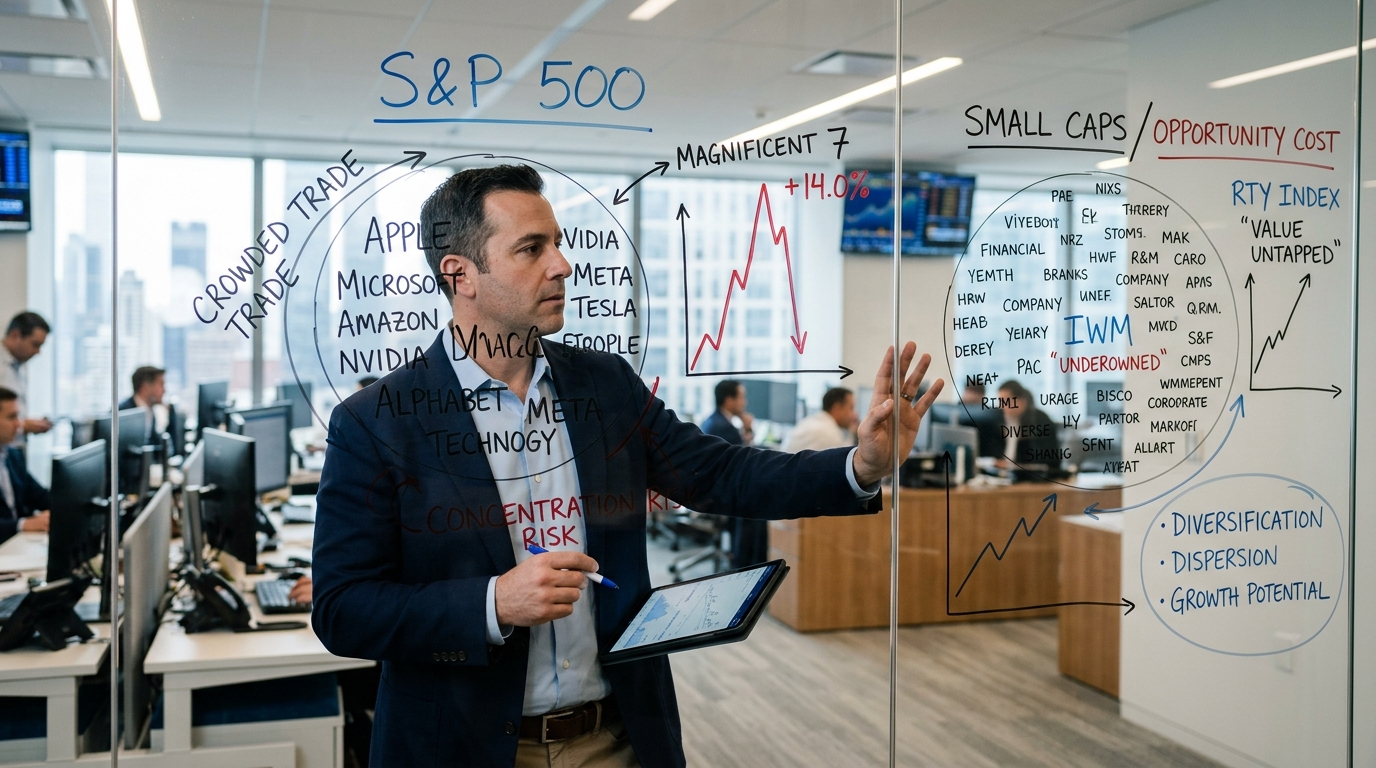
Now comes the less comfortable part: in 2026, owning “the S&P 500” is starting to look like owning a very specific trade and calling it diversification.
That is why the warnings about greed and complacency are landing with retail investors. Not because indexing is wrong, but because the easiest portfolio to hold is also the easiest portfolio to stop thinking about.
Scoreboard: what happened
Three data points tell you why the concentration debate is not academic this year.
- Small caps have led. In the Associated Press’ market recap dated August 20, 2026, the S&P 500 was up 11.6% for the year while the Russell 2000 was up 20.6%. That is not a rounding error. That is an allocation statement.
- The S&P 500’s top end is heavy. S&P Dow Jones Indices’ constituent weights (as of July 31, 2026) show a top holding at 7.6%, with the top 10 collectively landing in the high-30% range of total index weight.
- Breadth is improving. In an August 11, 2026 Indexology post, S&P Dow Jones Indices highlighted broadening participation and noted that the S&P 500 Equal Weight Information Technology Index outperformed its cap-weighted counterpart by 19% year-to-date.
Put those together and you get the 2026 message: this market is paying investors to own more than the top of the capitalization stack.
Sam Altman’s Next Venture Could Be 500 Times Bigger Than ChatGPT
What Sam Altman’s launching next could be 500 times bigger than ChatGPT, unlock an industry worth more than $1 million per American, and send one small group of stocks soaring as this news spreads.
Click here to learn about the stocks tied to Sam Altman’s Next Venture.
The real reason: expectations vs reality
Expectation: “I’m in 500 stocks, so I’m covered.”
Reality: you are in one country, one size bucket, and a cap-weighted system that automatically funnels more dollars into whatever is already huge.
Cap-weighted indexing is a brilliant invention. It is also a machine that concentrates your portfolio when a small group dominates market cap.
When the top of the index is driving your outcome, the S&P 500 stops being “passive” in the everyday sense of the word. It becomes a bet on:
- continued dominance of the biggest U.S. franchises,
- continued multiple support for those franchises,
- continued U.S.-centric leadership vs the rest of the world.
Deep dive: how the business of “the S&P 500” works
The index does not “pick.” It weights.
That weighting is the whole story in 2026. If a handful of companies become a giant share of U.S. market capitalization, then you are not buying 500 equally important engines. You are buying a portfolio where a few engines are the jets and the rest are the luggage carts.
There are years when that is a feature. When leadership rotates, it becomes a problem.
Data section: the metrics that keep you honest
As a bargain hunter, you do not need more opinions. You need a dashboard.
- Top-10 share of the S&P 500: track it monthly. The July 31, 2026 weights put it in the high-30% range.
- Largest constituent weight: also monthly. July 31, 2026 shows a single name at 7.6%.
- Equal-weight vs cap-weight relative return: quarterly. If equal-weight keeps winning, crowding is being punished.
- Russell 2000 vs S&P 500: monthly. The AP snapshot on Aug. 20, 2026 had Russell 2000 +20.6% vs S&P 500 +11.6% YTD.
- Sector concentration: not just in the index, but in your own holdings. If you own the S&P 500 plus a tech-heavy satellite, you may be doubling down without realizing it.
Is it cheap?: fees vs opportunity cost
Here is the uncomfortable truth: low fees do not guarantee a low-cost outcome.
The 2026 cheap test: if your “simple” portfolio misses the leadership pocket, you pay with performance instead of expense ratios.
Small caps outperforming by close to nine percentage points year-to-date in that Aug. 20, 2026 AP snapshot is exactly what “opportunity cost” looks like in the wild.
3X Over Lunch? (True Story)
I bought a tech stock back in 1998 for $5.
It nearly 10X’d to $45 in two years.
Then… one day I stepped out for lunch.
When I came back, the stock was at $135…
All said… a 2,600% gain.
I made a quarter of a million dollars in that single afternoon.
Right now, the same setup is forming again.
Bull / Base / Bear: three paths from here
Bull case: the biggest names keep earning the biggest weights. Earnings momentum holds, buybacks keep absorbing supply, and investors keep paying up for perceived certainty. Concentration feels scary but works.
Base case: leadership broadens. The S&P 500 still participates, but a larger share of returns comes from outside the very top. Equal-weight, small caps, and selected non-U.S. exposures look better than they have in years.
Bear case: the top cohort hits a valuation wall or an earnings reset. The rest of the index can be fine and you can still feel pain because the weights are not democratic.
Action plan: diversify without getting fancy
You do not need to declare war on the S&P 500. You need to stop making it your entire equity personality.
- Keep the S&P 500 core if it keeps you disciplined.
- Add a small-cap sleeve sized to matter, since 2026 is already showing you what “missing small caps” costs.
- Add an international sleeve so you are not making a single-country call with your whole equity book.
- Optional: use an equal-weight sleeve if you want a mechanical anti-crowding tilt inside U.S. large caps.
Cheap is good. Cheap and properly diversified is better.
Cheap Investor checklist: 10 things to monitor
- Top-10 weight in the S&P 500
- Largest constituent weight
- Equal-weight vs cap-weight relative performance
- Russell 2000 vs S&P 500 spread
- Sector leadership rotation
- Tech participation breadth (how many names are driving returns)
- Earnings revisions: small caps vs large caps
- USD trend vs major currencies
- Your non-U.S. allocation percentage
- Your own behavior under stress
Bottom line
If the S&P 500’s top 10 sit in the high-30% range of index weight and small caps are leading 2026, then “S&P 500 only” is not a neutral default.
It is a concentrated bet you might not realize you are making.