
August 22, 2026
The US-Canada Deal That Wasn’t
Featured: The US-Canada Deal That Wasn’t
Most people see Monday as just another day.
Another week starting.
Another grind beginning.
But what if I told you there’s an explosive trading pattern that happens almost every Monday, like clockwork?
A market event that reoccurs so often…
Tim Bohen built an entire system around it.
He calls them “Money Monday” trades.
Small cap stocks that have surged 100%… 200%… even 500% in a single day.
Not over months.
Not over weeks.
In hours.
Past performance doesn’t indicate future results. And all trading carries risk, of course…
But the pattern is simple… once you know what to look for.
However, spotting it manually? Nearly impossible.
That’s why Tim’s team created a scanner.
It watches 15,000 stocks every Monday morning…
Looking for the exact 4 criteria that forecast these explosive moves.
When all 4 boxes get checked?
You get an alert.
Simple trade instructions.
Entry point. Exit point. Everything.
Next Monday could be the start of something completely different for your trading.
Want to see exactly how this works?
Watch Tim explain the Monday pattern that could change your trading… forever
The US-Canada Deal That Wasn’t
Hey there, bargain hunter.
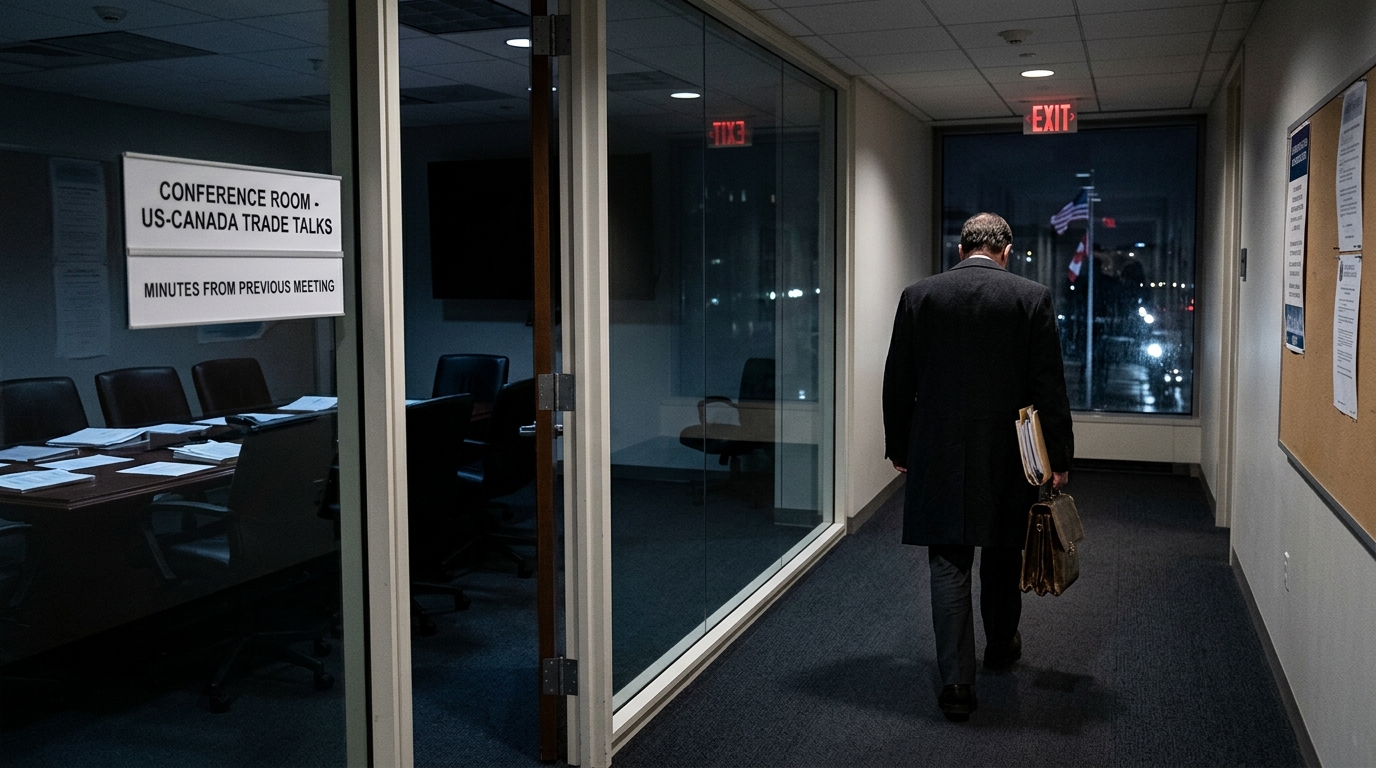
Trump said there was a deal. There was no deal. Sixty hours later, 50% tariffs on roughly $20 billion worth of Canadian goods clicked into place at midnight Friday, and Prime Minister Mark Carney sent his negotiators home to Ottawa. The longest stretch of optimism in this trade war lasted about three days before it evaporated in a conference room at the USTR offices in Washington covering the $880 billion bilateral trade relationship and the 96-year-old legal weapon at the center of it.
Welcome to the next chapter.
Scoreboard: What Just Happened
The numbers first, because this is where most coverage goes soft.
- Tariff rate: 50%, imposed under Section 338 of the Tariff Act of 1930
- Goods covered: roughly $20 billion in annual Canadian exports to the US
- What’s on the list: plywood, electrical equipment, dairy ingredients, wine and spirits, hockey gear, clothing, footwear, furniture, building materials, cement, plastics, cosmetics, agricultural seeds
- What’s NOT on the list: energy, potash, critical minerals, steel, aluminum, autos (those already carry Section 232 tariffs; this is an anti-stacking rule, not a favor)
- Canada’s response: PM Carney suspended talks and promised to match the tariffs “dollar for dollar”
- Timeline of the collapse: Trump paused an earlier deadline Tuesday, wrote on social media the two sides had a deal, talks resumed Thursday and Friday, fell apart before midnight Friday
The new duties cover about 5% of everything Canada sent south last year. That sounds small until you realize it layers on top of an already thick stack of Section 232 measures on steel, aluminum, lumber, and autos that were already in place.
The Real Reason: Expectations vs. Reality
Markets and headlines spent Tuesday through Friday pricing in resolution. Trump’s social-media declaration of a done deal created a brief wave of relief. That wave broke badly.
The US side, led by Trade Representative Jamieson Greer, said Canada’s negotiators made last-minute demands that unraveled a draft agreement built over days of intensive talks. Greer noted that the US had offered Canada significant tariff reductions on steel, aluminum, autos, and lumber, and that Canada had agreed to commitments on aerospace supply chains, critical minerals cooperation, and stronger enforcement against forced-labor imports. Then, according to the US account, the Canadians walked those commitments back near the deadline.
Carney’s version: the US offer “had not been enough to meet our objectives as Canadians,” and it was the American side that requested last-minute changes. Two governments, two stories. One outcome: tariffs live, talks suspended, no new talks scheduled.
The legal instrument matters here. Section 338 of the Tariff Act of 1930 had not been used since the 1940s. The Trump administration invoked it three times on July 20, citing three specific Canadian practices: provincial bans on US alcohol sales, a dairy quota system that disadvantages US suppliers over EU competitors, and Canada’s auto import quota regime. US data shows Canadian purchases of US vehicles fell roughly 22%, or $5.6 billion, over the past year. US alcohol exports to Canada collapsed 81%, roughly $582 million, as most provinces pulled American spirits from shelves. Those are the grievances that drove the legal theory. The remedy, a 50% tariff on a broad basket of consumer and industrial goods, is blunt and escalatory by design.
Deep Dive: The Trade Relationship at Stake
The US and Canada conducted nearly $900 billion in combined goods and services trade last year. Canada was the second-largest US trade partner by total value in 2025. Statistics Canada data shows Canada sent 73% of its total goods exports to the United States. That dependency flows in one direction much harder than the other: the US accounts for 46% of Canadian goods imports, and US foreign direct investment stock in Canada sits at roughly $459.6 billion.
USMCA, the 2020 trade deal that replaced NAFTA, still shields the bulk of this relationship. More than 80% of Canadian exports remain duty-free under USMCA certifications. The new Section 338 tariffs, critically, apply even to USMCA-certified goods, which is the legal novelty here. For the first time since USMCA took effect, origin compliance provides zero protection on covered lines. A valid certificate of origin is simply irrelevant to a Section 338 tariff.
That legal precedent is more dangerous than the tariff rate itself. A dormant statute now overrides a modern trade agreement’s core preference on a presidential finding alone. If the administration repeats the playbook, USMCA’s protective value shrinks with each use.
Data Section: The Numbers That Actually Matter
- $20B: approximate annual value of Canadian goods now subject to 50% Section 338 duties
- $17.7B: value covered after Section 232 carve-outs, per Global Trade Alert analysis from July 2026
- 5%: share of total Canadian exports to the US directly affected by Section 338
- 80%+: share of Canadian exports still duty-free under USMCA certification (RBC Economics estimate)
- ~0.4% of Canadian GDP: RBC’s estimate of the Canadian value-added content in newly tariffed goods, suggesting direct economic drag is contained, for now
- ~90,000: Canadian jobs estimated at risk from a full 50% tariff regime, per analysis from The Hub, which would push Canada’s unemployment rate roughly 0.4 percentage points higher, to approximately 6.8%
- $12.6B: Canada’s existing counter-tariffs on US goods, weighted toward steel and iron at rates up to 25%
- 13 million: US jobs estimated to depend on trade under USMCA, per the Canadian Chamber of Commerce
- 6.27%: Canada’s average US tariff rate after Section 338, up 1.89 percentage points overnight
- $110B: estimated total US tariff revenue in 2026 across all active tariff measures, per Tax Foundation modeling
The Tax Foundation’s broader tariff analysis, updated through August 2026, estimates that all current and scheduled US tariffs combined will reduce long-run US GDP by 0.4%, shrink the capital stock by 0.3%, and eliminate the equivalent of 345,000 full-time jobs. Those are not Canada-specific numbers, but they frame the cost side of this political bet.
3 Triggers Set to Ignite America’s Biggest Tech Boom in 20 Years
Three triggers are converging right now.
The same kind that once turned $5,000 into $135,000 on Qualcomm in 12 months…
And $127,500 on Amazon in two years…
Wall Street already knows.
They quietly piled billions into this corner of the market while the headlines screamed recession.
This 25-year Wall Street veteran says most Americans will miss it completely.
See why FREE…
>>Reveal the 3 Triggers – See Which Tech Stocks Could Move Next<<
Is It Cheap? Valuation Framing for Exposed Names
Markets had been pricing in a deal. They weren’t pricing in this.
The names most exposed to a sustained US-Canada trade war fall into clear buckets. Magna International (MGA), which posted Q2 FY26 sales of $11 billion and free cash flow of $617 million (more than double the prior year), trades at a forward P/E near 10x with an analyst consensus target of around $73. Management already baked a full-year tariff headwind into FY26 guidance of $6.70 to $7.30 in adjusted EPS. Any escalation from here is not in that model. Shares had recovered sharply this year, up over 32% year-to-date through August 19. That recovery assumed resolution. Revision risk is now real.
Canadian liquor and consumer goods exporters face a straightforward problem: 50% tariffs make their products uncompetitive in the US market almost immediately. Constellation Brands (STZ), which sources from Mexico rather than Canada, is less directly exposed, but Diageo (DEO) has meaningful Canadian operations and distribution in the US alcohol category where the tariff grievance originated.
Building materials are the sleeper exposure here. The Section 338 annexes include plywood, cement, doors, and related construction materials. With US housing activity already under pressure from elevated mortgage rates, adding a 50% duty to Canadian building supply inputs is a cost-push shock the sector cannot easily absorb. Look at how US homebuilder stocks respond Monday morning. That is your tell on how the market is re-rating this.
Bull / Base / Bear
- Bull case: Both sides return to the table within weeks. Canada drops the provincial alcohol bans and relaxes the auto quota mechanism. The US reduces or suspends Section 338 tariffs. USMCA renegotiation formally restarts, giving markets a defined timeline. Exposed names rally hard on any credible signal of resolution.
- Base case: Tariffs stay in place through Q3 and into Q4 2026. Canada follows through on dollar-for-dollar retaliation, targeting US consumer goods and agricultural exports. Negotiations restart at lower temperature in late 2026 or early 2027, tied to a formal USMCA review. The trade drag is real but contained, roughly 0.4% of Canadian GDP directly exposed. US consumers absorb modest price increases on the covered goods categories. No catastrophic break, but a prolonged drag on cross-border supply chains.
- Bear case: The US administration treats Canadian retaliation as justification for further escalation. US officials have already said they will present Trump with options to respond if Canada retaliates. Section 338 has no sunset clause and can continue indefinitely unless the president modifies it. A second wave of proclamations could expand coverage. The Canadian Chamber of Commerce previously warned that this level of tariff conflict “would damage both economies, drive up costs for US families, further disrupt critical supply chains, and risk the 13 million American jobs that depend on trade under USMCA.” That scenario is now on the table.
Action Plan
This is not the moment to be a hero on Canadian-exposed names. But it is also not a moment to panic-sell positions you researched for reasons that have not changed structurally. Here is the framework:
- Hold, do not add, on Canadian industrials with US revenue exposure. Magna’s 10x forward P/E looks cheap in isolation, but the tariff headwind is not fully modeled. Let the Q3 guidance update do the work before averaging in.
- Trim US homebuilder and building materials exposure on Monday’s open if you have not already. Canadian lumber, plywood, and cement are in the Section 338 annexes. Input cost pressure arrives before any revenue offset.
- Watch the Canadian dollar. CAD weakness against USD cushions some of the pain for Canadian exporters by making their goods cheaper in USD terms before the tariff is applied. A meaningful CAD move is a real-time leading indicator of how the market is pricing duration of the trade conflict.
- Do not touch Canadian alcohol or spirits exporters with a direct US distribution exposure at current prices. That sector is the named grievance. Tariff relief there will be the last to arrive, not the first.
- Scale into diversified Canadian ETFs in stages, not all at once. If this resolves, the recovery in names like Canadian rails, energy (excluded from Section 338), and financials will be rapid. Keep dry powder for a second entry at a lower level or on a confirmed deal signal.
Cheap Investor Scorecard: 10 Things to Track
- Are new US-Canada talks scheduled? (Yes/No is the binary that moves markets most.)
- Does Canada follow through on dollar-for-dollar retaliation, and which US goods get targeted?
- Does the White House present Trump escalation options, and does he act on them?
- Watch CAD/USD. A move below 0.72 signals the market sees a prolonged conflict.
- Magna International (MGA) Q3 guidance revision: does management lower its FY26 EPS range?
- US homebuilder starts and permits in September data: does Canadian building material scarcity show up?
- Canadian unemployment rate: a move toward 6.8% confirms the 90,000-job-loss scenario is unfolding.
- Bank of Canada rate decision: does the BoC hold, cut, or signal concern about tariff-driven stagflation?
- USMCA formal renegotiation timeline: any announcement of a restart date would be a significant positive catalyst.
- Section 338 escalation: does the administration issue additional proclamations beyond the original three?
Bottom Line
If talks restart within 30 days and Canada concedes on alcohol distribution and dairy quota allocation, the 50% tariffs are a short-lived negotiating bruise and the playbook is to buy the dip on Canadian industrials and building materials.
If Canada retaliates and the US escalates, you are in a multi-quarter trade war between two economies that did $900 billion in business last year, and every supply chain that crosses the 49th parallel is getting repriced. That is a different world for input costs, housing, and North American manufacturing margins.
Section 338 has no automatic expiration. That is the sentence that should keep you up at night, bargain hunter. Watch the scorecard. Do not guess on the timeline. The deal that “pretty much” existed on Friday afternoon was gone by midnight.
Stay cheap. Stay patient.
The Cheap Investor