August 2, 2026
Meta Is Down 30% From Its High. Microsoft Just Showed Why.
Featured: Meta Is Down 30% From Its High. Microsoft Just Showed Why.
Dear Reader,
Do you hold any of these AI stocks?
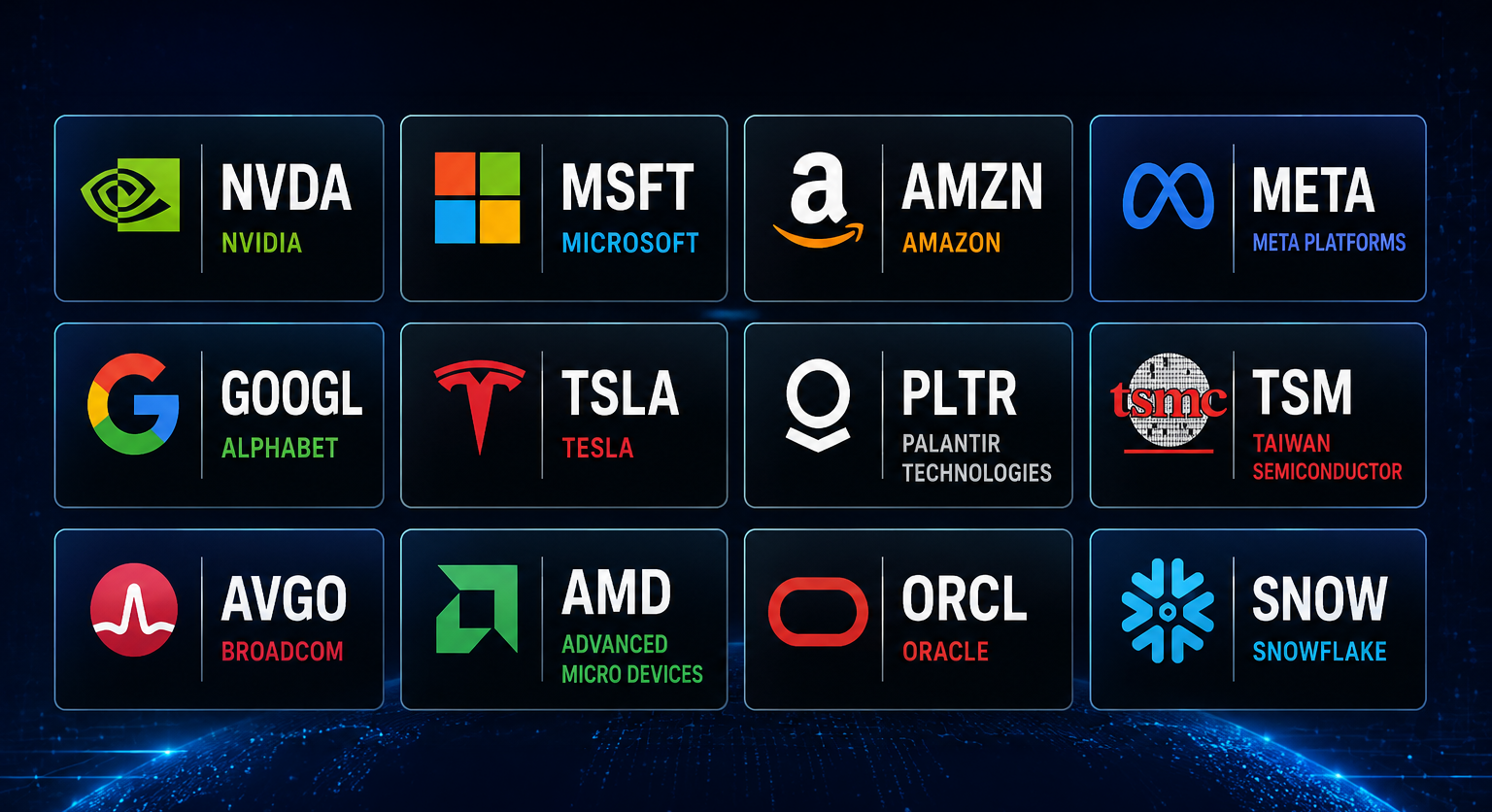
Wall Street insider Jason Bodner – the man who called Nvidia at $4.50 – says today’s AI stocks are about to hit a wall.
And a completely different group of AI firms… names Wall Street is starting to ignore… are about to take off.
This has nothing to do with SpaceX…
A new chatbot…
Autonomous robots…
Or anything you’re likely hearing about.
It has to do with a brand-new “light-speed” device turning AI as we know it into “Accelerated AI”…
Making it 100 times faster…
And 100 times more energy efficient – right here, on Earth.
Already, some of the biggest tech investors like Elon Musk, Mark Zuckerberg, Cathie Wood, and Bill Gates are moving money into it.
Just to name a few…
They’re all moving money to prepare for what’s coming.
But you won’t hear anything about it in the mainstream news…
In fact, TV pundits spent most of this past year talking about AI worries and its “existential risk” to jobs…
Or arguing whether we’re in an AI bubble and when it would pop…
That’s why most Americans won’t see it coming until it’s too late.
Don’t be one of them…
Because if you’re holding the wrong AI stocks when “Accelerated AI” goes mainstream…
You could spend the next decade just trying to claw back to even…
But if you make the one move Jason reveals in this urgent video message…
The next 12 to 24 months could hand you bigger gains than the entire AI boom of the last three years.
Click here to hear the full story and get ahead of the crowd.
But hurry, because this opportunity won’t stay hidden much longer.
We have so much to look forward to,
Jeff Brown
Founder & CEO, Brownstone Research
P.S. Jason also shares details on 10 popular AI stocks he says you must dump before this shift goes mainstream. Names sitting in millions of 401(k)s, IRAs, and brokerage accounts. Click here to see if yours made the list.
Meta Is Down 30% From Its High. Microsoft Just Showed Why.
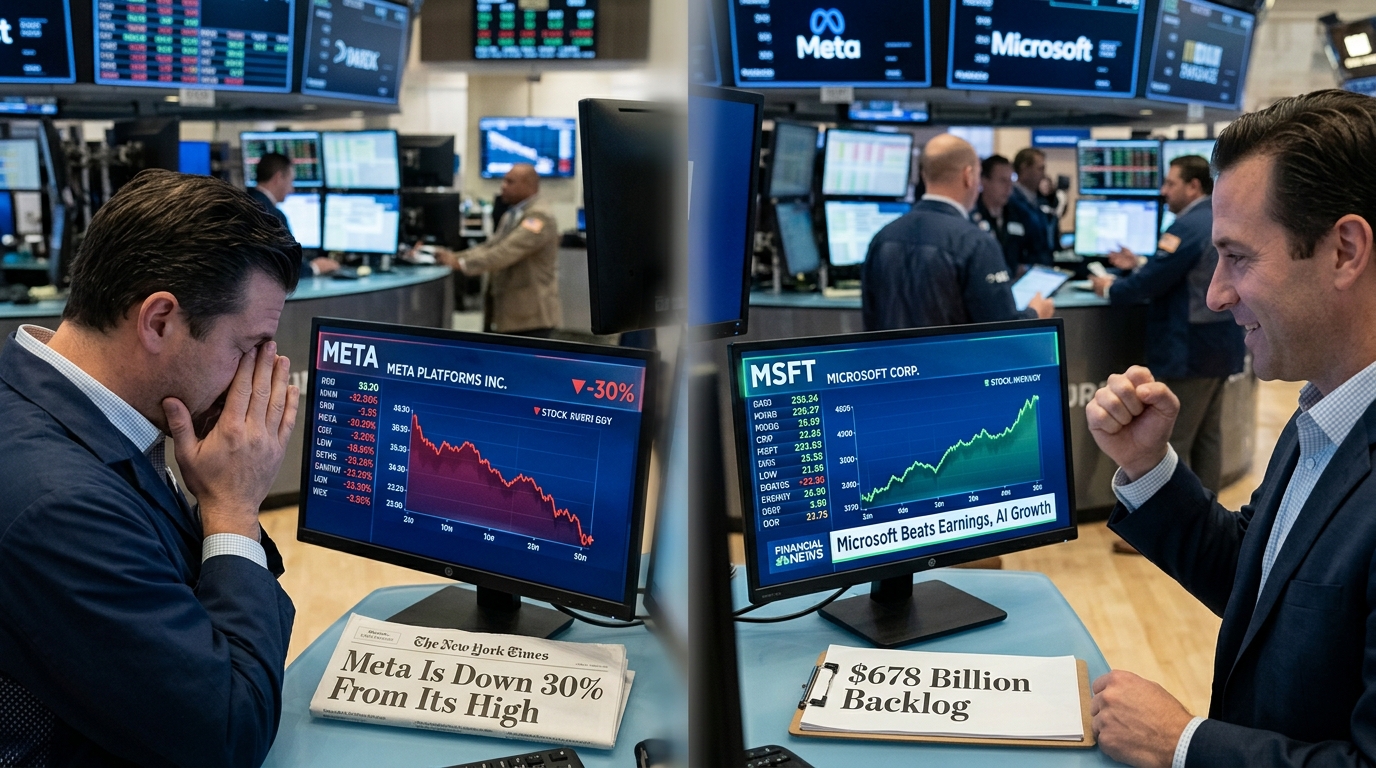
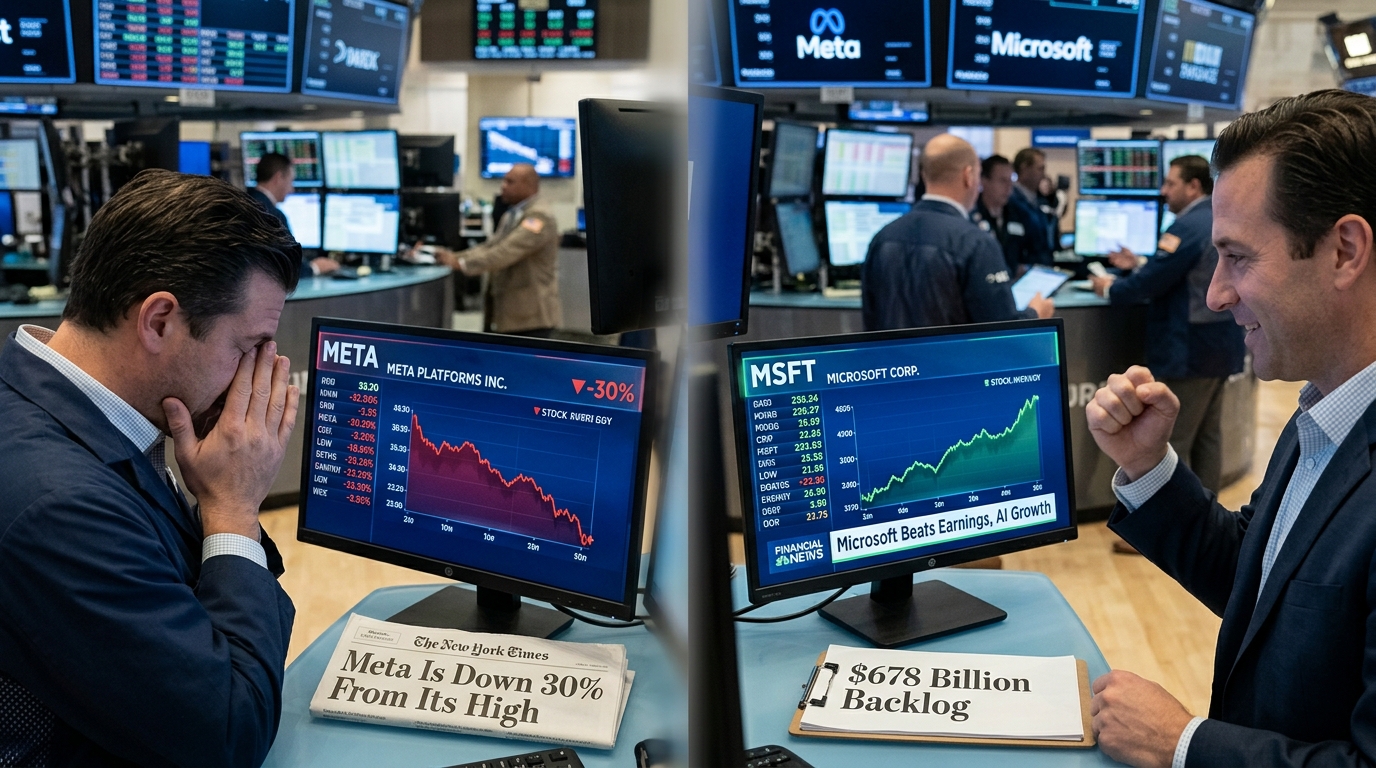
Two of the largest companies on earth reported earnings within hours of each other on July 29, 2026. The market’s reaction could not have been more different: Microsoft posted roughly $90 billion in quarterly revenue, an 18% year-over-year jump, and was rewarded with a sharp stock move higher after hours. Meta reported $60.8 billion in revenue, a faster 28% growth rate, and got punished with a steep decline.
Same week. Same AI spending religion. Opposite verdicts.
That divergence is worth sitting with, because it tells you something precise about how markets are currently pricing the AI buildout, and where the genuine value question lives heading into August.
What Microsoft Actually Proved
The number that mattered on July 29 was not quarterly revenue. It was a milestone that reframes the entire AI capex debate. Microsoft said Azure revenue surpassed $100 billion for the first time, and that the company is seeing strong demand for paid AI offerings like Microsoft 365 Copilot.
Microsoft also reported that commercial remaining performance obligations increased 84% to $678 billion. That figure is the most important one in the entire earnings release. A backlog at that scale, growing at that rate, is not priced on fear. It is priced on signed contracts from enterprises that have decided where their AI infrastructure will live for the next several years.
Microsoft said Microsoft 365 Copilot reached over 30 million paid seats. The monetization flywheel is turning. Slowly, but it is turning.
You’re Being LIED To About The Iran War
Forget EVERYTHING you’ve heard about the Iran war.
Especially the reasons why we’re bombing the country.
What Meta Could Not Show
Meta’s business is not broken. That needs saying first. Ad revenue reached $59.4 billion in Q2, up 27% year over year. Advertising impressions rose 14% year on year, and average price per ad grew 12%. The advertising engine accelerated. What collapsed was everything below it.
Free cash flow shrank from $8.55 billion to $784 million as Meta’s capital spending surged. In one quarter, Meta spent nearly every dollar it generated from operations on data centers and chips, leaving $784 million in free cash flow from a business that produced $60.8 billion in revenue.
The company posted Q2 2026 earnings per share of $6.18, missing analysts’ expectations. FactSet said analysts, on average, were expecting $7.19 per share.
The charges made the miss worse than the underlying business justified. Meta said net income came in at $15.85 billion, down from $18.34 billion in the year-ago period. Total costs and expenses reached $42.03 billion, a 55% increase from the prior year, a figure that included $2.40 billion in legal charges and $1.18 billion in severance expenses stemming from a round of layoffs that started in May.
Strip those out and the picture looks different. But markets do not strip out recurring legal exposure at a company that, by its own disclosure, is facing ongoing legal proceedings that can produce large, lumpy charges.
The Structural Difference Markets Are Pricing
Here is the question that explains everything. Both companies are spending at historic scale on AI infrastructure. Why does the market applaud one and punish the other?
Microsoft and Alphabet can point to fast-growing cloud businesses that rent AI capacity to customers, offsetting their own spending with new revenue streams. Meta has no such cloud business; its AI spending funds only its own apps and models, leaving investors to see the cost without an obvious new revenue line.
That is the core asymmetry. Microsoft builds, charges rent, reports a backlog, and shows you the conversion. Meta builds, improves its own ad targeting, and asks you to trust that the improvement in average ad prices is worth the scale of its capex plans.
That trust is not impossible to grant. Bulls would counter that the capex ramp is building AI infrastructure that is already improving engagement and ad performance. But the market in late July 2026 was not granting it without proof.
Is Meta the Bargain Here?
Meta peaked near $785 in August 2025 before grinding lower into July 2026. After the Q2 selloff, the stock sits roughly 30% below that level.
The honest answer is that Meta presents a more complicated opportunity than Microsoft right now. The ad business is undeniably healthy. The cash flow implosion is not structural, but it is also not entirely temporary if legal charges keep arriving and capex guidance keeps moving higher.
The valuation case depends on what you think the AI buildout eventually produces. If Meta’s models improve ad targeting enough to sustain 25%+ revenue growth for several more years, today’s price is probably too low. If adoption of AI agents fails to create a new revenue vertical for Meta beyond advertising, the capex spend looks like an expense, not an investment.
He Doesn’t Buy Gold. He “Skims” It.
A former hedge fund manager ranked in the top 1% by Barron’s has developed a three-step strategy to profit from gold – without buying a single ounce.
His followers have had the chance to collect $2,975… $3,781… and even $6,786 at a time. With a 73% win rate.
He calls it “Gold Skimming.” And he’s just revealed the full strategy for the first time.
The Microsoft Case Is Cleaner, But Not Simple
Capital spending reached $41 billion in the quarter. Microsoft spent $35.80 billion on property and equipment during fiscal Q4, more than double the year-ago quarter, bringing full-year capital expenditures to $115.95 billion, up nearly 80% from $64.55 billion in fiscal 2025. Despite that spending pace, the company still generated $55.44 billion in quarterly operating cash flow, up 30% year over year, a positive sign the AI buildout is not cannibalizing the core business.
That is the distinction that makes Microsoft a more legible bet. The capex is enormous, but the revenue machine keeps running ahead of it. The commercial remaining performance obligations rose 84% to $678 billion, and management has emphasized that demand is broadening beyond a narrow set of early AI buyers. That is enterprise adoption, not just venture-funded infrastructure spending.
The risk is real though. Copilot has 30 million paid seats, but it is still early in the adoption curve relative to the installed base of Microsoft 365. One way to look at this is that Copilot has a lot of headroom for growth. Another way is that even with aggressive integration, converting the average knowledge worker to an extra paid AI seat may be slower than bulls assume.
The Cheap Investor Scorecard
Microsoft (MSFT): Azure at $100 billion annually, with a $678 billion backlog. The cloud monetization loop is closed and documented. The risk is valuation, capex scale, and Copilot adoption hitting a ceiling. After the July 29 surge, the stock is not obviously cheap. But it is one of the most legible AI infrastructure bets in the market.
Meta (META): Down roughly 30% from its August 2025 high, with a world-class ad engine and a free cash flow problem that is partly structural and partly temporary. The legal overhang is real. The capex is running ahead of any visible new revenue line. But the core business is generating $59.4 billion in quarterly advertising revenue on improving ad prices and impressions. Patience is required. The thesis is not broken. The proof is just not here yet.
The market decided both questions in a single evening. That kind of decisiveness is worth treating with some skepticism. Earnings weeks produce clarity that sometimes lasts six months and sometimes lasts six days. The more durable read is this: Microsoft has answered the monetization question with a $678 billion backlog. Meta has not answered it yet. Until it does, the discount on Meta reflects genuine uncertainty, not pure pessimism. Both things can be true at once.