July 25, 2026
Broadcom: Cheap, or Just Popular?
A $200B+ supply pact forces a valuation reset.
First a note from Behind the Markets
Dear Friend,
It’s not oil.
It’s not solar. Not wind. Not nuclear.
It doesn’t come from a mine, a well, or a foreign country.
It runs 24 hours a day. Produces zero carbon. Needs no fuel, no batteries, and no sunlight.
The International Energy Agency measured it at 140 times global electricity demand.
So why haven’t you heard of it?
Because until last year, nobody could reach it. It sits three miles underground, locked behind solid rock.
Then a crew near the Grand Canyon drilled through in 16 days. The Department of Energy said it should take 64.
Google signed a 15-year contract the next quarter. Bill Gates invested $100 million. The Pentagon called it priority one.
And on August 18th, Washington gives this energy source something it’s never given solar or wind – a competitive advantage that runs through 2033.
One company controls the technology. Sixty years of infrastructure. No competition in sight.
See the energy source that eliminates the competition >>
“The Buck Stops Here,”
Kelly Maguire
Behind the Markets
Why do markets misprice great businesses?
Because investors don’t discount “the company.” They discount the next problem. And in AI semis, the next problem has not been demand. It’s been supply, packaging, and execution risk at scale.
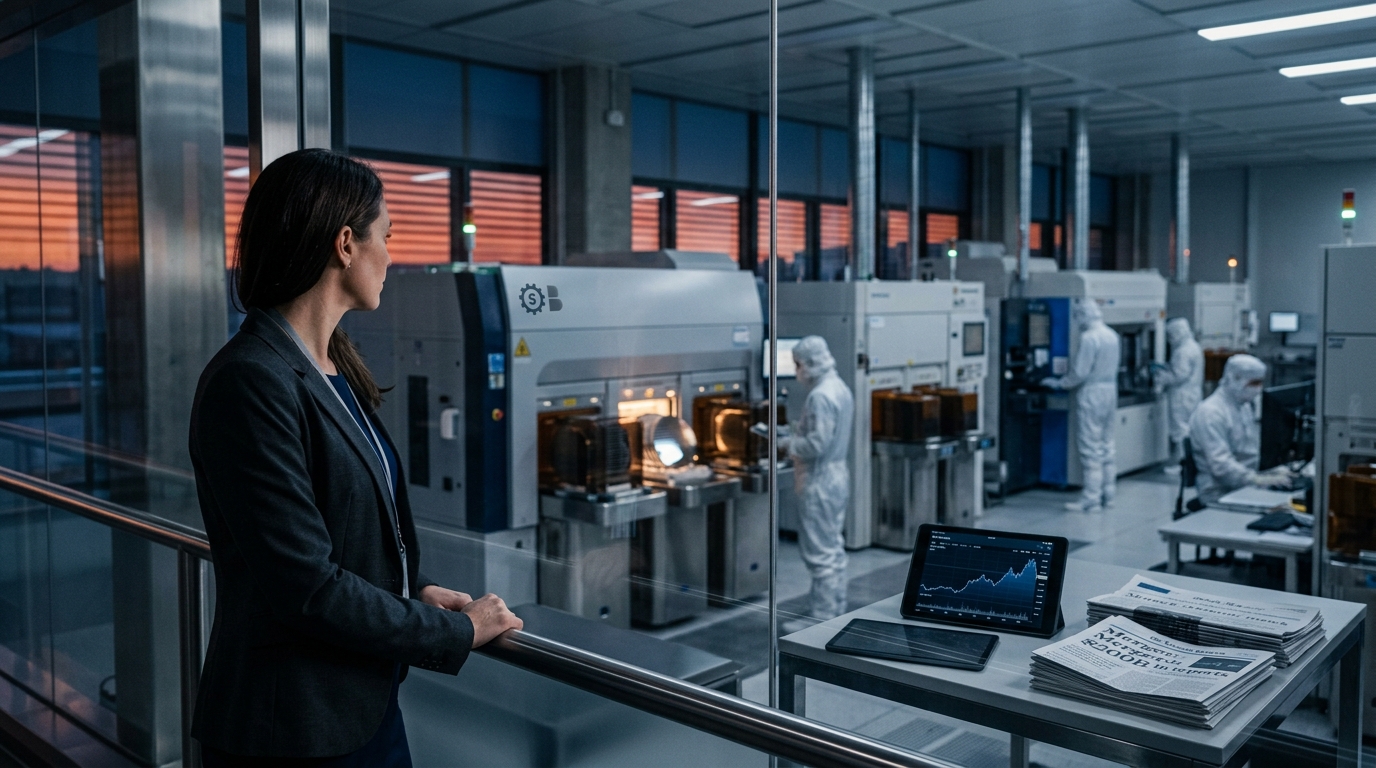
That’s why the Samsung Electronics and Broadcom headline on July 25, 2026 matters: the two companies signed a memorandum of understanding to expand collaboration across memory and foundry technologies, and Samsung said the collaboration is expected to be estimated at more than $200 billion across memory and foundry over the next five years through 2030.
As bargain hunters, we’re not here to chase the headline. We’re here to ask a sharper question: is Broadcom (AVGO) still being discounted for risks that are shrinking, or is the stock already priced for a perfect AI future?
What caused the discount?
AVGO has not been “left for dead.” It’s a mega-cap leader. But even leaders get discounted when the market smells execution risk.
In Broadcom’s case, investors have been forced to underwrite three big uncertainties at the same time:
- Supply chain certainty: AI accelerators are useless without high bandwidth memory and advanced packaging capacity that can actually be delivered on schedule.
- Customer concentration: Custom silicon is lucrative, but it often comes with a small number of giant customers. The market hates relying on a few wallets.
- Peak-cycle fears: When spending ramps fast, the market starts asking when it slows. Even if that slowdown is not visible yet, it gets priced.
So when Samsung describes an estimated $200B+ collaboration through 2030, that is not just “more demand.” It is a signal that the supply side is being organized. And that’s the part the market has been nervous about.
Nasdaq Ticker Reserved
They’ve reserved the NASDAQ ticker FASF. They just broke ground on their $850M flagship coal reformation facility in West Virginia. Frontieras is hitting massive milestones in very little time. This positions the company for potential valuation impact. Final weeks to become an early-stage shareholder.
Join 12K+ people and invest in Frontieras at $9.01/share by 8/6.
Disclosure: This is a paid advertisement for Frontieras’s Regulation A offering. Please read the offering circular at invest.frontieras.com
Business quality: would it be great if it were private?
Broadcom passes the “private business” test for one reason: cash generation.
In its Q2 fiscal 2026 results (quarter ended May 3, 2026), Broadcom reported AI semiconductor revenue of $10.8 billion, up 143% year over year, and guided Q3 AI semiconductor revenue to $16.0 billion, which it described as over 200% year-over-year growth. That’s a growth profile most chip companies only dream about.
But the real value-investor part is not growth. It’s the conversion of that growth into operating profit and free cash flow.
Broadcom’s release also reported record revenue, operating profit, and free cash flow in Q2, with the company emphasizing that the AI ramp is driving results. This is a business that tends to turn scale into cash. That’s a real moat in semis, where many companies can grow revenue but struggle to keep margins intact through cycles.
So yes, as a private business, this would still be a great business. The question becomes pricing.
The cheap test (without fooling ourselves)
I’m going to be careful here: I’m not going to toss out a P/E, EV/EBITDA, or free-cash-flow multiple unless we can verify the current figures in a way that holds up. Right now, we do have one clean and useful valuation clue that you can’t hand-wave away:
AVGO is still well below its 52-week high.
As of late July 2026, AVGO was trading around the high $300s and had a 52-week high at $495.00. That gap matters. It tells you investors are paying up for the AI ramp, but they’re also keeping a discount in the price for execution risk and cyclical fear.
The Samsung MOU is relevant because it attacks a chunk of that discount. If the market believes supply certainty improves, a business like Broadcom can re-rate even without a big change in the next quarter’s earnings.
That’s the mispricing test in plain English: the stock price may still reflect “AI is amazing, but the machine breaks.” The evidence is starting to tilt toward “the machine is getting sturdier.”
The 7-point checklist that saves bad trades
You can grab my Smart Trade Options Checklist free today – normally $29.97.
It’s a one-page filter. Seven checks. Run it before you place any options trade and you’ll catch the bad ones before they cost you.
Print it. Keep it next to your screen. Use it on every trade.
Download your free copy right here
Heads up: that link expires soon.
So what is the market getting wrong?
Possibly this: the market may be treating supply as a persistent structural bottleneck for Broadcom, when the biggest players are actively locking in solutions.
The Samsung MOU covers memory and foundry collaboration supporting next-generation AI infrastructure. That matters because it suggests a more integrated, longer-dated plan to feed Broadcom’s roadmap, not just a spot purchase.
And I want to underline a second point that value investors sometimes forget: expectations can change without the fundamentals changing much. A single de-risking event can do it.
In other words, Broadcom might not need to “beat” anything next quarter for the market to pay a higher multiple. It might just need the market to stop assuming the supply chain breaks at the worst possible time.
What would have to happen for perception to improve?
Three things, in order of importance for a patient bargain hunter:
- Confirmation that the $200B+ collaboration turns into real delivery: watch for follow-on commentary, volume commitments, and timeline clarity.
- Broadcom keeps the AI ramp intact: the company’s guided Q3 AI semiconductor revenue of $16.0 billion is a public bar. If that stays firm, the market’s “peak fears” get pushed out.
- Margin durability: growth is nice. Durable cash generation through a cycle is the difference between “cheap” and “value trap.”
There’s also a near-term catalyst worth watching on the Samsung side. Samsung issued Q2 2026 earnings guidance of approximately 171 trillion KRW in sales and 89.4 trillion KRW in operating profit. When Samsung provides more color in its full results, investors will try to infer how fast advanced memory and related AI infrastructure lines are scaling. That can feed back into how credible the supply story feels for partners like Broadcom.
Cheap or broken?
Broadcom is not broken. If anything, it looks like a high-quality compounder in the middle of an unusually strong demand cycle.
The real risk is not that the business collapses. It’s that investors overpay for the future and then discover that growth slows faster than expected, or that supply constraints shift from memory to packaging to something else. AI hardware is a chain, and chains always find their weakest link.
Still, if AVGO is below prior highs while AI revenue is accelerating and the supply story is being actively reinforced, that is exactly the shape of opportunity The Cheap Investor looks for: quality plus skepticism, not quality plus euphoria.
A Small Gold Market “Loophole”
There’s a little-known quirk in how certain gold trades behave… Especially when the market first opens. It creates moves that are often larger – and faster – than expected.
Not because of news… But because of how the gold market is structured. Most traders never notice it. And even fewer know how to use it. But once you see it, it’s surprisingly straightforward. A new report explains how this “loophole” works – and how it shows up in real time.
The Cheap Investor Scorecard
- Business Quality: High (cash-generative infrastructure semiconductor franchise)
- Financial Strength: Strong, but monitor debt and acquisition integration cycles
- Cash Flow: Strong in Q2 fiscal 2026, with record free cash flow reported
- Competitive Position: Strong in AI networking and custom accelerators
- Valuation: Not “deep value,” but potentially discounted versus fundamentals given the drop from the $495 52-week high
- What the market fears: supply bottlenecks, customer concentration, peak-cycle timing
- What changed: Samsung MOU estimated at $200B+ through 2030 reduces supply uncertainty
- Catalyst Strength: Medium to high, but needs execution proof and follow-through
- Margin of Safety: Depends on entry price discipline and patience
Bottom line: if you want a true bargain, you rarely get it when a company is universally loved. Broadcom is loved, but it’s also being discounted for a real risk. If that risk keeps shrinking, the discount can disappear slowly, then suddenly.