July 20, 2026
OPI: Cheap Stock or Broken Business?
The bankruptcy is over. The hard part is just starting.
Heads up –
I just set you up with a temporary link that skips the order page for my Simple Options Trading For Beginners guide. No cart. No checkout. It lets you skip ahead to the download page.
The only catch?
The link expires soon. Once it goes, you have to pay $29.97.
Use the backdoor link below to get free access before it closes.
Simple Options Trading For Beginners << BACKDOOR LINK
Good Trading,
Bill Poulos
Hey there, bargain hunter.
Here is a question worth sitting with: when does a company that just shed $714 million in debt deserve a second look, and when does it deserve to be put back on the shelf?
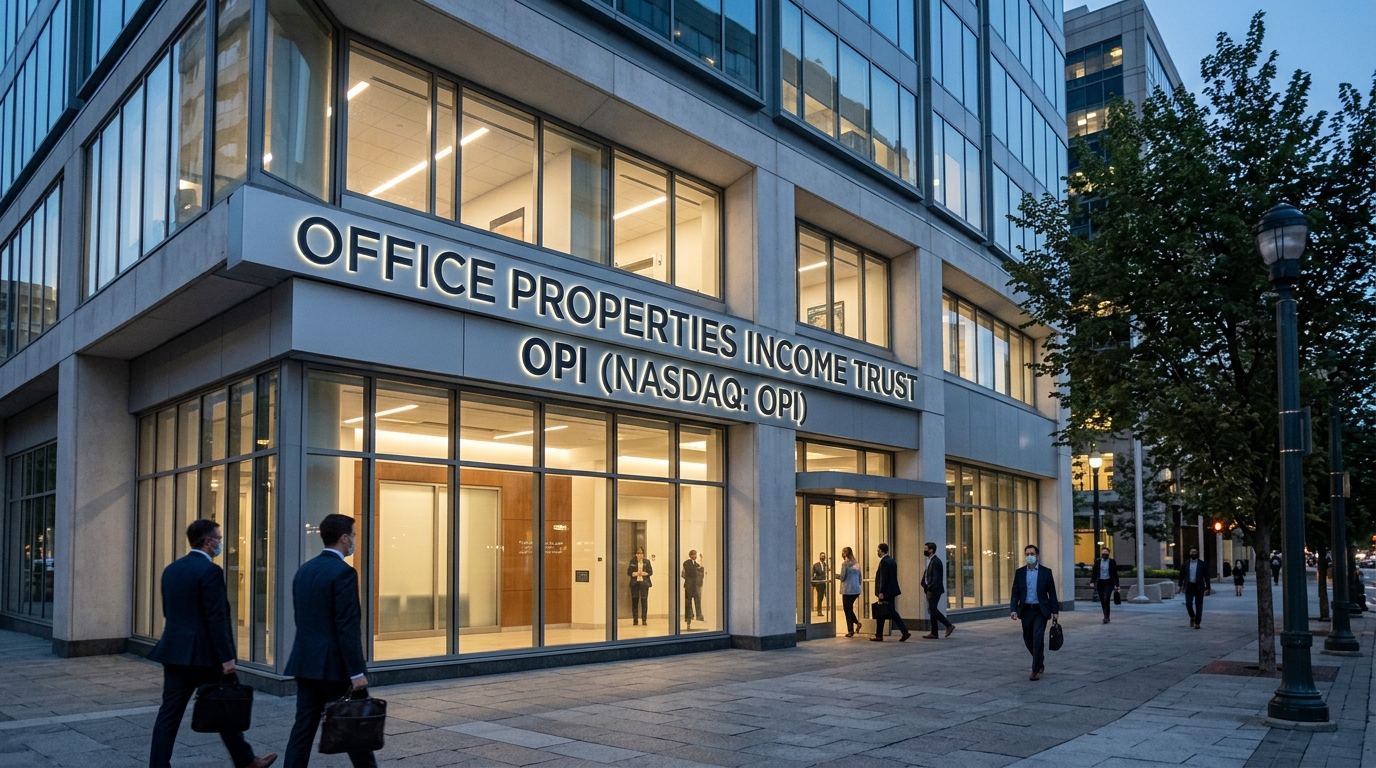
Office Properties Income Trust, trading on Nasdaq under the ticker OPI, is exactly that kind of question. Fresh out of Chapter 11, new shares, new board, new capital structure. On paper, the hard part is over. In practice, the hard part may have only just begun.
What Actually Happened
OPI filed voluntary Chapter 11 petitions on October 30, 2025, in the U.S. Bankruptcy Court for the Southern District of Texas. The restructuring was pre-arranged. Holders of roughly 80% of its September 2029 senior secured notes had already agreed to the terms before the filing.
The plan was confirmed April 22, 2026. The company emerged June 17, 2026.
Here is what changed on the balance sheet:
- Total debt reduced by approximately $714 million through the restructuring
- All 73.9 million old common shares were canceled. Shareholders received nothing.
- Approximately 22 million new common shares were issued
- Post-restructuring debt load stands at roughly $1.7 billion
- New debt includes $420 million of 10.0% senior secured exit notes due 2031 and $385 million of 8.375% senior secured notes due 2029
- A $425 million revolving credit facility was amended, now carrying a 9.1% interest rate
- $125 million DIP financing was terminated through equity conversions
Former noteholders, including affiliates of Helix Partners Management LP and Redwood Capital Management, now own a significant portion of the reorganized equity. Jonathan Heller of Helix chairs the new board. Yael Duffy stays on as CEO and Brian Donley remains CFO.
The new shares began trading June 18, 2026. Within weeks, the stock was down roughly 50% from its debut.
The Business Underneath
OPI is a national REIT that owns and leases office properties to credit-quality tenants across the United States. As of June 30, 2025, approximately 59% of revenues came from investment-grade rated tenants. The portfolio consists of 122 wholly owned properties across 29 states and Washington, D.C., totaling approximately 17.1 million rentable square feet.
The manager is The RMR Group, which secured five-year property and business management agreements as part of the post-bankruptcy structure. RMR has over $37 billion in assets under management and 40 years of institutional experience in commercial real estate. OPI retained RMR through the restructuring, which is worth noting. It signals continuity but also keeps a structural cost embedded in the business.
On revenue, the trailing figure sits around $442.6 million annually. Quarterly revenue is roughly $108.9 million. That sounds solid. The margins are where it falls apart. EBIT margin is approximately negative 29%, and profit margin is around negative 73%. Q1 2026 net income came in at roughly negative $93 million. Operating cash flow is negative. Free cash flow is negative. The current ratio is 0.9 and the quick ratio is 0.2.
This is not a stable cash machine that got temporarily punished by the market. This is a turnaround that just completed step one of a multi-step process.
The Sector Headwind Is Real
Slight tangent, but it matters.
Office real estate is not a simple recovery story. The sector posted a total return of negative 14.0% in 2025, finishing 12th out of 13 REIT sectors. National office vacancy peaked at 17.2% in the first half of 2024, then declined to 16.3% by late 2025. Marcus and Millichap projects a further decline to 15.9% by year-end 2026, supported by seven consecutive quarters of positive net absorption through Q4 2025.
The broader picture: the fourth quarter of 2025 marked the second consecutive quarterly uptick in REIT office occupancy, which reached 86.0%. That is a step in the right direction, but it is still well below the 93.4% average recorded in Q4 2019 before the pandemic.
J.P. Morgan Research has estimated that U.S. office vacancy rates would peak around late 2025 or early 2026, after which improving sentiment could shift. The logic: over 70% of office occupants have now had the opportunity to adjust their footprints post-pandemic, and return-to-office trends are still playing out.
Office attendance has climbed to nearly 70% of pre-pandemic levels. New office construction hit a 13-year low in 2025 deliveries. That tightening supply side is a genuine tailwind for landlords who can hold on long enough to benefit from it.
The challenge for OPI specifically is that it does not own exclusively Class A, amenity-rich, transit-adjacent trophy properties. The office market recovery is heavily bifurcated. Premium, well-located assets are absorbing tenants and maintaining rents. Older, suburban, or lower-amenity properties are not. That split matters enormously for how OPI’s portfolio actually performs over the next three to five years.
Is the Stock Actually Cheap?
This is where it gets complicated.
At around $17 per share with roughly 22 million shares outstanding, the market cap is approximately $374 million. Total debt is approximately $1.7 billion. That puts enterprise value somewhere in the range of $2 billion or above, against trailing revenue of $442 million.
The debt is expensive. Carrying rates of 9.1%, 8.375%, and 10.0% on a portfolio generating deeply negative free cash flow is a serious constraint. The interest burden alone will consume a meaningful share of whatever operating income the business can generate in the near term. There is no dividend. There is no clear near-term path to one.
Post-bankruptcy equity in a structurally challenged sector, with negative cash flow, a leverage ratio of approximately 4.4x, and coupon rates averaging near 9% on $1.7 billion in debt is not what most people would call cheap in any traditional sense. It is speculative. That distinction matters.
At first glance, a 50% decline from the debut price might look like an overreaction. But the debut price itself was set by creditor negotiations, not by organic market price discovery. The market has now had a chance to weigh the facts independently. The drop may not be irrational.
Bull, Base, and Bear
The bull case: office vacancy peaks and begins a multi-year recovery. OPI’s investment-grade tenant base provides revenue stability during the transition. The new, leaner capital structure reduces interest expense versus pre-bankruptcy levels. Asset sales generate liquidity. RMR’s operational experience helps stabilize leasing. The stock, carried by distressed debt players who know what they paid for, gradually re-rates as cash flow improves.
The base case: OPI muddles through. Occupancy holds roughly flat. A few leases roll and are re-signed at lower rents. Cash flow stays negative but manageable with the revolving facility. The company sells some properties to pay down debt. Progress is slow, uneven, and not particularly rewarding for equity holders over a two-to-three year horizon.
The bear case: Office leasing deteriorates further. Tech sector job losses reduce demand in key markets. Interest on $1.7 billion in debt at high single-digit rates overwhelms operating income. Asset sales happen at distressed prices. The revolving credit facility, which now runs at 9.1% and steps up to a higher margin after December 2026, becomes a cash drain. Equity gets diluted or squeezed again before the cycle turns.
The bear case is not far-fetched. The delinquency rate on office commercial mortgage-backed securities hit 11.66% in August 2025, the worst level ever recorded and above the peak seen during the 2008 financial crisis.
The Cheap Investor Scorecard
| Category | Assessment |
|---|---|
| Business Quality | Below average. Office sector under pressure; portfolio quality is mixed. |
| Financial Strength | Weak. $1.7B debt, negative free cash flow, current ratio of 0.9. |
| Valuation | Speculative. Low price reflects real operational risk, not irrational panic. |
| Competitive Position | Limited. No clear pricing power. Investment-grade tenants are a positive offset. |
| Balance Sheet | Improved vs. pre-bankruptcy, but still heavily leveraged at 4.4x. |
| Cash Flow | Negative operating and free cash flow. Financing activity carrying the near term. |
| Management Execution | Incomplete verdict. New board installed. Duffy and Donley retained. Early days. |
| Catalyst Strength | Moderate. Office vacancy broadly declining. Asset sales could surface value. |
| Margin of Safety | Low. Multiple execution risks remain. High debt costs limit buffer. |
| Long-Term Potential | Possible, but contingent on sector recovery and debt paydown over 3-5 years. |
What to Watch
- Leasing activity: are tenants renewing or walking? Watch same-property occupancy each quarter.
- Asset sales: is OPI generating enough from dispositions to reduce debt, or are sales happening at distressed prices that shrink the asset base faster than the liability side?
- Cash flow trajectory: the path from negative to breakeven free cash flow is the single most important metric over the next 12 to 18 months.
- Revolving credit facility terms: the margin steps up after December 2026. That deadline is not far off.
- Sector occupancy: national office vacancy declining toward 15.9% by year-end 2026 would be a meaningful tailwind for the broader thesis.
- Investment-grade tenant renewals: 59% of revenue from investment-grade tenants is a genuine strength, but only if those leases actually renew at reasonable rates.
The Bottom Line
OPI is not the same company that filed for bankruptcy eight months ago. The debt load is meaningfully lighter. The equity base is restructured. Former creditors with real skin in the game are now in the boardroom.
But the problems that pushed OPI into Chapter 11 in the first place, including an overleveraged balance sheet, a challenged office market, persistent negative cash flow, and a portfolio that does not sit uniformly at the top of the quality spectrum, did not disappear with the filing. They are still there, just with a different set of owners absorbing the consequences.
If you are the type of bargain hunter who buys distressed post-bankruptcy equities as a deliberate strategy, with a long time horizon, a tolerance for binary outcomes, and position sizing that reflects the risk, OPI at current levels is at least worth serious due diligence. The office sector does appear to be turning, slowly and unevenly.
If you need a business with clean financials, growing free cash flow, and a margin of safety built into the price, this is not it. Not yet.
Check back when OPI posts two consecutive quarters of positive operating cash flow. That would be the first real signal that the turnaround is tracking.
Until then, it is a watch, not a buy.
– The Cheap Investor