
July 3, 2026
The Chip Options Frenzy Has a Number Most Investors Are Ignoring
Featured: The Chip Options Frenzy Has a Number Most Investors Are Ignoring
Editor’s Note: Louis Navellier manages a $1.1 billion portfolio – including $358 million in AI stocks. He called Nvidia before it soared 44,000%… Intel before it climbed 3,228%… and Qualcomm before it went from $2.05 to $128. But his newest opportunity, he says, could top them all. It involves a secretive lab in the mountains of Tennessee. It involves Jeff Bezos and President Trump. And it’s about to produce a new AI model 258 trillion times more powerful than ChatGPT, Gemini or Grok. He’s agreed to provide us the details, including the name and ticker of the company behind this breakthrough, for free.
Dear Reader,
AI stocks aren’t dead.
They’ve just been sleeping…
Setting the stage for something much, much bigger.
Behind the scenes, America’s top AI scientists have been hard at work.
Behind the secure wall’s a secretive laboratory in the mountains of Tennessee…
They’ve been building a new category of AI-powered device so powerful…
President Trump himself just compared it to the creation of the atom bomb.
But this device won’t trigger a nuclear explosion.
It’ll trigger something AI scientists call an “intelligence explosion…”
A sudden 360-fold acceleration in major AI-powered breakthroughs.
That means it’d shrink AI breakthrough times from 3 years… down to 3 days.
In the process, it’s poised to spark a $100 trillion reset of the AI markets… starting THIS YEAR.
How? By instantly leapfrogging America’s current crop of AI models.
That includes ChatGPT, Claude, Gemini, and even Elon Musk’s Grok.
That’s why I believe this event could send certain AI stocks tumbling…
While creating a new generation of AI millionaires and billionaires…
Starting with the company I reveal here (down to the ticker) in my new presentation.
Please, don’t buy or sell another AI stock until you’ve seen what’s coming.
And don’t delay here.
This video contains time-sensitive information.
So, I’ll be forced to take it offline soon.
Regards,
Louis Navellier
Senior Quantitative Investment Analyst, InvestorPlace
P.S. Again, this is the biggest prediction of my 40-year career. For context, I called Nvidia before it went up 44,000%. I called Apple before it went up 36,000%. And I predicted Microsoft’s rise, before it soared 60,800%. I successfully called the 2008 crash, as noted by MarketWatch… and the 2020 Covid rally. But what’s coming this year will top them all. The time to prepare is right now. Go here for the details.
FEATURED
The Chip Options Frenzy Has a Number Most Investors Are Ignoring
There is a number buried in Citadel Securities’ first-half 2026 market structure review that should stop every investor cold.
Not the semiconductor index return. Not the AI capex figures. The options number.
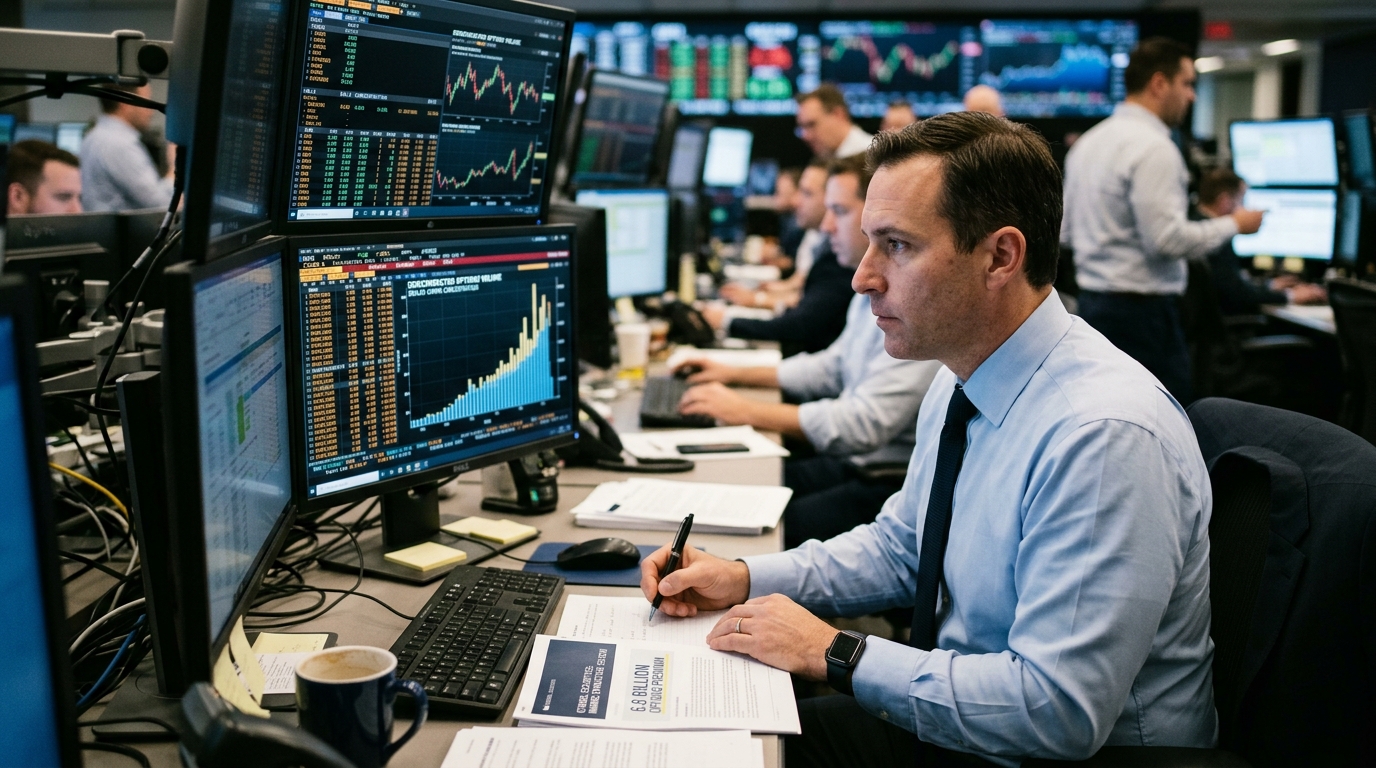
Retail traded a record $6.8 billion of options premium per day in June on the Citadel platform — up from $5.8 billion in May, which was itself a record, and more than double the 2024 average. Nine of the ten largest retail trading days ever recorded on Citadel’s platform occurred within the past month. That alone is an extraordinary data point. But the sector breakdown is where it gets genuinely concerning.
In June alone, retail traded approximately $1.9 billion of semiconductor options premium per day — six times the historical average — with roughly 75% of that activity concentrated in call options.
Six times. Not 20% above average. Not double. Six times.
The part people skip is what this means for portfolio construction across millions of individual accounts simultaneously. When one sector dominates retail buying activity to this degree, individual investors may be taking on more semiconductor-specific risk than they realize. A diversified portfolio that was 5% semiconductors six months ago might now be 15% or 20%, purely from price appreciation and additional buying. And that is before accounting for options leverage.
The Structural Picture
The ten largest companies now account for nearly 40% of the S&P 500, remaining near record concentration levels. Their combined index weight has increased by roughly 10% since June 2023 and 13% since June 2020.
Here is the stat that reframes everything. Semiconductor companies now represent a record 19.7% of the S&P 500 — almost four times their weighting of around 5% in June 2020, according to Citadel Securities. Before the dot-com crash, semiconductors represented just over 8% of the index. Today they are more than double that historical peak. Roughly 18 cents of every dollar allocated to the S&P 500 flows directly into semiconductor companies.
AI bubble to POP July 29th
He predicted the 2008 financial crisis…
He predicted Trump’s election in 2016…
He even predicted the rise of COVID-19 writing:
That was three months before the first reported case.
If he’s right again, God Bless America…
Because this crisis will be tectonic in scale…and it’s going to begin with the bubble popping in AI.
The iShares Semiconductor ETF (SOXX) returned approximately 90% in the first half of 2026, easily outpacing the broader technology ETF category average of roughly 13-14% over the same timeframe. That is a gap worth sitting with for a moment.
What is interesting is the mechanics of how this amplifies on the downside. The average 3-month implied volatility of the ten largest semiconductor companies has more than doubled over the past decade, rising from 32% in 2016 to nearly 72% today. Higher IV on the way up means higher IV on the way down. The options market is not cheap on these names.
Bank of America’s proprietary Bubble Risk Indicator recently reached 0.91 for the PHLX Semiconductor Sector on a scale where 1.0 represents extreme bubble-like conditions. The reading for the broader Technology Select Sector came in at 0.82. Both are flashing signals not typically seen outside of major cycle peaks.
The semiconductor sector has reached a concentration level that is actively masking deteriorating breadth. Breadth beneath the surface of the rally is historically narrow — just 27-28% of S&P 500 constituents have outperformed the index over recent 30-day periods, a first-percentile observation relative to the past 30 years. When that concentration wobbles, there is no broad market underneath to absorb it.
Where the Risk Actually Lives
The demand story for AI chips is real. Nobody serious is arguing that. The chip market is heavily exposed to AI chips for data centers, with semiconductor companies generating some of the most explosive earnings numbers in sector history. The question is not whether the business is good. The question is what multiple that business deserves when everyone from pension funds to retail traders is piling into the same call options.
The semiconductor sector increasingly trades like a duration asset because so much of the expected cash flow is back-loaded into the AI capital spending cycle. If there is a real hawkish surprise from the Federal Reserve or a credit event in private AI infrastructure financing, the sector moves fast — not because the demand picture is wrong, but because the valuation is sensitive to the discount rate. That is the concern from analysts who are simultaneously bullish on the underlying demand.
Leveraged ETF assets reached a record approximately $218 billion, more than 4.5 times their levels from June 2020. Since the end of March alone, assets increased by roughly $82 billion — led by technology exposure up 136% and semiconductor exposure up 175%. Leveraged semiconductor ETF AUM nearly tripling in a single quarter is not a footnote. It is a mechanical amplifier.
These instruments rebalance daily. When semiconductor stocks are up, forced buying happens near the close. When they are down, forced selling. At $218 billion in assets concentrated in the same names retail is already buying calls on, the daily rebalancing effect operates in both directions with equal force.
Slight tangent, but it matters: the Roundhill Memory ETF (DRAM), launched in early April 2026, became the fastest ETF in history to reach $10 billion in assets under management, accomplishing that in just 43 days. Three companies — Micron, SK Hynix, and Samsung — account for roughly 75% of that fund. The appetite for concentrated semiconductor exposure has become genuinely remarkable.
What the Options Market Is Pricing
Approximately 82% of Nasdaq rallies during May were accompanied by higher 1-month at-the-money implied volatility — the highest monthly frequency observed since 2005 and more than three times the long-run average. By the end of May, 55% of S&P 500 constituents exhibited inverted 1-month call skew, the highest proportion in more than a decade.
Inverted call skew means the market is paying more for upside calls than downside puts. That is the technical signature of a market that has collectively decided the direction is known. When everyone agrees on direction in options markets, the risk is not that they are wrong about the destination — it is that the timing is uncertain and the positioning is crowded.
For options traders specifically, this is where the asymmetry sits. Buying puts on semiconductor ETFs or individual names right now costs real premium given elevated IV. A more capital-efficient expression for those expecting a cooling period: out-of-the-money put spreads on SMH or SOXX in the September or October expiry. They define the risk, cap the cost in a high-IV environment, and position for a mean reversion that does not need a crash to pay off — just a pause.
REVEALED: Wall Street “Outlaw’s” Most Wanted Trading Secret
A 20-year trading veteran’s most valuable secret helps him see more gains in one day than most people see in a year.
It involves a simple move practically anyone can execute…
For long-term investors, the more actionable point is simpler. The defining story of 2026 has not been a single macro event. It has been the structural transformation of equity markets, where concentration, passive investing, retail participation, leverage, and volatility are no longer independent trends but together increasingly determine how capital flows, how prices are discovered, and how risk is transferred.
That structural shift is real. It is also the same force that makes unwinds sharper and faster than they used to be. The semiconductor trade is not broken. But the people buying $1.9 billion a day in semiconductor calls should probably know how crowded the room has gotten.
- The data: Retail semiconductor options volume at $1.9B per day — 6x historical average, 75% calls, average expiry under three days
- The concentration reality: Semiconductors now 19.7% of the S&P 500 — nearly 4x their June 2020 weight and more than double the dot-com peak
- Leveraged ETF amplifier: Semi-leveraged ETF AUM up 175% since end of March — a mechanical buying and selling engine operating in both directions
- Bubble risk signal: BofA Bubble Risk Indicator at 0.91 for the PHLX Semiconductor Sector — on a scale where 1.0 is extreme bubble territory
- Options structure for skeptics: September/October put spreads on SMH or SOXX — defined cost in a high-IV environment, positions for a pause rather than a crash
- The real risk: Fed hawkish surprise or private AI credit stress re-rates multiples fast — demand story intact, valuation sensitivity is the variable