July 4, 2026
SPCX at $162. Three Businesses, One Price.
Featured: SPCX at $162. Three Businesses, One Price.
Editor’s Note: Silicon Valley legend Jeff Brown is forecasting that Elon Musk’s “Kardashev Project” is about to trigger the greatest wealth creation event in history. If you missed out on Tesla… Read more below.
Dear Reader,
Elon Musk has transformed more American industries than maybe anyone in the world.
Today, well positioned investors have a chance to profit as it all comes together.
He gave manufacturing its biggest overhaul since Henry Ford.
In fact, the term “Factory-is-the-Product” was created to describe Tesla’s radical business model. Centered around Gigafactories pushing cars out with 95% automation in under forty seconds.
With SpaceX, he’s dropped the cost to launch material into space by 97%. Becoming the backbone of the U.S. space program.
And then there’s AI.
Most people forget, Musk founded the company behind ChatGPT. Recently, his own AI, Grok, beat out ChatGPT to become the world’s top public AI.
These may seem like separate businesses, and they largely have been…
Until now.
Elon Musk is bringing all of his most revolutionary technologies together in Phase II of his master plan. A plan he believes will unleash a quadrillion-dollar wealth creation event.
But as usual, the media is focusing on bringing Musk down instead of talking about the real story.
The story investors should care about.
Legendary Silicon Valley insider and tech investor Jeff Brown is sharing the full story – including where you should put your money before July 31 – in this brief video.
There’s still time to get in, but you have to move fast.
Jeff believes Elon could be making a new announcement by the end of this month that the mainstream media won’t be able to ignore.
By the time this story is plastered across the pages of The New York Times and The Wall Street Journal the best opportunity will be past.
Regards,
Lindsey Hough
Managing Director, Brownstone Research
FEATURED
SPCX at $162. Three Businesses, One Price.
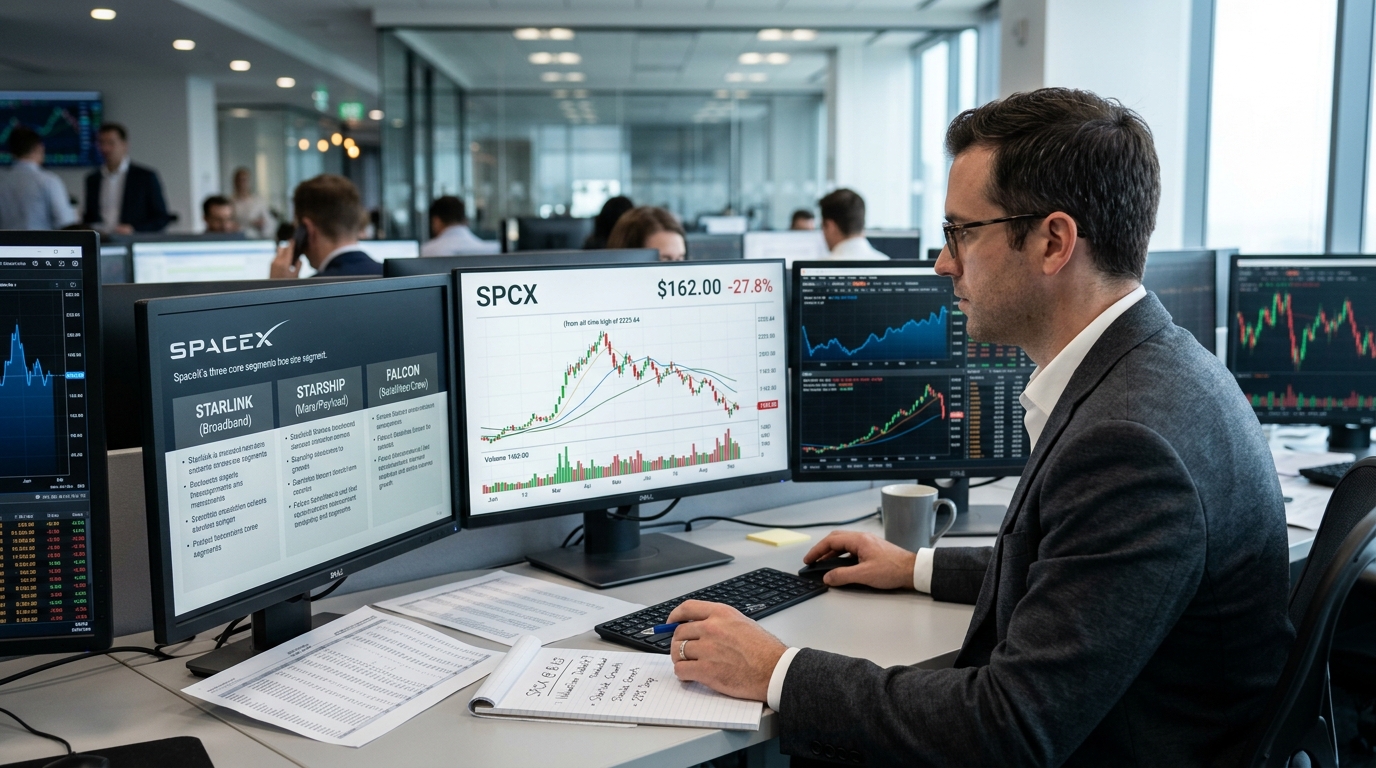
The confetti has settled. The Nasdaq crowd has gone home. And SpaceX, which completed the largest initial public offering in recorded history on June 12, is now trading around $162 — down roughly 28% from its intraday all-time high of $225.64, reached just four days after listing.
Most people are reading this wrong.
The story right now is not that SPCX had a massive IPO. SpaceX priced 555,555,555 shares at $135 on June 11, raising approximately $75 billion at a valuation of $1.77 trillion — surpassing Saudi Aramco’s roughly $29 billion offering from 2019 to become the largest equity offering in history. That part everyone already knows. What the market hasn’t fully worked through is what you’re actually buying when you buy SPCX today.
Here’s where it gets interesting.
The investment case for SpaceX rests on three pillars: the Starlink satellite internet business, the Starship launch vehicle program, and the company’s AI infrastructure through its xAI acquisition. Three businesses. Three different economics. Three different timelines. And right now the market is putting one multiple on all of them.
Let’s start with the part that actually makes money today.
Starlink generated $11.4 billion in revenue in 2025 and $4.42 billion in operating profit, with an adjusted EBITDA margin of 63%. Its subscriber base grew from roughly 4.5 million to 10.3 million in a year, across 164 countries as of March 31, 2026. That is a real business — a fast-growing, high-margin telecommunications franchise that already rivals some of the best software companies on the planet by margin profile.
Then there’s xAI. This is the part that makes the valuation math uncomfortable.
The AI segment posted a $6.36 billion operating loss in 2025 on just $3.2 billion in revenue. In Q1 2026 alone, the AI division produced an operating loss of $2.47 billion and consumed $7.7 billion in capital expenditure — roughly 76% of everything SpaceX spent across the entire company that quarter. So Starlink is funding a cash-burning AI unit that is consuming the majority of the company’s capital. That is not a knock on the long-term vision. It is just context for where the risk actually lives inside SPCX today.
SpaceX only floated about 4% of its shares in the IPO. Index funds tracking the Nasdaq and MSCI indexes are required to buy SPCX proportional to its weighting — creating structural, price-insensitive buying pressure against a very thin float. That mechanical bid is real. It is not the same thing as fundamental value. But it is a legitimate reason why the stock may hold better than pure valuation math suggests near term.
An Elon Musk Fan’s Warning About SPCX
Jon Najarian is one of Elon Musk’s biggest believers on Wall Street. He called Tesla in 2014 when legacy automakers were calling it a delusional toy company.
So when Jon tells investors to skip SPCX – the largest IPO in stock market history – it’s worth listening.
To be clear: He’s not bearish on Elon. He’s bearish on the math.
The bear case has a number. Morningstar currently values SPCX at $62 per share — updated slightly from their $63 IPO-era estimate after SpaceX announced its $60 billion acquisition of AI coding platform Cursor. At $162, that puts the stock at roughly a 160% premium to Morningstar’s discounted cash flow model. Their analysts describe xAI as a material source of uncertainty with an “indeterminate” economic moat, and note the company’s valuation implies investors will need to wait decades for earnings to grow into current multiples.
The bull case also has a number. The Wall Street consensus 12-month price target sits at $204.14, with a Moderate Buy rating. The spread between $62 and $204 tells you everything about what kind of stock this actually is. SPCX is not a value stock. It is not even a growth stock in the traditional sense. It is a bet on a very specific version of the future.
SpaceX is scheduled to release its first publicly audited earnings report on August 6, 2026. That is the first real data point the market will get to stress-test the thesis against actual public company numbers. Watch xAI capex guidance and Starlink subscriber trajectory. Those two numbers will set the tone for the second half of the year.
There’s also a date worth circling in December. The 180-day insider lock-up expires then, at which point the 96% of shares currently locked up become eligible to trade. The thin float that helped push SPCX from $135 to $225 in three sessions could work in the other direction if that supply hits the market all at once.
The pullback from $225 to $162 is not a crisis. It is the market finding its footing on a genuinely unprecedented asset. The three-business model is real. The valuation gap between the bulls and the bears is unusually wide. August 6 closes some of that gap.
Until then, the float is thin, the passive bid is real, and nobody actually knows what xAI is worth. That combination makes this one of the more interesting situations in the market right now. Not necessarily cheap. But very far from boring.