June 18, 2026
What If Apple Acquires Nintendo?
The $50 Billion Move That Could Consolidate Global Gaming Dominance
Hey there, bargain hunter.
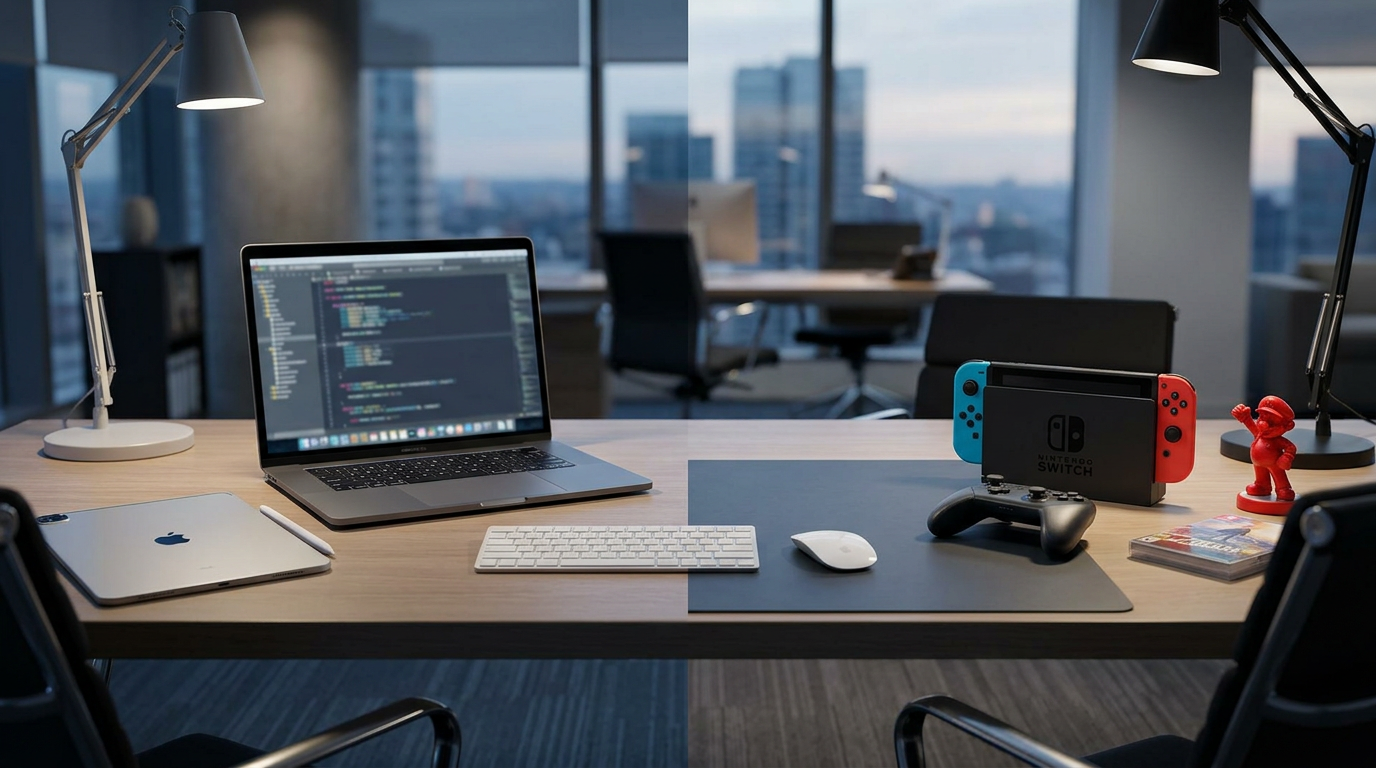
This one is purely hypothetical. No leak, no credible rumor, no banker whisper. Just a question worth sitting with: what happens to the entire gaming industry if Apple writes a $50 billion check and buys Nintendo?
Because the math is not as crazy as it sounds.
The Setup
Nintendo’s market cap sits around $52–57 billion depending on the day and which exchange you’re quoting. Apple, for context, is sitting on a cash pile that could fund this deal several times over without blinking. A 30–40% acquisition premium would put the all-in price somewhere in the $70–80 billion range. Uncomfortable, yes. Impossible for Apple? Not even close.
What Apple would be buying is not a hardware company. Not really. It would be buying the most battle-tested IP library in the history of gaming.
The Mario franchise has surpassed 950 million lifetime software units worldwide. Pokémon – technically a joint venture but effectively a Nintendo property – is the highest-grossing entertainment media franchise of all time, estimated at over $150 billion in lifetime revenue. The Legend of Zelda has crossed 172 million total units sold. These are not just video game characters. They are multigenerational cultural assets with near-zero brand decay.
Elon’s $4 Trillion Takeover Target, Revealed
Banking. Cars. Rockets. The Internet itself. Each time, the same pattern: Elon targets an industry the world says can’t be disrupted, the experts call him crazy, the short sellers pile in… and then he does it. Now he’s preparing for his biggest takeover yet.
Apple’s current gaming problem is exactly this. Critics have noted for years that Apple lacks a “killer IP” – the kind of franchise that makes a consumer choose a platform rather than just tolerating one. Nintendo has three of them. At minimum.
The Synergy Case
Here’s where it gets interesting – and where most people stop thinking too early.
Apple Arcade already runs across iPhone, iPad, Mac, Apple TV, and Apple Vision Pro. It offers 200+ games ad-free with a family subscription. The service is clean, well-structured, and quietly growing. What it does not have is a reason for a serious gamer to care. Drop Mario Kart, Zelda, and Pokémon into that catalog as exclusive Arcade titles – suddenly the calculus changes entirely.
Spatial computing is the other angle most people skip. Apple Vision Pro is still in early innings, searching for a killer use case beyond productivity demos and tech showcases. Spatial games built for Vision Pro already blend digital content with the physical world – eye tracking, hand gestures, full environmental immersion. Now imagine a spatially rendered Zelda dungeon in your living room. Or a Mario Kart track that wraps around your furniture. That is not a stretch. That is the natural next step for both platforms combined.
Nintendo has 21.5% year-on-year growth in Switch Online subscriptions driven by brand loyalty alone. Apple has the device distribution – 60% of U.S. households own an iPhone. The overlap between these two audiences is enormous, and right now, neither company is fully capturing it.
The Market Disruption
Sony and Microsoft have spent the last decade trying to own the living room. Microsoft dropped $68.7 billion on Activision Blizzard. Sony has been quietly acquiring first-party studios – Bungie, Firewalk, and others – to build out its exclusive content moat. The race is real, the stakes are enormous, and the console ecosystem has never been more competitive.
An Apple-Nintendo combination enters that race with a different weapon entirely. Not better graphics. Not a faster CPU. Consumer trust and generational nostalgia at a scale that neither Sony nor Microsoft can manufacture. Nintendo maintains its market position not through specs but through what one analyst called “Brand Authority and hardware exclusivity that competitors cannot replicate.”
Slight tangent, but it matters: Nintendo was founded in 1889 as a playing card company. It has survived every console generation, every mobile disruption, every platform shift. That kind of institutional durability does not show up on a balance sheet, but any serious acquirer would be paying for it.
Satellite Confirms: Elon Musk Activating Strange ‘Dark Energy’ Across U.S. South
Confirmed by satellites 300 miles above the Earth’s surface… Elon Musk is rolling out a breakthrough technology that could replace our need for foreign oil and ignite a $10 trillion boom a small group of stocks.
Click here to learn how you can invest in this before it becomes mainstream.
The Friction
None of this is clean. Nintendo is a Japanese company headquartered in Kyoto, and cross-border tech acquisitions involving national cultural assets face serious regulatory and political resistance. The Japanese government has shown a willingness to protect strategic domestic companies. This alone could kill the deal before it starts.
Then there is the culture problem. Nintendo’s development philosophy is insular, deliberate, and allergic to the kind of aggressive platform monetization that Apple runs. Cramming Nintendo’s IP into an ad-supported or aggressive subscription model could destroy exactly what makes those franchises valuable. Apple would need to resist the instinct to over-optimize.
And antitrust. Mobile gaming already commands roughly 45% of the global gaming market. Apple controls the iOS App Store. Adding Nintendo’s dominant console IP to that infrastructure would draw serious scrutiny from regulators in the U.S., EU, and Japan simultaneously.
The Bottom Line
If Apple ever pulled this off – and the odds remain long – it would not just be a gaming acquisition. It would be a statement that the subscription content wars have fully migrated to gaming, that hardware exclusivity is a moat worth paying for, and that the console era as we know it is effectively over.
The question is not whether Apple could afford Nintendo. It is whether Apple understands what it would actually be buying. Because the moment Mario becomes just another Arcade title, you have already lost the most important thing.
Worth watching – even if this stays hypothetical for another decade.
– The Cheap Investor