May 30, 2026
Vertiv is the unglamorous AI winner
If data centers are the factories, Vertiv sells the power and cooling that keeps them running.
Hey there, bargain hunter.
Everyone wants the AI gold rush. Very few people want to own the company selling the generators, switchgear, and cooling loops that keep the gold mine from overheating.
That’s Vertiv (VRT). It is not “exciting” in a demo-day way. It is exciting in the “this is what gets ordered when a hyperscaler is actually building” way. That difference matters more than most folks want to admit.
Scoreboard (as of May 29, 2026)
- Stock price: $315.71 (close May 29, 2026).
- Market cap: about $123.8B.
- Trailing P/E: about 79x (headline rich, more on that below).
- Q1 2026 results: strong quarter and raised full-year outlook.
- 2026 guidance (company): revenue $13.5B to $14.0B, adjusted operating margin 22.8% to 23.8%, adjusted diluted EPS $6.30 to $6.40.
- Credit: investment grade ratings (Moody’s Baa3 and S&P BBB-) cited by the company in Q1 materials.
Here’s the part people skip. AI demand does not hit the economy evenly. It hits in lumpy purchase orders for power and thermal equipment, and in bigger build-outs that force new facility designs. That is Vertiv’s backyard.
One of these 4 “smart” beginner moves slowly collapses the account of nearly every new options trader who makes it.
It’s the #1 account-killer that most trading educators never warn you about.
Chances are you’ve made this trade at least once in the past month.
Do you know which one it is?
Click on your answer:
A: Trading right before earnings
B: Buying cheap out-of-the-money calls
C: Adding more indicators to your chart
D: Holding the option longer to recover
Click above to guess, or click here to skip straight to the answer.
The real reason this works
At first glance, Vertiv looks like “data center stuff.” In reality it is a picks-and-shovels business tied to one very specific pain point: higher compute density creates heat and power delivery problems that can’t be solved with vibes.
When racks get denser, cooling changes. Air cooling starts to run out of room, and liquid cooling becomes more common. Vertiv has been positioning itself for exactly that shift, including direct-to-chip cooling architectures and the supporting infrastructure around them.
Slight tangent, but it matters: in past cycles, “data center” meant a lot of commoditized white space and fairly repeatable builds. AI is pushing designs into more custom configurations. That tends to favor incumbents who already speak the language of uptime, service, and field support.
Deep dive: what Vertiv sells and how it makes money
Vertiv supplies critical digital infrastructure for data centers and networks, with a focus on power, thermal, and services.
- Power: UPS systems, power distribution, switchgear integration, and related controls.
- Thermal: cooling systems that are increasingly designed for high-density compute.
- Services: installation, maintenance, and lifecycle support. This part can be underrated because it tends to be sticky once you are inside the customer’s facility.
The reason I like this angle as a cheap investor is simple: it ties the AI boom to physical orders. Less debate, more invoices.
The market is already lopsided against the regular trader.
Without access to privileged info (think company executives, corporate insiders, politicians, etc)…
Or a ridiculous amount of capital (think banks, hedge funds, corporate institutions, etc)…
Or advanced algorithms (think market makers)…
The regular trader is practically a sitting duck, more likely to lose all their money.
It’s been my goal to level this playing field for the last decade or so, and I believe I’m now closer to that goal than I ever was.
I’d like you to meet K.I.R.A. – Key Intelligence Research Assistant.
This is an AI engine that practically combines pristine pattern recognition with next-level financial forecasting.
Data section (numbers first)
From the company’s first-quarter 2026 release, Vertiv raised its full-year outlook across revenue, margin, and adjusted EPS. The headline ranges matter because they tell you management thinks demand is still strong enough to support both growth and profitability at the same time.
- 2026 revenue guide: $13.5B to $14.0B.
- 2026 adjusted operating margin guide: 22.8% to 23.8%.
- 2026 adjusted diluted EPS guide: $6.30 to $6.40.
If you want one extra, concrete checkpoint: Vertiv’s May 2026 investor conference deck is worth a skim. It lays out the cooling transition and why infrastructure power overhead is becoming an explicit design variable, not an afterthought.
Is it cheap?
Let’s be honest. At $315, Vertiv is not optically cheap. The trailing P/E near 79x will scare off anyone who only buys single-digit multiples.
So the question becomes: are earnings in a transition year understating what the business can earn once capacity, sourcing, and service attach rates catch up? That is the bet the market is making.
My cheap investor framing: you do not buy this because it is cheap on last year’s earnings. You buy it because you believe the 2026 guidance is credible, the cycle lasts longer than a couple of quarters, and margins keep moving up with scale. If any one of those breaks, the multiple can compress fast.
Bull / Base / Bear
- Bull: AI build-outs continue, liquid cooling adoption accelerates, and Vertiv captures a larger share of each new facility, with services expanding as the installed base grows.
- Base: growth slows from today’s pace but stays healthy, and the company hits the mid-point of its 2026 revenue and margin ranges.
- Bear: customers pause projects, pricing gets competitive, or execution stumbles while the market is paying up for perfection.
The Next AI Winner Isn’t Making Chips
Most investors still think the AI boom is about semiconductors.
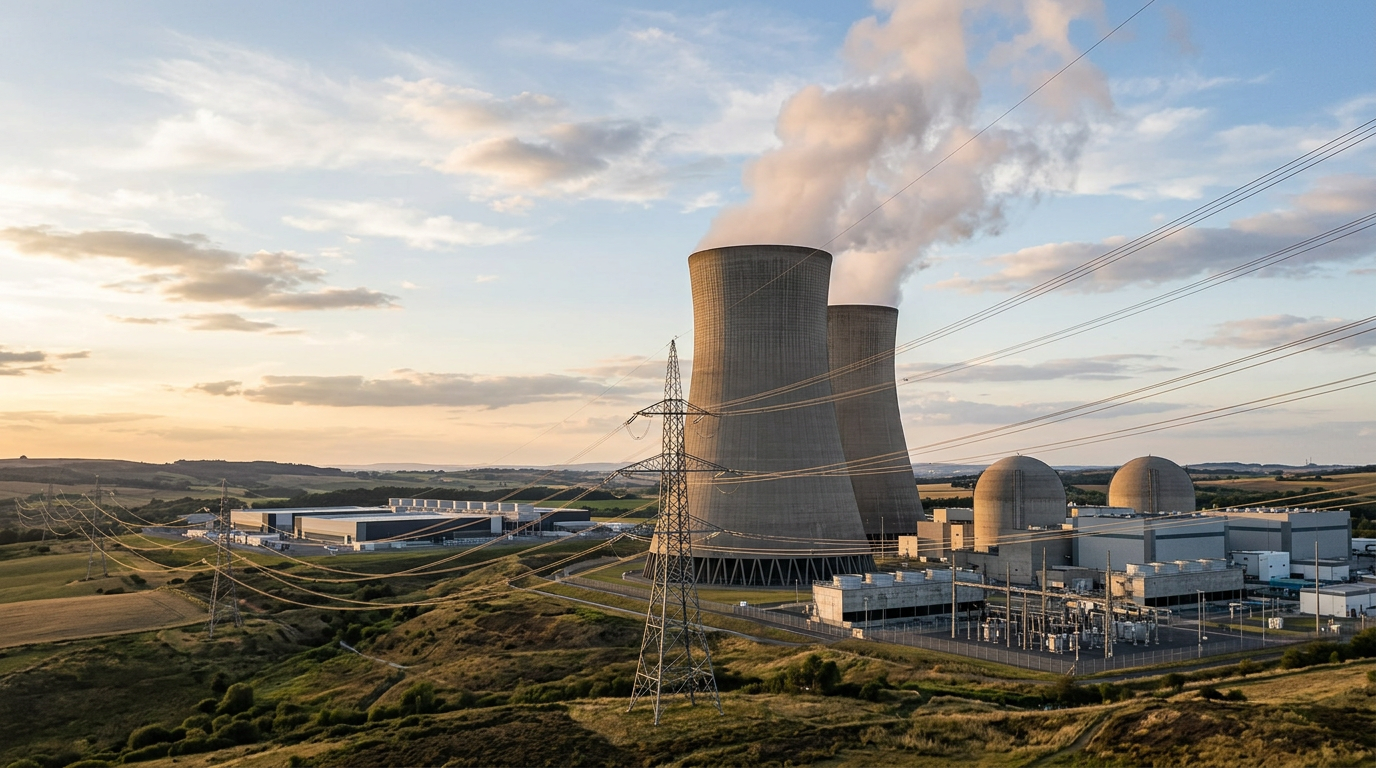
But a growing number of data centers are running into a different problem: not enough power.
One company has quietly built a $1.5 billion backlog supplying equipment these facilities depend on, yet Wall Street continues to value it like an old-school industrial stock.
Action plan (conservative bargain hunter version)
I would not chase this in one bite. If you want exposure, treat it like a position you earn over time.
- Starter: small initial buy only if you can tolerate volatility.
- Add: after the next quarterly update if the company keeps the 2026 ranges intact and margins hold.
- Pause: if guidance stops moving up while the stock keeps moving up.
- Exit trigger to respect: repeated misses on margins, because the whole point of paying up is that operating leverage shows up.
Cheap Investor checklist (watch list)
- Next-quarter update to 2026 revenue, margin, and EPS ranges
- Evidence services attach rates are rising
- Any mention of supply constraints easing or returning
- Cooling mix shift toward higher density deployments
- Working capital behavior as growth stays high
- Signs that investment grade status reduces financing cost over time
Bottom line
If AI keeps pushing data centers toward higher density and more complex thermal designs, Vertiv has a very clean claim on that build-out. The stock is not “cheap” in the usual sense, but the business is tied to the unsexy constraint that is not going away.
Worth a look: compare the current $315 price to how you feel about $6.30 to $6.40 in 2026 adjusted EPS, then decide if you want to own a slice of the plumbing behind the hype.