May 30, 2026
The Melt Up Is Here
Featured: Comfort Systems USA (FIX): AI spending needs pipes and cooling
Dear Reader,
Something extraordinary is happening in the markets right now.
I’ve been watching the markets for nearly 20 years… And the data I’m looking at right now is unlike anything I’ve seen before.
Consider this: Six years ago, $30 billion sat in U.S. leveraged ETFs – the type of instrument that allows investors to make turbo-charged bets on the market.
Today, they just hit a record $177 billion. That’s nearly six times more money, making bigger and more aggressive bets.
Investors are sprinting full-speed into the stock market. And it’s not just Americans…
Foreign investors now hold a record $21 trillion in U.S. stocks – up 170% since 2020. They have an unusually large share of their money in U.S. stocks – more than even during the peak of the dot-com bubble.
In other words, the entire world is piling into American stocks.
Meanwhile, the S&P 500 just hit a fresh all-time high, adding $11 trillion of value in just seven weeks.
This is what a Melt Up looks like.
I know what the skeptics will say: “This sounds like a top.”
But here’s what they’re missing…
Every bull market in history – 1929, the dot-com boom, Japan in the late ’80s, and more – followed the same exact pattern.
Stocks rise steadily for years… Then, something changes. People who sat on the sidelines panic that they’re missing out. They rush in all at once… prices explode… and then, when there’s nobody left to buy… it all comes crashing down.
We’re not at peak euphoria yet. Not even close. You’ll know it arrives when your neighbors and barber are giving you stock picks.
But Melt Ups happen fast. During the dot-com bubble, the Nasdaq nearly doubled in just a few months.
The window is still open – for now.
That’s why I just published a brand-new presentation laying out everything you need to know to maximize your returns during the Melt Up (including how to know when to get out before the Melt Down).
Watch it right here while there’s still time.
Regards,
Brett Eversole
Senior Editor & Analyst, Stansberry Research
P.S. If you’re over 55, navigating the next 12 to 18 months in the markets will be the final, most important decision of your financial life – the difference between the retirement you’ve planned for… and one haunted by “what ifs.” You deserve to be on the right side of it.
Click here to learn the simple steps I’m urging my readers to take before it’s too late.
FEATURED
Comfort Systems USA (FIX): AI spending needs pipes and cooling
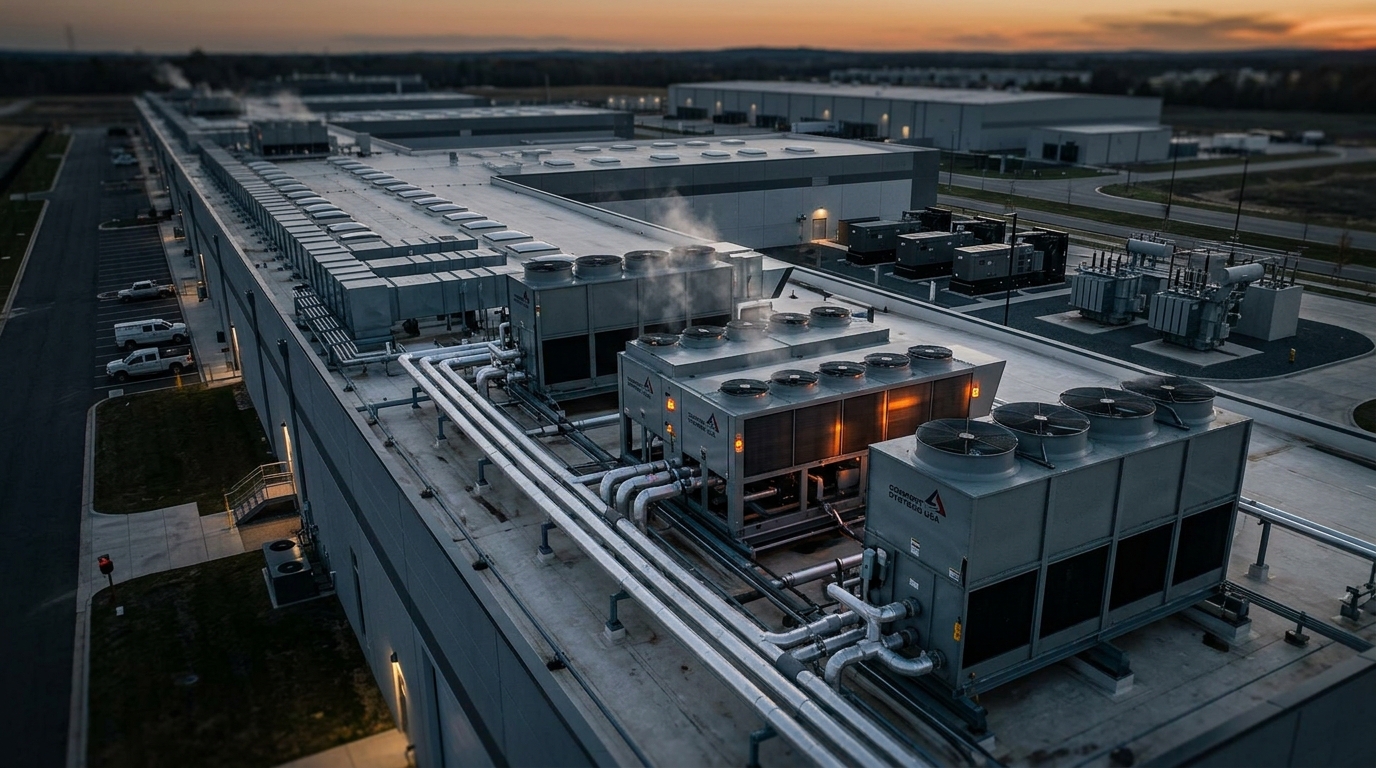
Everyone wants to own “AI.” Most people reach for chips or cloud software. Fair. But before any model runs, somebody has to build a building that can handle the heat, power, redundancy, and uptime demands. That work is not glamorous. It is mechanical, electrical, plumbing. And that is where Comfort Systems USA (FIX) keeps showing up.
It is also where the numbers got loud in Q1 2026.
Scoreboard
- Revenue: $2.87B in Q1 2026, up 56.5% year over year
- Organic growth (same-store revenue): 51%
- Diluted EPS: $10.51 vs $4.75 a year ago
- Operating cash flow: $388.8M vs ($88.0M) a year ago
- Backlog: $12.45B as of March 31, 2026 (vs $6.89B March 31, 2025; vs $11.94B Dec 31, 2025)
Those are not “nice for an industrial” numbers. That is a business in a demand pocket that is still getting bigger.
The real reason the stock keeps surprising people
The key is not that Comfort Systems had a “good quarter.” The key is that expectations for a contractor usually get capped by some combination of labor constraints, project timing, and the idea that growth is cyclical.
But data centers are changing the profile of this business. They are bigger projects, more repeatable, more standardized, and they pull forward years of spend. When hyperscalers decide they need capacity, they do not wait for a perfect macro backdrop. They try to secure land, power, equipment, and crews.
Slight tangent, but it matters: if you have ever tried to schedule a reputable electrician or HVAC team in a growing city, you already understand the moat. It is not just skill. It is availability.
Health Insurance Declared “Useless”
That headline hasn’t been written yet. But a 41-year market veteran says it could happen sooner than we think.
An AI doctor… more accurate than any human physician, available 24/7… could soon be free for every American. No copays. No deductibles. No three-week wait. And the investors who see this coming? They could make an absolute fortune.
Deep dive: what FIX actually does (and how it makes money)
Comfort Systems is a services and construction company focused on mechanical and electrical systems. Translation: they design, install, and maintain the guts of commercial and industrial buildings.
In data centers, that means HVAC and cooling systems, piping, controls, and related electrical work. You do not get to “ship it and iterate later” with this stuff. If cooling fails, performance drops or equipment gets damaged. If redundancy is wrong, uptime suffers. The customer pays for competence.
And when backlog is rising this fast, it is telling you demand is not just present. It is being reserved in advance.
Data section: what stands out (and what I would watch)
- Backlog quality and duration: $12.45B is the headline, but the bigger point is that it is up sharply year over year and still up sequentially versus year-end.
- Cash flow swing: going from an $88.0M outflow to $388.8M inflow in a year is a real operational signal, even if working capital timing can be lumpy quarter to quarter.
- Growth mix: management called out strong organic growth (51%). That matters because it reduces the “it is all acquisitions” objection.
One more macro anchor: multiple reports tied to Q1 results across the mega-cap platform names point to very large 2026 capital spending budgets. Whether you believe the exact number or not, the direction is clear: the buildout is not slowing down yet.
Is it cheap?
Here is where I get a little stubborn. The business looks great. The stock can still be expensive.
The email you are reading earlier mentioned analyst price targets around the $2,000 area. Those numbers move constantly, and they are not a valuation method. What matters more is how much perfection is already embedded in the multiple. With a stock like FIX, the market is effectively paying up for continued data center strength plus continued execution, quarter after quarter.
If you want a bargain-hunter approach, you do not need to “call the top.” You just need to avoid paying peak enthusiasm for a contractor, even a very good one.
Bull / Base / Bear
- Bull: data center demand stays strong, labor constraints ease just enough to keep margins healthy, backlog converts cleanly, and FIX keeps posting upside surprises.
- Base: growth cools from “stunning” to “strong,” backlog normalizes but stays elevated, and valuation becomes the main swing factor rather than fundamentals.
- Bear: hyperscaler spending pauses, projects get delayed, or competitive pressure increases. Add a tight labor market and you can get margin compression right when expectations are highest.
Action plan (cost-conscious version)
If you already own it: I would frame it as a hold unless the position has grown into an uncomfortable slice of your portfolio. This is the kind of winner that can keep winning, and trimming purely because something “went up a lot” is not always the smartest move.
If you do not own it: I would treat FIX like a scale-in candidate rather than an all-at-once buy. A simple way to do it is 3 entries spaced out over time, with the middle entry only happening if you get either (1) a market-wide risk-off week or (2) a company-specific dip that does not come with a fundamental crack.
Worth a look, but not at any price. That is the bargain-hunter rule.
The AI Bottleneck Nobody Saw Coming
Everyone talks about AI chips.
What’s getting less attention is power.
Goldman Sachs estimates electricity demand tied to AI is rising 15% annually, and many new facilities could face power shortages within a few years. One company already has $1.5 billion in orders for equipment these projects can’t operate without.
The interesting part? Investors still value it like a traditional industrial business.
With the SpaceX IPO approaching, that disconnect may not last.
Cheap Investor scorecard (track these)
- Backlog: level and growth rate (and whether sequential growth continues)
- Organic growth: does same-store stay elevated as comps get harder?
- Operating cash flow: direction over a full year, not one quarter
- Margin trend: do margins hold as the company staffs up?
- Customer concentration: how dependent is growth on a few hyperscalers?
- Labor: headcount growth, wage pressure, and project staffing constraints
- Project timing: signs of delays or cancellations in tech-related work
- Acquisitions: disciplined bolt-ons or growth-at-any-cost?
Bottom line
If data center construction stays strong and backlog keeps converting into cash, FIX can keep earning its premium.
If hyperscaler spending slows or labor tightness bites harder than expected, the stock can look expensive fast.
I will be watching the next backlog update like a hawk. Not because it predicts everything, but because it tells you whether the physical side of AI is still being booked out in advance.