
April 22, 2026
Tesla’s Q1 Beat Was Real. The Bigger Question: Is the Car Business Shrinking?
Margins jumped, cash flow surprised, and the mix keeps drifting away from “just cars.” Here’s what that does (and doesn’t) mean for TSLA.
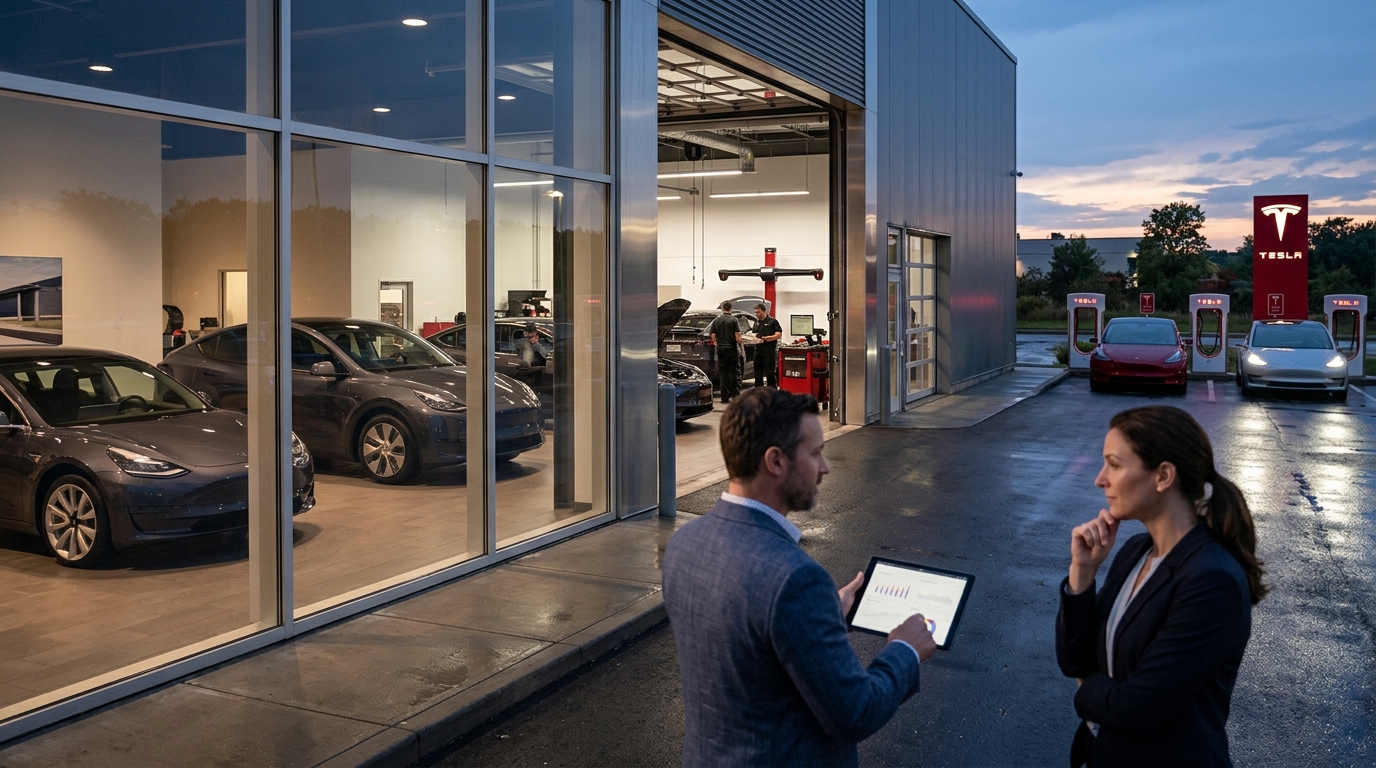
Hey there, bargain hunter – Tesla’s quarter landed like a hammer: higher margins, real free cash flow, and enough upside surprise to make the stock the main conversation again.
But the part people skip is the uncomfortable one.
If Tesla is printing better profitability while the auto unit side is under pressure, that can be a strength… or it can be a warning that the “car company” engine isn’t the only engine anymore. And if you own TSLA, you need to know which one you’re actually paying for.
Scoreboard (what happened)
- Adjusted EPS: $0.41 vs ~$0.35–$0.37 expected
- Total revenue: $22.39B (+16% YoY)
- Gross margin: 21.1% vs 16.3% a year ago
- Free cash flow: $1.44B (when a lot of people were bracing for ugly cash dynamics)
Those are not “meh” beats. Margin expanding that hard is the headline – it changes the whole debate about whether Tesla is stuck in a price war forever.
Slight tangent, but it matters: a big EPS beat without cash flow is a sugar high. A big EPS beat with free cash flow tends to stick in investors’ minds longer, because it answers the quiet question: “Is this quarter actually funding the next one?”
The real reason the quarter worked: expectations vs. reality
Going in, expectations were basically: revenue growth is fine, but margins are fragile, and cash could get weird (inventory, incentives, capex timing, you name it).
Tesla flipped that. The quarter reads like a company that found levers outside pure unit growth. That’s usually some combination of:
- better cost per vehicle (materials, manufacturing efficiency, logistics)
- less discounting than feared (or improved take-rate on add-ons)
- mix shift (more high-margin pieces showing up in the P&L)
- services/software contributing more than people model
And that leads directly into your question.
Is the car story shrinking? In my view: the car story is shrinking as the only story. That’s different from “cars are collapsing.” Tesla can still sell a lot of cars and still become a business where cars are the platform and everything else is the profit pool.
That sounds like a nice evolution until you remember the catch: the market will pay a very different multiple depending on whether those high-margin profit pools are proven, repeatable, and not just a one-quarter optical boost.
Electric cars. Satellites. Humanoid robots. AI… and Mars?
Elon has spent decades assembling the ultimate puzzle…
What’s Elon’s master plan? Because it’s not just to make him richer – he already has more money than you could spend in a thousand lifetimes.
There’s something much, much bigger happening.
Click here to see the document that shows exactly how all the pieces fit together.
Deep dive (plain English): what Tesla is selling now
Historically, Tesla was easy to underwrite:
Build EVs → sell more units → scale factories → margins rise → repeat.
That model still exists, but it’s not the only one management wants you to price.
Today Tesla increasingly behaves like a stack:
- Hardware: vehicles (the “installed base”)
- Software: paid driver assistance and features over time
- Services: financing, insurance, service, charging, subscriptions
- Autonomy/ride services (aspirational, but being pushed hard): paid rides, potentially higher utilization per vehicle
- Energy (cyclical execution): storage + solar + services
If that stack works, cars don’t need to grow as fast for earnings to grow. If it doesn’t, then you’re back to a pretty normal auto problem: competition, incentives, slower replacement cycles, and lumpy demand.
Here’s where I’m at: the quarter’s margin jump is the strongest evidence in a while that Tesla has non-car profit levers. But it’s still early to treat them like a mature software business.
Data section (the metrics that matter after a margin surprise)
If you want to answer “car story shrinking?” without guessing, focus on these measurable items over the next 2–4 quarters.
1) Gross margin quality
21.1% gross margin is the headline, but you want to know why it’s 21.1%.
- If margin strength came from lower input costs + manufacturing efficiency, that’s more durable.
- If margin strength came from one-time items (timing, accounting, unusually favorable mix), it can fade fast.
- If margin strength came from higher-margin software/services attach, that’s the “cars as a platform” thesis showing up in numbers.
2) Free cash flow: why it surprised
$1.44B in free cash flow changes the tone because Tesla has a history of quarters where profitability and cash don’t always move together cleanly (working capital swings can get dramatic).
What I’d watch next:
- Inventory: if inventory keeps creeping higher, cash can reverse even with good margins.
- Capex cadence: if spending ramps for AI compute, manufacturing refreshes, or new programs, cash can compress.
- Receivables/payables: short-term boosts can flatter a single quarter.
3) Revenue composition (this is the “shrinking car story” test)
Total revenue was $22.39B (+16% YoY). The question isn’t just “up or down.” It’s: what share is coming from autos vs everything else?
If auto revenue growth slows while gross margin rises, it usually implies the “everything else” bucket is doing more work. That can be great – but you must confirm it’s recurring and scalable.
One more nit: Tesla can improve margins even if unit growth is slower by leaning into pricing discipline, options, software, and services. That’s not magic. It’s just mix and operating focus.
So… is the car story shrinking?
I’d frame it in two layers.
Layer 1 (demand): The global EV market is more competitive than it was even 24 months ago. That naturally compresses the “cars alone justify the premium” argument. You don’t need doom-and-gloom here. You just need realism: competition makes volume and pricing harder, which makes Tesla’s profit mix more important.
Layer 2 (profit pool): This quarter’s margin expansion says Tesla has found levers beyond simply moving more metal. That’s the “car story shrinking” in a healthy way: cars become the distribution channel, not the only product.
The risk is that investors mentally promote Tesla to “software-like” economics before the underlying numbers prove it consistently. That gap – between what’s possible and what’s measurable – is where TSLA tends to get volatile.
Is it cheap?
On the numbers you shared, TSLA is trading with a very high earnings multiple (the kind of multiple you don’t get for being a “good car maker”). That’s the core tension. A huge multiple can be justified, but only if:
- margins stay structurally higher than the auto industry, and
- non-auto profit streams become large enough to matter, and
- cash generation holds up through investment cycles.
If those don’t happen, then valuation math starts to look heavy fast, even after a strong quarter.
My cheap-investor lens: I’m less interested in whether TSLA looks “cheap” on last quarter’s EPS. I’m interested in whether the next few quarters prove the margin level is repeatable without pulling demand forward with discounts.
Bull / Base / Bear
Bull case
- Margins stay near this level because cost per unit keeps falling and higher-margin add-ons keep scaling.
- Free cash flow becomes less lumpy, more consistent.
- Software/services attach keeps creeping up per vehicle, turning the fleet into an annuity-like base.
- Energy stabilizes and stops being a swing factor.
Base case
- Auto demand is fine but competitive – growth exists, just not effortless.
- Margins settle below this quarter’s peak but above the worst fears.
- Cash flow is positive on average, but still choppy quarter to quarter.
- Non-auto streams grow, but not fast enough to fully change the multiple debate.
Bear case
- The quarter’s margin jump proves temporary (mix/timing), and margins drift back down.
- Competition forces heavier incentives, pushing down profitability.
- Cash generation weakens as investment spending ramps.
- Investors decide TSLA should be valued more like an automaker than a hybrid tech-industrial business.
ChatGPT’s TRILLION Dollar IPO (Announcement June 11?)
Most regular investors are locked out of Pre-IPO investing.
But for $100… You can get Pre-IPO Exposure to ChatGPT.
Action plan (conservative framing)
You didn’t ask for a trade. So here’s a practical investor framework instead – especially if you’re trying to stay cost-conscious while TSLA swings around.
- If you’re not in TSLA: don’t chase a single quarter. Put it on a watchlist and demand confirmation: margins + cash + stable demand indicators for at least 2 more quarters.
- If you already own it: decide what you own. Is it an auto growth story, or a platform story? If you can’t answer that, position size is probably too big.
- If you’re adding: scale in with time, not emotion. Smaller adds over several weeks tends to beat “all at once” in a stock that can swing hard on headlines.
One more thing I’d do: write down the one metric that would make you change your mind. For me, it’s sustained margin strength without demand getting propped up by aggressive pricing.
Cheap Investor checklist (track these next)
- Gross margin: does it hold above ~20%, or fade back?
- Operating margin: is the improvement showing up below gross profit too?
- Free cash flow: positive again next quarter, or one-off?
- Inventory days: rising (demand concern) or stable?
- Auto revenue vs non-auto revenue: is the mix shifting faster?
- Services/software contribution: steady climb, or flat?
- Energy volatility: stabilizing or swinging results?
- Capex trajectory: manageable, or compressing cash?
- Price discipline: fewer incentives, or more?
Bottom line
If Tesla can keep gross margin near this quarter’s level and keep free cash flow positive while competition stays intense, then the “car story shrinking” becomes a feature, not a bug: cars become the base layer for higher-margin streams.
If margins slip back while demand requires heavier pricing pressure, then the quarter starts to look more like a great print than a structural turn.
Worth a look: on the next report, ignore the headlines and go straight to margin bridge + cash flow + inventory. That’s where the truth usually hides.