Dear Reader,
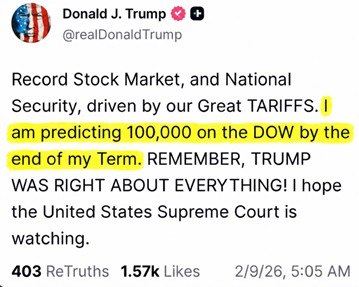
Earlier this year, President Trump made a prediction that raised plenty of eyebrows on Wall Street.
He said the Dow could reach 100,000 by the end of his term.
Now, you can agree or disagree with the President’s politics.
But there’s a much bigger question investors should be asking:
Could the stock market really double over the next few years?
According to economist Dr. Mark Skousen, the possibility deserves serious consideration.
And if it happens, the implications for investors could be staggering.
This kind of market move could be worth $80 trillion? (Yes, trillion, with a “T.”)
It sounds like an extraordinary prediction.
But Dr. Mark Skousen, the economist who told his readers to sell everything a few weeks before Black Monday, has been studying the possibility of another historic market boom.
And his analysis suggests the market could double by 2029.
Not because of any one politician or policy, but because of the powerful economic and market forces he believes could drive the next wave of wealth creation.
He says, “If history repeats, the market could double from here. And when it does, it will create more new wealth than any boom America has ever seen.”
For good reason.
All the stocks in America are now worth about $80 trillion. So a double would add $80 trillion more.
But something even more spectacular could happen.
Skousen says most of that money will rush into a small handful of stocks most people have barely heard of. And those who know where to look could make a fortune.
For the full story, click here.
Good investing,
Rachel Gearhart
Publisher, The Oxford Club
Micron and Taiwan: What the Walk-Away Threat Means
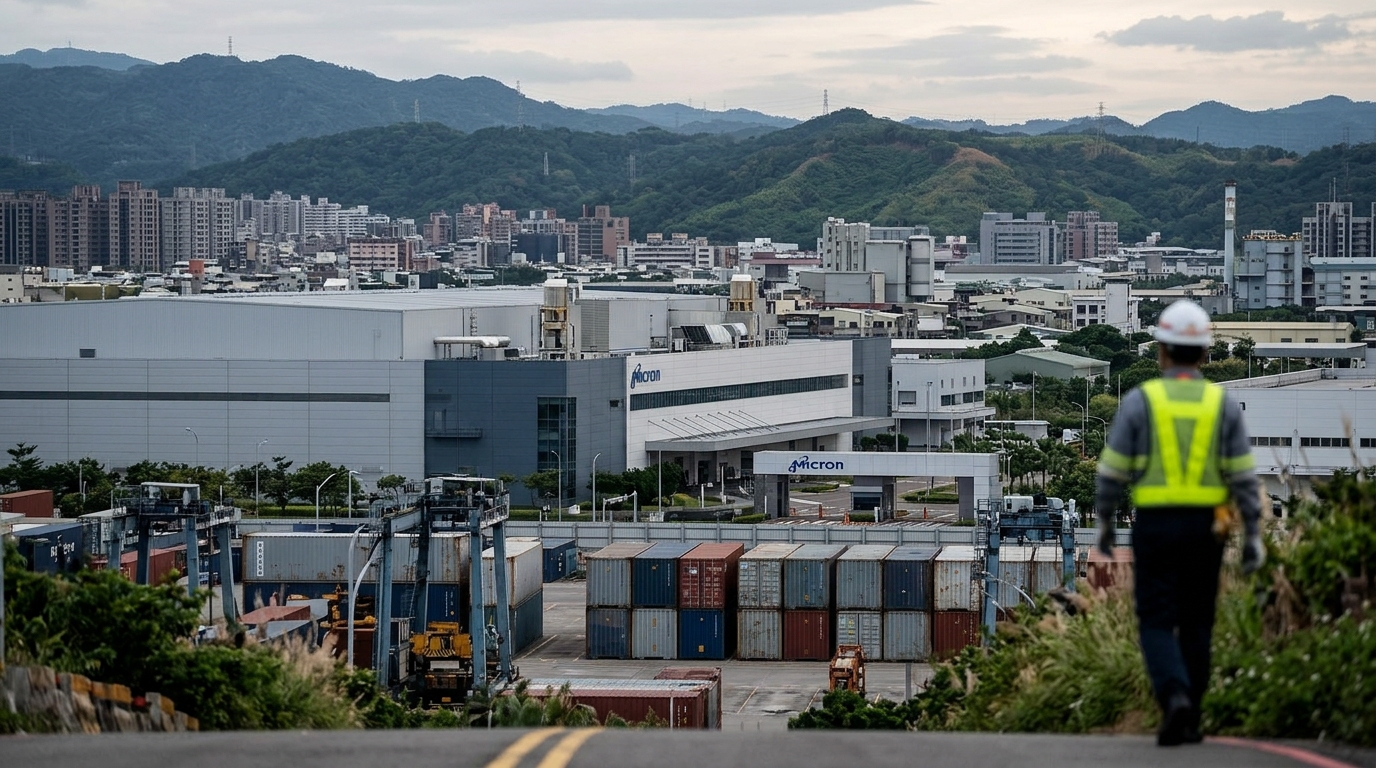
Hey there, bargain hunter. Micron just handed the market a headline that sounds expensive but might actually be cheap, depending on which side of the ledger you read first.
Scoreboard
Taiwan’s Commercial Times reported Thursday that Micron may suspend investment plans in Taiwan said to total NT$1.6 trillion, and that a worst-case scenario floated by a local commentator included closing Micron’s Taoyuan site and cutting around 3,000 jobs if a labor dispute escalates. MU sold off into U.S. trading this week: it closed at $629.79 on Tuesday, November 24, down about 11.0% on the day, and then closed at $601.25 on Wednesday, November 25.
What Actually Happened
Reports tied the dispute to Micron’s Taoyuan operations and to future expansion plans discussed publicly, including a Taoyuan DRAM-related project often referred to as Fab 11E. Some coverage has described the Taoyuan plan as a multibillion-dollar project and linked it to a 2028 start date, but Micron has not published a single, definitive “Fab 11E” budget-and-start-date package in U.S. filings that matches every detail in the draft headline, so treat the project specifics as reported, not confirmed.
Commercial Times reporting, as relayed by other outlets, said mediation talks resumed around mid-November and did not resolve the dispute. One reported figure in the coverage is that workers are pushing for a profit-linked share; the precise percentages and mechanics remain, at best, secondhand until Micron or Taiwanese labor authorities put the terms on the record.
The Real Reason This Matters
NT$1.6 trillion sounds terrifying. Convert it and you get roughly US$50 billion, but in the reporting it is described as a combined, long-horizon figure connected to Taiwan investment discussions, not a single near-term check that hits cash flow all at once. The investable question is the narrow one: does any near-term production or ramp get disrupted, and does Micron actually shift incremental capacity away from Taiwan?
On Singapore, the “contingency plan” is already moving. Singapore’s JTC said on November 19 that Micron marked the first tool move-in at its HBM advanced packaging facility in Singapore, and the site is targeting initial output in early 2027. Separately, Micron’s own January 26, 2026 announcement said it plans an approximately $24 billion NAND wafer fabrication investment in Singapore over 10 years, with initial wafer output scheduled for the second half of calendar 2028.
Singapore capacity alone does not fill every gap a Taiwan disruption could open. SK Hynix, Micron’s closest HBM rival, posted record margins and still trades near 4x forward earnings — a reminder that memory supply tightness benefits more than one name.
The Business and the Book
Micron’s own fiscal 2026 results were enormous. In its fiscal 2026 release and filings, Micron reported revenue of about $133.2 billion and non-GAAP diluted earnings per share of $75.52.
On demand visibility, the cleanest, sourceable version is what Micron has disclosed about its long-term supply agreements and what management has said publicly about forward commitments. In a Micron investor deck published in 2026, the company described multi-year “supply chain agreements” structured as take-or-pay, and said fourteen of sixteen such agreements had cumulative revenue at minimum price of about $100 billion over the remaining term. In addition, CEO Sanjay Mehrotra has said that about 75% of Micron’s 2027 supply is already committed, with customer discussions already moving to 2028.
Is It Cheap?
The valuation call in the original draft leaned on specific trailing P/E and “five-year median” figures that vary materially by data provider and by whether you use GAAP vs non-GAAP earnings, and those exact numbers were not reliably verifiable from primary sources. What is verifiable is directionally simple: after this week’s drawdown into the low-$600s, MU is trading well below its late-October levels (when it was still in the $900s on some sessions). Whether it is “cheap” depends on whether you think FY2026 earnings power is sustainable through a memory cycle that can turn fast.
The bear counterpoint still holds: a Taiwan production disruption is not trivially replaced by Singapore advanced packaging. Packaging helps ship HBM, but it does not create wafer starts, and any lost Taiwan output would have to be covered by capacity elsewhere, not just by back-end capability.
Bull / Base / Bear
- Bull: Labor deal closes before year-end. Any threatened Taiwan capex pause is brief. Singapore HBM packaging stays on track for early 2027. If the market regains confidence in 2027 volume commitments, MU can recover meaningfully from the current drawdown.
- Base: Taoyuan uncertainty lingers, but disruption stays localized and largely administrative rather than operational. Micron continues executing its Singapore expansion (HBM packaging and the NAND fab timeline), and the stock churns while investors wait for clearer 2027 supply-and-margin proof.
- Bear: Dispute widens beyond Taoyuan and starts to threaten operational continuity, not just future projects. That hits shipment confidence, the memory cycle turns, and the multiple compresses further.
Action Plan
This is a situation for staged entries, not a single swing. The Taiwan risk is real but needs to be separated into two buckets: (1) near-term operational disruption, and (2) long-horizon capex allocation. Buy a starter position only if you can tolerate headline volatility. Add on a confirmed Taiwan resolution or a concrete, on-the-record milestone that Singapore HBM packaging is ramping as planned. Trim if you see credible signs the dispute is spreading into broader operational risk.
Cheap Investor Checklist
- Taiwan mediation status: next scheduled session or any government intervention
- Operational risk: any confirmed impact to current Taiwan output or shipment schedules
- Singapore HBM line: first output confirmation, targeted early 2027
- Singapore NAND fab: build milestones toward second-half 2028 wafer output
- Long-term agreements: any updated disclosures on take-or-pay supply agreements and their minimum-revenue coverage
- Forward-commitment signal: management updates on 2027 committed supply and 2028 discussions
- Capex guidance: any formal disclosure of a Taiwan deferral or reallocation
- HBM competition: evidence Micron is closing the execution gap vs SK hynix as supply stays tight
Bottom Line
If the Taiwan dispute stays localized and Singapore’s HBM packaging timeline holds, the scary NT$1.6 trillion figure reads more like negotiating leverage and long-horizon capex pressure than an immediate hit to intrinsic value. But if labor risk starts to threaten real, near-term output, the thesis breaks quickly. Watch operational continuity and disclosed commitments, not just the headline number.