
Dear Reader,
A little-known meeting in 1910 cost the average American family their entire financial freedom.
They met in secret, used fake names, and told absolutely no one where they were going.
On November 22nd, 1910, seven of America’s most powerful bankers gathered on Jekyll Island to design the Federal Reserve.
Their goal?
To create a system where they control the money supply and you foot the bill.
Fast forward to today…
That system has created $40.5 trillion in debt and destroyed 97% of the dollar’s purchasing power since 1913, according to the government’s own CPI data. And now they’re building the final piece:
A programmable digital dollar.
In 2025, Washington moved to “ban” a Fed digital dollar. But the ban didn’t stop it… it just changed whose name is on it.
Don’t care about protecting your retirement savings? Skip this.
But if you have at least $100,000 saved and you’re concerned about what’s coming, you need to read this.
The same people who met on Jekyll Island have one fatal weakness they didn’t plan for…
Decentralized finance.
It’s the one thing they can’t control, can’t inflate, and can’t confiscate.
I’ve put together a free 18-page report on what this new digital dollar can do to the money in your account.
Inside, you’ll see how programmable money can track your spending, cap what you hold and freeze an account… and the legal back door a growing number of investors are using to stay outside it.
Send me the free Digital Dollar report →
To your freedom,
Tan Gera, CFA
Decentralized Masters
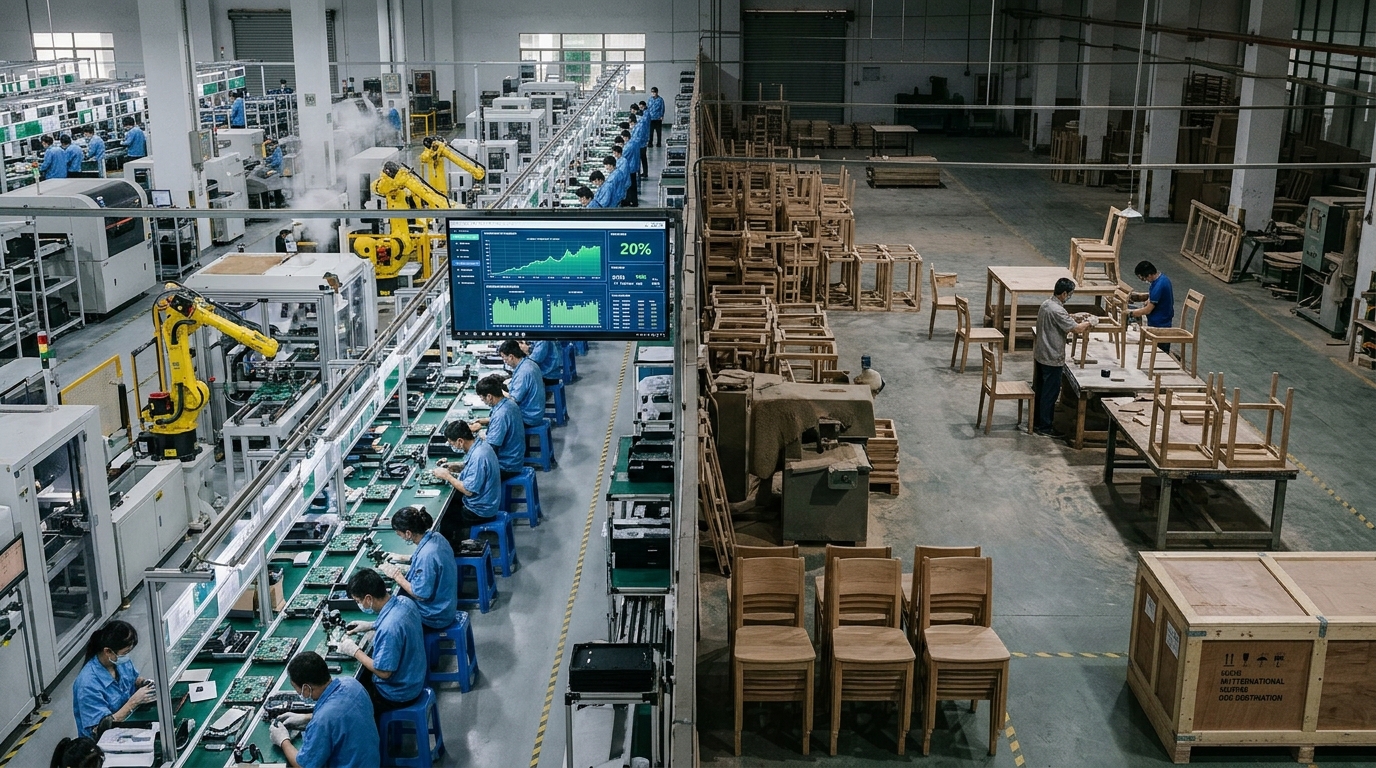
China’s Factories Are Up 20%. Furniture Makers Lost Half Their Profits.
Hey there, bargain hunter. China’s headline industrial number this morning looks like a party. Dig one layer down and you’ll find half the guests left.
Scoreboard
Profits at industrial firms above the designated size surged 20.1% in October from a year earlier, according to data released Friday by the National Bureau of Statistics. That is the fastest monthly pace since May, up from 14.4% in September. Profits at industrial firms above the designated size reached CNY 6,737.36 billion in January to October. For the first 10 months of 2026, profits climbed 16.0%, up from 15.5% through September.
Sounds like a broad recovery. It is not.
The Real Reason
Electronics makers drove the advance, with sector earnings doubling in the first 10 months as demand for AI computing power lifted memory chips and related manufacturing. Profits in high-tech manufacturing jumped 50.9%. Mining added its own fuel: non-ferrous smelting climbed 71.7% and coal was up 61.4% year to date.
The same split is visible inside individual Chinese tech names. Baidu’s GPU cloud revenue surged while its ad engine contracted for a fifth consecutive quarter, a company-level version of the same two-economy dynamic.
Now the other side. Industrial earnings continued to show a sharp split, with profits in computer, communications and other electronic equipment manufacturing roughly doubling in the first 10 months, while furniture manufacturing posted a decline of 52.4%. Auto manufacturing profits are down 26.0%. Two economies, one number.
What the Business Actually Is
China’s industrial sector is not one thing. The winners right now are capital-intensive exporters riding AI hardware demand: Luxshare Precision, which assembles for Apple and AI server clients; CATL, whose battery margins are recovering on global EV orders; Zijin Mining, the gold-and-copper giant whose profits benefit directly from elevated metals prices. These are not consumer-facing names. They earn in dollars and ship globally.
The losers are domestic. Furniture makers sell to Chinese households buying homes that are not being bought. In the first half of 2026, the furniture industry saw revenue fall 8.6% and profits drop 52.7%. That is not a cyclical dip. That is a property-driven demand collapse still grinding through the value chain.
Data That Matters
- Zijin Mining’s total profit for H1 2026 reached 63.5 billion yuan, up 84% year on year; net profit attributable to shareholders was 39.2 billion yuan, up 68%.
- For the first three quarters of 2026, Zijin reported operating revenue of RMB 283.5 billion, up 11.5% year over year, and net profit attributable to shareholders of RMB 57.5 billion, up 51.9% year over year.
- China’s industrial profits are on track to log their strongest annual expansion since 2021, extending a notable rebound in 2026 after three years of declines followed by tepid 0.6% growth in 2025, according to Reuters reporting earlier this year on the full-year 2025 NBS release.
- Capital Economics publishes a “China Activity Proxy”, but I could not verify the specific 2.4% year-over-year October estimate and the 3.5% first-half pace from public materials, so that figure is removed here.
Is It Cheap?
FXI trades at roughly 11x trailing earnings, a notable discount to US benchmarks such as the S&P 500. The fund is heavily weighted toward financials (about 36% of assets), with top positions including China Construction Bank, Tencent, and Alibaba, plus other large holdings such as ICBC, Xiaomi, and Meituan. At 11x, you are paying developed-market prices for emerging-market risk, plus geopolitical premium. That math only works if the consumer half eventually recovers.
The consumer-facing names priced for permanent decline are the more interesting question. Furniture stocks sitting at 52%-down profit levels with any sign of property stabilization could re-rate fast. The question is whether they are merely cheap or genuinely broken.
Bull / Base / Bear
Bull: Beijing’s rate cuts and liquidity injections begin pulling property through, furniture orders recover in H1 2027, and the AI hardware cycle sustains electronics profits. FXI re-rates toward $45.
Base: The tech-and-mining boom continues, consumer drags persist through 2027, and the index grinds sideways with dividends providing the only real return. FXI stays in the $31 to $38 band.
Bear: The outlook for exports, a key source of support for manufacturers this year, becomes less certain as new tariff risks bite, the property market worsens, and the gap between tech profits and household demand widens into a full demand crisis.
Beijing has tried to close that gap before. A prior stimulus package showed credit flowing freely while retail sales and fixed-asset investment kept falling, which is the policy ceiling any consumer-recovery thesis has to clear.
Action Plan
Do not chase the 20.1% headline. That number belongs to chips, copper, and coal. For bargain hunters, the asymmetric trade is in the consumer wreckage, specifically names where profits are down 50%-plus on a structural demand problem that policy can fix, not a competitive problem it cannot. Scale in slowly. The property drag could last another two quarters.
FXI gives you broad exposure at 11x earnings but with heavy financial-sector weight. If you want targeted consumer-side exposure, Global X’s CHIQ (MSCI China Consumer Discretionary) is trading further below assessed fair value than FXI per available valuation data.
Cheap Investor Checklist
- Watch monthly NBS profit data: does furniture’s 52.4% year-to-date loss narrow in November and December?
- Track Chinese property completion data: residential floor space finished is the leading indicator for furniture demand
- Monitor FXI price relative to NAV (currently ~$31.25); a sustained move above $35 signals momentum shift
- Check CATL and Luxshare quarterly margins: AI server supply chain demand is the key variable for electronics profits
- Watch Zijin’s copper and gold production guidance: H2 2026 output targets are the primary profit lever
- Track Beijing policy signals: any mortgage rate cuts or property purchase incentives are direct tailwinds for consumer-sector earnings
- Confirm auto sector stabilization: profits down 22.8% through September; any reversal is a broad consumer recovery signal
Bottom Line
If China’s AI hardware cycle holds and metals prices stay elevated, Zijin and the electronics supply chain keep compounding. If Beijing’s stimulus finds its footing in the property market, the consumer names now priced for ruin become the better trade. The 20.1% headline is real. It is just not the whole story, and the half that is missing is exactly where the cheap investor should be looking.